














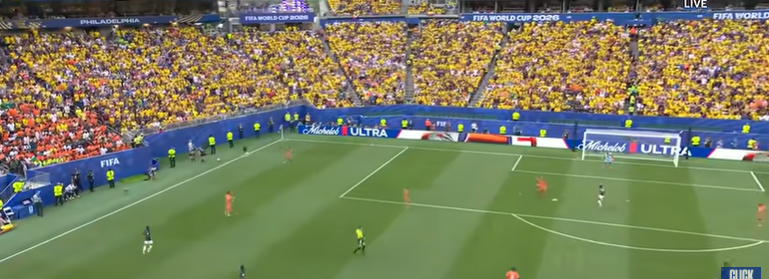
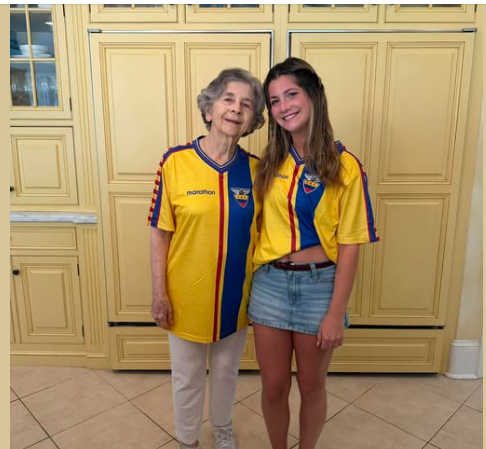
A breakdown of ticket holders by nationality or team affinity at Sunday’s Ecuador-Ivory Coast World Cup match at the Lincoln Financial Field in Philadelphia is, of course, not available. However, judging from the sea of bright yellow and blue, the vast majority of the nearly 70,000 fans were certainly passionate fans of Ecuador, wearing some form of their team’s “home jersey.” Among them my sister, Norma Colyer, and her beautiful granddaughter, Emily Colyer, proudly wearing Ecuador’s colors (below).
Wearing or displaying one team’s colors — whether in soccer, baseball, football or chariot racing — to show team pride, support or loyalty is not new.
Back in ancient Rome, fans wore blue, green, red or white colors to show support for their favorite chariot racing teams — the Blues, Greens, Reds, and Whites.
Soccer fans have been showing their team loyalty since the early 1900s using scarves, ribbons and other items in teams’ colors.
As soccer became an international sport, especially after the World Cup’s first tournament in 1930, shirts and hats resembling teams’ uniforms and reflecting on both the team’s and the fan’s national identity became more popular worldwide. The World Cup jersey has now become one of the most recognizable symbols of football culture.
At Fantasy Names Aura, Elton Philip explains “Why Football Fans Love World Cup Jerseys.”
“Wearing a jersey allows supporters to feel connected to their favorite teams and players…[jerseys] symbolize…represent their homeland and football heritage,” he writes.
Philip adds that wearing these jerseys makes fans feel connected with their football heroes, gives them a sense of belonging, helps them feel part of a larger soccer family.
Today, the Word Cup jersey phenomenon has evolved not only into a booming industry that produces millions of stylish, colorful jerseys and other clothing articles for soccer fans, but also into a fashion statement that is now influencing fashion outside the soccer field, shaping what millions will wear long after World Cup fever has subsided.
Sportswear giants such as Adidas, Nike and Puma, along with scores of smaller companies, try hard to meet the growing demand for authentic and replica national World Cup jerseys and “team kits” (the primary “home” uniform a national football team wears during matches).
A demand that is clearly reflected in a report that there has been “a 652% jump in searches for World Cup jerseys in the last five weeks, and a 26% increase in sales week over week.”
As mentioned, the demand for soccer style clothing extends beyond the soccer stadium stands.
The Spanish global retailer Sivasdescalzo (SVD) says this about the connection between soccer and style, “Football references no longer belong exclusively to the stands — they are now fully embedded in the global fashion conversation.”
Some say this trend started in the 1980s and 1990s when British football aficionados “began incorporating their team’s colors and logos into everyday attire…the beginnings of blokecore.”
Today, blokecore is alive and well and has become more mainstream. However, it is more than a retro-style jersey, baggy bottoms and scuffed-up sneakers.
World Cup team uniforms are now seriously swaying everyday fashion trends with famous designers and major design houses embracing the new blokecore look in their collections.
.
SVD describes it this way:
Today, [the World Cup] also shapes how we dress, which sneakers we wear, and which cultural references dominate the conversation. From vintage football jerseys to technical boots reinterpreted as fashion objects, as well as collaborations between brands and designers directly inspired by the pitch, football culture has become one of the most influential languages in contemporary fashion…
Interestingly, high fashion has also arrived for the uniforms of World Cup teams and players, with luxury fashion houses deeply involved in designing and producing team uniforms that not only make a fashion statement, but also reflect the team’s country’s culture, history, traditions and colors.
For example, Ecuador’s 2026 World Cup “home” jersey’s primary color is a vibrant yellow, the major color of Ecuador’s flag. It is embossed with geometric patterns and textured lines drawing from Ecuador’s rich culture and biodiversity. Below the rear collar, the phrase “Soñar Trascender y Hacer Historia” (“Dream, Transcend and Make History”)…exactly what Ecuador hopes to do in the 2026 World Cup.
