






A defunded marketing agency and a stack of new visa rules have turned America’s World Cup into everyone else’s windfall.
Would you excise something from your portfolio that was earning $24 for every dollar you had invested? Neither would I, but that’s what the GOP did the summer of 2025 when they slashed the Brand America matching funds by 80%.
The budget cut was part of the summer 2025 budget reconciliation bill, which passed the Senate 50-51 and the House 215-214 initially and 218-214 on Senate concurrence. Brand USA, a public-private partnership, receives no tax dollars; its federal funding comes from fees collected from international travelers.
Travel is important to the economy. The domestic and international travel industry contributed $3 trillion to the U.S. economy in 2025, according to the U.S. Travel Association. That was 2.4% of the value of goods and services (GDP) produced in the U.S.
Brand USA was created under the bipartisan Travel Promotion Act of 2009 to promote international travel to the U.S. Slashing its budget less than 12 months before the World Cup came to the U.S. makes the hatchet feel even more shortsighted.
As if cutting Brand USA’s matching funds by 80% wasn’t on-brand enough, Trump followed it five months later by creating a competitor: the country’s first-ever “minister of tourism,” a position with no precedent and no qualifications required other than a good relationship with the White House.
The man holding the title is Nick Adams, a self-described “alpha male” influencer from Australia whose previous government experience consists of a failed nomination to be ambassador to Malaysia. Trump withdrew the nomination after Malaysian officials objected to Adams’ record of anti-Muslim remarks.
It is, nonetheless, his job to convince the world that the country he represents is open for business. After all, worldwide international tourist travel was up 4+% in 2025, according to U.N. Tourism.
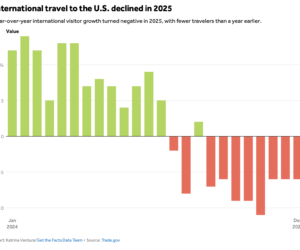
The U.S., on the other hand, saw a 6% plunge in international tourism travel compared to 2024 ($).
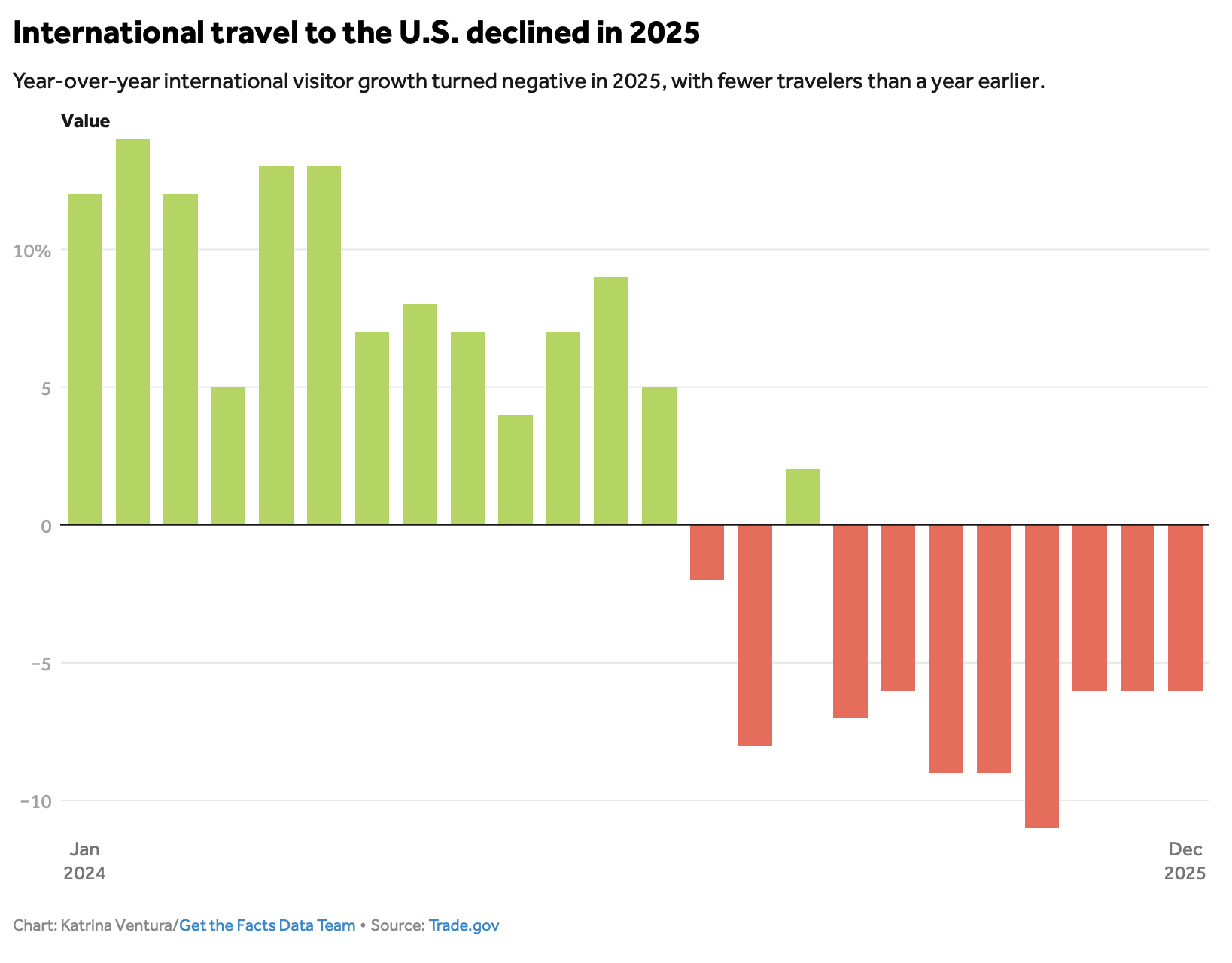
When put in context, 2025 was the worst year for international tourism in the U.S. in 20 years, outside of Covid-19. The drop in international visitors was bigger than that of the global recession of 2008. Shockingly, Canadian travel to major U.S. cities may have dropped by 42%, according to The Daily Beast, citing Cuebiq.
This year is looking worse.
In April, international travel to the U.S. was down as much as 14% when compared with 2025. Also in April, U.S. hotels began slashing rates by as much as a third.
Now it’s June, and the World Cup — 48 teams and 104 matches — is being hosted by 16 cities across Canada, Mexico and the U.S. Hotel bookings in Canadian and Mexican cities are outpacing U.S. bookings according to an analysis of 14 of the 16 cities. The top five cities in terms of average booking percentage are in Canada and Mexico: Guadalajara, Monterrey, Vancouver, Toronto and Mexico City. Cities six–fourteen are in the U.S.
And the hotels in Canada and Mexico are also making more money per room. Their hotel rates are up +92% and +114%, respectively. In Vancouver, prices have almost tripled. In the U.S., rates are up only about 50% compared to the same period last year.
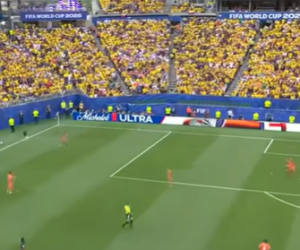
The American Hotel & Lodging Association pointed out that in the U.S., “domestic travellers (sic) are outnumbering international visitors – an imbalance that threatens the overall economic impact the World Cup was meant to generate.” The event runs from June 11-July 19.
Despite missing hotel booking promises, some host cities like Dallas and Houston are seeing a year-to-year increase in flight bookings. That gain is uneven; it has failed to materialize for Seattle and the three Mexican host cities, however.
There is a ripple effect when tourists fail to arrive. Their absence negatively affects local businesses, restaurants, theme parks, tour operators and the broader economy.
Brand USA’s federal match — the government’s contribution, which is tied to visa-waiver fees, not a blank check, and is capped — was cut by 80%, from $100 million to $20 million. And we can’t point at that $80 million shortfall as the primary culprit for lost hotel and airline demand. Nope, there’s additional self-mutilation going on.
In no particular order:
- In early 2025, the Trump Administration narrowed visa-interview waiver eligibility and added new in-person interview requirements.
- Visitors from 42 visa-free countries (which includes the UK and most of Europe) may soon be required to “provide five years’ worth of social media history in order to enter” the U.S. Others already must supply this information.
- The Administration imposed two travel bans and visa bonds while shortening visa validity periods for various nationalities.
- The Administration has increased the cost of a visa from $250 to $435, making it one of the most expensive visas in the world.
- The Administration increased the number of prohibited countries to 39 from 12.
- In addition, Congress has stalled on the bipartisan VISIT USA Act, introduced in November 2025, which would have restored funding to Brand USA.
That’s just travel-specific friction. There’s more.
“The current situation seems to treat Europe more as an opponent than an ally, whether it’s the tariffs, the NATO rhetoric or the broader tone towards European countries,” Johan Konst, the founder of EUSA PR, told the BBC.
Juliette Kayyem, faculty chair of the Homeland Security Project at the Harvard Kennedy School, told CNN that “the long-term harm is that the world will not know America … the narrative of the United States is now a country that is at best, not to be respected, and at worst, a democracy that is floundering.”
It’s not a surprise, then, that 46% of international travelers “said they were less likely to visit the U.S. in 2025 specifically because of Trump,” Fortune reported.
That’s the sobering outlook for the World Cup, an event that was supposed to be America’s audition for the world’s sports stage; a dry run for the 2028 Olympics; a chance to show off 16 renovated stadiums; manna for a hospitality industry hungry for business; and a six-fold increase in World Cup revenue over Qatar in 2022.
The World Cup is a stress test. It reveals a Congress that is nonchalant about marketing the country to international tourists. It spotlights a White House that seems determined to generate more and more friction for international travelers while double-crossing the official, Congressional marketing body, Brand USA. None of this happened by accident. You don’t accidentally narrow the visa-waiver program; almost double the price of entry; and give short shrift to the one entity whose entire job is convincing skeptical foreigners to visit.
Somewhere between the travel bans and the empty stadium sections, “Visit America!” became “Visit America, Eventually, Maybe, If You Can Get and Afford a Visa and Give Up Your Privacy.” With those impediments, why would you even want to try?
This post first appeared at Substack.

Known for gnawing at complex questions like a terrier with a bone. Digital evangelist, writer, teacher. Transplanted Southerner; teach newbies to ride motorcycles. @kegill (Twitter and Mastodon.social); wiredpen.com