














 I’ve yet to read Mearsheimer and Walt’s book, The Israel Lobby, but I have been following the controversy surrounding its publication. Cries of anti-Semitism have, I’m afraid, been the major way that critics have attempted to discredit the work. Jeffrey Goldberg, in a 7000-word-plus article for The New Republic, provides a typical example. He argues that the book “represents the most sustained attack, the most mainstream attack, against the political enfranchisement of American Jews since the era of Father Coughlin.” Goldberg then goes on to note that the authors are “alleging the existence of an open Jewish plot to control American foreign policy.”
Similar examples abound. Jeff Robbins, in the WSJ, alleges that the book is full of “Anti-Jewish bias.” Alan Dershowitz has suggested that it’s “a bigoted attack.” Tim Rutten, in the LA Times, argues that the work was “inspired by the Nuremburg Laws.” I could go on, but you get the point.
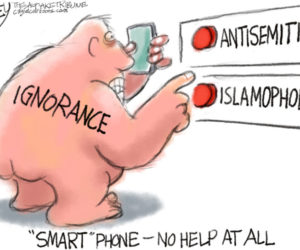
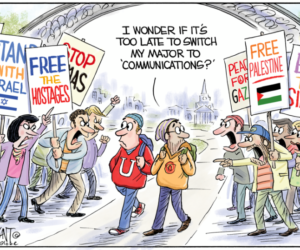
I’m not going to spend time analyzing these clearly-baseless assertions. The shrill call of anti-Semitism has become a familiar, convenient refrain for responding to anyone who might criticize Israel or its Washington lobby. But even amongst less reactionary commentators, such as CFR President Leslie Gelb, responses to the book have been way off-base. Criticizing this notion of a powerful Israeli lobby, Gelb notes the following:
…the record clearly shows that when Israel crosses certain important lines, as when it expanded Jewish settlements into Palestinian areas like the West Bank and Gaza, Washington usually expresses its displeasure in public and, even more so, in private. Mearsheimer and Walt just don’t mention that.
Indeed, they don’t, but for obvious reasons; expressing displeasure for settlement policies doesn’t matter much at all. What matters is whether the United States decides to turn those words into actions and use its substantial leverage to force Israel to make policy changes. And the fact is, although it’s clearly in our best interests to do so, American presidents have been painfully lacking in their willingness to put any real pressure on Israel. All of which, I’d suggest, hints at the formidable influence of the Israel lobby.
Last night, I watched an interesting hour-long interview with both of the authors (I’ll post it below) in which Walt gave a very compelling explanation of the lobby’s influence in Washington. He started off by noting that during the Cold War, the US maintained connections to Israel for strategic and moral reasons. Strategically speaking, Israel was considered a bulwark and a useful ally against Soviet expansion. Walt also suggested that the US felt compelled to support the Jewish homeland on moral grounds, as a response to the horrors of WWII and preceding decades of anti-Semitism.
Over time, however, both of these justifications for supporting Israel have gradually eroded. Rather than being a strategic asset, Israel has turned into something of a liability. With the fall of the Soviet Union, Israel has become much less of an important partner; in fact, its continued rivalry with its Arab neighbors has made close association with it increasingly problematic. The moral justification has also diminished. With Israel’s ongoing occupation of Palestinian territories, aiding Israel can no longer be easily justified on moral grounds.
Interestingly, despite the diminishing moral and strategic arguments for giving so much support to Israel, foreign aid has actually increased in the past few decades. In Walt’s own words: “Although the moral case for giving Israel unconditional support has gone down, and the strategic case for giving Israel unconditional support has gone down…American support for Israel continues to go up.” Pretty good evidence, I’d say, that AIPAC has gotten better and better at pulling the strings in Washington.
For those interested in the full interview, here it is: