














On election night 2016, even President-elect Trump seemed surprised by his victory.
Last night, it was the Democrats’ turn to be surprised, in a good way.
While there are exceptions (like 1998), the general rule is that the party holding the White House loses seats in the midterms.
With only a three-seat majority in the House, a Democratic takeover seemed almost inevitable. Of course, our current president has a knack for defying the inevitable, starting with the 2016 election that brought him to power.
Some have even argued that political “waves” are a thing of the past in an era of fake news and an increasingly fragmented media landscape. But last night, the public proved that waves can still happen.
And while at least a narrow Democratic takeover of the House may have seemed inevitable, the question of just how many seats Democrats would gain remained. An even bigger question loomed for weeks: What about the Senate?
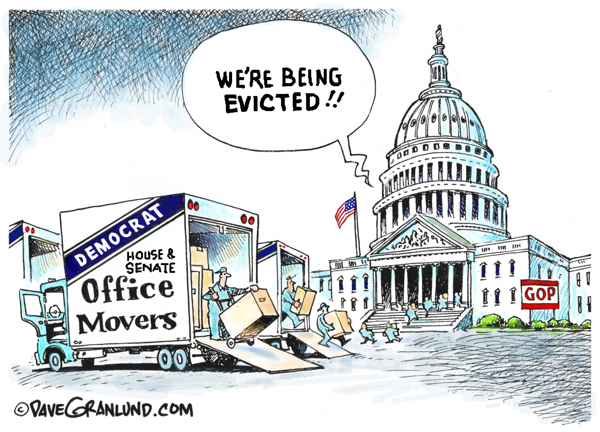
It turned out the answer was more seats than either side anticipated, and the results came in faster than either side expected. Before 1 a.m. Wednesday, it was clear the Democrats would, in fact, retake both chambers of Congress.
By Wednesday morning, Democrats had gained at least 28 seats in the House and captured seven Republican-held Senate seats, giving them control of both chambers of Congress. This blue wave extended to traditionally Republican states such as Texas, South Carolina and Kansas.
This victory eclipsed the Democratic Senate gains of 2006, when Democrats captured six Republican-held seats and regained control of the chamber. Unlike this year, the outcome in 2006 was not clear on election night. It took until the following day for Democrats to secure the final seat they needed to regain control of the Senate.
The results also raise an obvious question: What changed between 2024 and 2026, when so many voters and demographic groups that had helped return Trump to the White House shifted toward Democrats? The events of January 6, 2021, including the attempt to overturn the election and the violence against Capitol Police officers, were already part of Trump’s political record when voters returned him to office in 2024. Yet countless voters appeared indifferent to those events. So what accounts for the apparent shift? The answer may lie less in Trump’s past than in the realities voters are facing today: the war in Iran, the cost of living and the economy.
The AP Voter Poll found that roughly 70% of voters under 30 supported Democratic House candidates, and Hispanic voters also shifted toward Democrats. However, voters under 30 represented only about 10% of the electorate.
There’s evidence to support that trend. Nearly nine in ten voters identified the cost of living as a major or crucial factor in their vote, according to exit polling. And voters expressed concerns about the economic effects of Trump’s policies, including the war in Iran and tariffs.
In 2024, New York magazine published an article arguing that the American people had not embraced Trumpism; Democrats had simply failed. In this election, the reverse may have been true. The public did not necessarily embrace the Democratic Party; Trump and his administration simply failed to meet voters’ expectations.
Senate Democratic Leader Chuck Schumer, who chaired the Democratic Senatorial Campaign Committee when Democrats recaptured the Senate in 2006, seemed to acknowledge that distinction. “Many of the folks who voted for us yesterday, of course, are still skeptical,” he said. He added that voters had entrusted Democrats with the majority to do what the American people want.
Democrats will now have to demonstrate that they can translate their electoral success into tangible results, particularly on the economy and the cost of living. Moderates like Senator Schumer will have to balance the demands of the progressive wing of their own base with the need to pursue an agenda that satisfies the middle class and mainstream voters. For Democrats, the celebrations will be short-lived. Their victory brings with it a difficult test: Can they turn voter dissatisfaction with Trump into meaningful improvements in people’s lives?
Former Vice President Harris had warned that Trump might try to interfere with the midterm elections, urging Democrats to turn out in numbers “too big to rig.”
Following the election, Trump acknowledged the results and congratulated Democrats, a sharp departure from his response to the 2020 election. For Trump, the election presents a different kind of challenge. He will still occupy the White House, but his ability to pursue his legislative agenda will be considerably more difficult, if not impossible, with Democrats controlling Congress.
The midterms have once again demonstrated the powerful influence of economic concerns on voters. Even a president who maintains a strong hold over his party is not immune to voter dissatisfaction with the economy.