









The real long-term casualty of America’s blue tsunami may not be Donald Trump, MAGA or even the Republican Party, but Israel. Whatever the immediate political fortunes of the President and his coalition, the Democratic resurgence could fundamentally alter the bipartisan political consensus in Washington that has traditionally underpinned America’s unique relationship with Israel.
The longer-term challenge for Israel, however, may be much deeper than the changing political mood in Washington. It concerns the very character of the Israeli state, its democratic credentials and the future of its substantial Arab minority, which constitutes approximately 17.2% of its citizen population.
The joint US-Israeli war against Iran may have opened a Pandora’s box, not only for Iranians but also for Israelis. It has exposed the vulnerability of Israel’s international standing and intensified questions about the sustainability of its regional military strategy. But it has also brought renewed attention to the character of Israeli society itself.
The Israel Democracy Institute’s 2025 survey found that 53% of Jewish respondents supported encouraging Arab citizens to emigrate from Israel, a sharp increase from 36% in 2019. Almost half, 48.5%, supported separating Jews and Arabs to preserve Israel’s Jewish identity. Only 27% favoured including Arab political parties in government.
These are deeply consequential findings. They suggest that a substantial section of Jewish Israeli society is increasingly willing to contemplate exclusionary measures in the name of preserving Jewish national identity, raising serious questions about the country’s commitment to integration, political inclusion and equal citizenship. They also raise uncomfortable questions about whether Israel can reconcile its Jewish national character with its obligations as a democracy towards all its citizens.
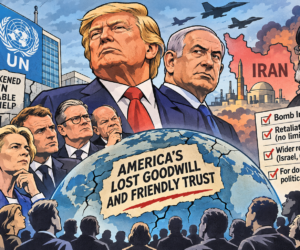
International and American public support for Israel had already been eroding following the devastation in Gaza and the growing controversy over the Netanyahu government’s policies in the West Bank. The Iran war has added another dimension, exposing American voters to its economic costs, its consequences for US international standing and the risks of an open-ended military commitment undertaken in close association with Israel.
The 2026 Chicago Council survey found that 68% of Americans considered the war not worth its costs, while 56% favoured reducing or eliminating US military assistance to Israel. Trump announced on Election Day that the United States would end its approximately $3.8 billion in annual military assistance to Israel after 2026, while continuing to sell it weapons. The implications remain uncertain because of the existing ten-year assistance agreement worth $38 billion, which runs through September 2028, and the role Congress would have in implementing any change.
Even more disturbing for international observers is evidence that younger Jewish Israelis are more exclusionary towards Arab citizens than their older compatriots. A May 2026 survey by Reichman University’s Institute for Liberty and Responsibility found that 58% of Jewish respondents aged 18–35 believed Jewish citizens should enjoy more rights than non-Jews, compared with 38% among those aged 36 and above. Only 30% of younger respondents supported ensuring equality between Jews and Arabs, against 52% of older Israelis.
This raises troubling questions about Israel’s political future. The younger generation, which will increasingly shape the country’s politics, appears less committed to equal citizenship and democratic inclusion than its older compatriots.
For international observers, that raises an even more fundamental question about the future of Israel itself: can its substantial Arab minority live peacefully as equal citizens, or are influential elements within the Jewish political establishment and youth seeking a more exclusionary national identity?
The issue goes beyond the inflammatory anti-Arab rhetoric of Benjamin Netanyahu, Itamar Ben-Gvir and Bezalel Smotrich. Israel’s 2018 Nation-State Basic Law reserves the right to exercise national self-determination in the State of Israel exclusively for the Jewish people. Together with recent government policies and initiatives concerning land, housing and development, it raises serious questions about the practical meaning of equal citizenship for Israel’s Arab minority.
The question now is whether Israel can continue to depend on American military and diplomatic protection for its long-term security while its internal policies generate growing international opprobrium.
Many outside Israel and the United States draw encouragement from the constructive political engagement of Arab Israelis in the October 27 elections. But, like growing numbers of American voters, they are questioning whether Israeli governments should enjoy unconditional US military and financial support.
International dismay may grow if Israel’s Jewish political establishment is willing to recognise its Arab citizens only as voters, while continuing to exclude their elected representatives from becoming legitimate partners in governing the country. Arab-led parties won 19 of the Knesset’s 120 seats, or 15.8%, in the latest election. In most other parliamentary democracies, a minority with such substantial representation would have a legitimate expectation of meaningful parliamentary influence, including the possibility of participating in a governing coalition.
All 19 Arab Knesset members, representing Ra’am and the Joint List, subsequently recommended Gadi Eisenkot to President Isaac Herzog as the candidate to form the next government. This does not mean that they have agreed to join his coalition, but it demonstrates their willingness to participate in determining Israel’s political future through its democratic institutions.
By ruling out their participation in a government he might lead, Gadi Eisenkot risks closing a potentially historic opportunity for Israelis to begin rehabilitating their country’s tarnished international reputation and demonstrating that it can embrace the democratic principle of equal political citizenship. The opportunity is particularly significant because the Arab representatives have themselves taken the initiative to support his candidacy.
Democracy requires more than elections. It demands equal citizenship, minority rights, independent institutions and limits on executive power. The University of Gothenburg’s V-Dem Institute downgraded Israel from a liberal to an electoral democracy in 2023, citing the erosion of judicial independence and institutional safeguards.
Israel’s greatest long-term vulnerability may not be the loss of American support, but the erosion of its own democratic foundations and the international legitimacy they confer.