







[Cross-posted at Central Sanity.]
The Samuel Adams restaurant and pub at Washington Reagan, just before Gate 30, is probably my favorite chain restaurant in any airport in America. Despite what I assume is a Henry-Ford-inspired production line in the kitchen, they make a great batch of fish ‘n’ chips, especially when it’s washed down with a pint of the namesake brew.
This was the same speck on the map where I had my second conversation with a soldier a few weeks ago. But there were no soldiers there last night, and frankly, no one else seemed interesting enough to engage in idle talk. They probably felt the same way about me.
So rather than conversation, I was left with a copy of the February 24 edition of the National Journal, wherein I found an article (subscription required) on the “authenticity� factor in American electoral politics.
The article wrestled with such head-thumping, furrowed-brow questions as: Was Nixon authentic despite his clear discomfort with public scrutiny? What happens if a candidate is an authentic jerk (George Allen) or authentically pig-headed (George Bush)? How much has authenticity ebbed and flowed as a factor in Presidential races? How important is it in the 2008 race? Which ’08 candidates have it; which don’t?
In the first paragraph, the writers acknowledged that “authenticity is a deceptively difficult concept to define, especially in the political arena.� They should have stopped there and concentrated on other aspects of the race.
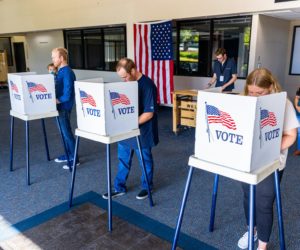
Let’s face it: In every political contest, none more so than the campaign for President, it’s a high-school-level popularity contest where three things matter above all else, and authenticity is not one of them.
Sure, authenticity is on the list, but not in the top-three, unless you consider it, perceived or real, as a sub-set of the second or third factors …
(1) How much money can the candidate access?
(2) How well does the candidate play on camera – especially in uncontrolled, non-paid situations – from overall appearance to mannerisms to oratory?
(3) Do a majority of American people believe they’d enjoy sharing a meal at home with the candidate?
In 2004, the money requirement was approximately $400 million each for Kerry and Bush. In 2008, given the campaign’s 2006 start, we’re probably looking at a half-billion-dollars-plus for the last two standing.
Net: No money, no race. But money is (literally) only the price of entry. After you’re on level financial terms, the other two factors kick in and take over.
Every student of American history should know that, starting with the very first Kennedy-Nixon televised debate in 1960, the camera has been crucial to making a candidate electable or not.
Why is Obama the rock-star of the race as it stands today? He’s intelligent. He’s a bridge-builder. He has a lot going for him. But I’d propose that of the things he has going for him, nothing may be more fundamental than this: The camera loves him and he loves the camera. They understand each other. They speak the same language. They’re better together than they are separated.
Think about it: Bill Clinton vs. Bush 41 and Dole? No contest when the red light on the front of the camera flickered on. G.W. vs. Gore and Kerry? Again, love or hate our current President, the camera liked him better than the other two.
A lobbyist I worked with previously in Washington was asked, days before the 2004 presidential election, to pick a winner. He declined to do so, but did say this: “The buzz around Washington has labeled Kerry ‘a talking tree’ … and in the age of TV, talking trees rarely if ever win elections.�
The “meal factor� is less tangible, but I think it’s still material. After money puts a candidate on the map, and after he/she wins the love of the camera, the American people parse through the issues and then make a gut call: “Could I see this man or woman in my home, breaking bread with my family.� Call it the “real person� factor. And yes, maybe that is authenticity, after all.
But I’m not sure we pick our dinner guests on authenticity alone. I think we pick them on a combination of authenticity plus perceived ability to (a) have an interesting conversation, (b) make us laugh, (c) make us comfortable, and (d) make us feel good about our lot in life, whatever it might be, for however brief a moment they might spare.
Viewed in that light, it’s relatively easy to understand why Kennedy, Carter, Reagan, Clinton, and Bush 43 won. (The omissions from that list are obvious: Nixon and Bush 41. Between they and their opponents, the dinner-at-home decision was centered more on who would be the least awkward or dull.)
You can say what you want about Gore – and maybe today, in a re-match, he’d beat G.W. But at the time they went head-to-head, the latter was seen as a better guy to have over to the house.
If you still don’t believe me, look back at the Carter-Ford race and then the Carter-Reagan race. Ford was a great man, but stiff on camera and an accidental president who pardoned a perceived crook. Do I really want him at my dinner table? Fast forward four years: Carter was an embattled, shrill character standing next to a smooth, handsome guy from Hollywood, who shrugged off every one of Carter’s gnashed-teeth complaints with “Well, there you go again …� And eight years after that, I remember when Reagan handed over the keys to the White House to Bush 41, my wife cried and said it was like watching your grandfather move away.
Perhaps my readers will find all of this insulting. Perhaps you’ll think I’m debasing the intellect and concerns of the American people – boiling all of this down as I have to an adolescent’s game. But I also bet, in your gut, if you’re honest, you’d agree.