







When America’s air traffic system when haywire, grounding thousands of flights and stranding travelers across the country, Transportation secretary Sean Duffy and Homeland Security secretary Markwayne Mullin faced a daunting challenge.
They had to explain what went wrong.
But first, apparently, they had to explain what was right: Donald Trump.
“This is what the leadership of President Trump looks like,” Mullin declared during a White House briefing. Duffy also lavished praise on the president, even as questions remained about the massive disruption.
It was another performance by what may someday be remembered as Donald Trump’s Team of Brown Nosers.
Presidents have assembled some remarkable cabinets throughout American history. Some were brilliant. Some were corrupt. Some were mixtures of talent, ambition, incompetence and clashing egos.
But few have turned public displays of presidential worship into such a conspicuous part of governing.
Historian Doris Kearns Goodwin famously described Abraham Lincoln’s “team of rivals,” a cabinet that included men who had competed against him for the presidency.
Lincoln appointed them because he valued their abilities. He didn’t demand they spend cabinet meetings telling him he was the greatest president since George Washington.
Warren G. Harding’s cabinet included some spectacularly corrupt characters, notably Interior secretary Albert Fall, who went to prison over the massive Teapot Dome scandal. Yet Harding also appointed capable officials, including Secretary of State Charles Evans and Commerce secretary Herbert Hoover.
Franklin Roosevelt surrounded himself with strong personalities and competing advisors. He frequently encouraged disagreement, sometimes to the frustration of those working for him.
Dwight Eisenhower valued experience, organization and competence, although his administration certainly wasn’t immune to mistakes.
John F. Kennedy assembled “the best and the brightest,” intellectual heavyweights whose intelligence and confidence nevertheless helped lead America into the Vietnam quagmire.
None of these administrations were perfect. But their cabinets weren’t expected to function as presidential fan clubs.
Enter Donald Trump.
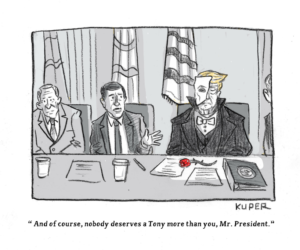
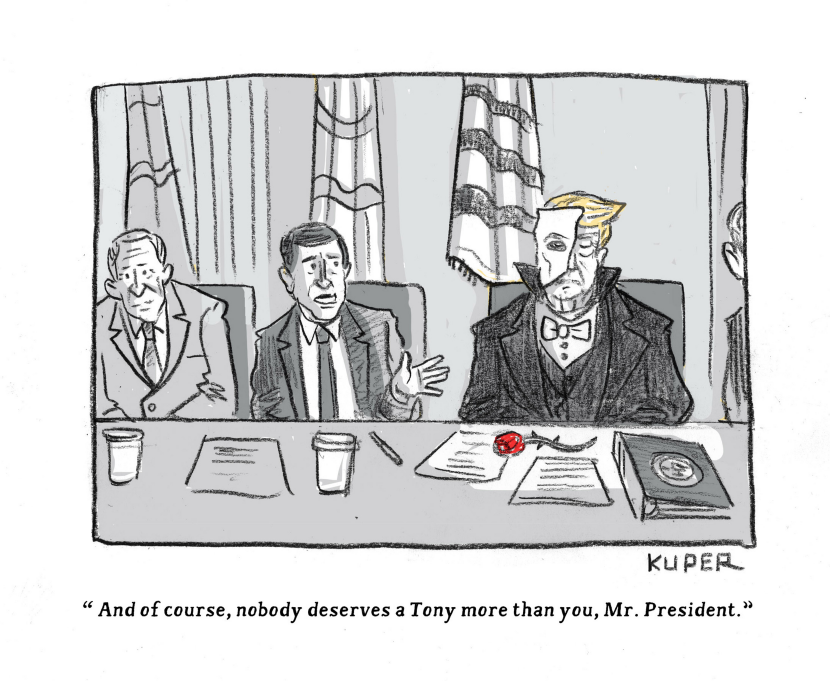
During televised meetings, his appointees have repeatedly competed to deliver increasingly extravagant testimonials to the man sitting at the head of the table.
Commerce secretary Howard Lutnick proclaimed: “This is the greatest cabinet working for the greatest president.”
Labor secretary Lori Chavez-DeRemer proudly invited Trump to admire his enormous portrait displayed outside her department.
Agriculture secretary Brook Rollins thanked him for saving college football.
Special envoy Steve Witkoff suggested Trump deserved the Nobel Prize.
Watching these spectacles, you almost expect a cabinet secretary to thank Trump for inventing electricity, discovering penicillin, and making the sun rise each morning.
New York Times reporter Magggie Haberman called one cabinet meeting “an endurance test of who could praise President Trump more.” Former Republican Congressman Joe Walsh was considerably more diplomatic. “This is so f*****g gross,” he wrote on social media.”This isw a cult.”
A May 2026 New York Times analysis found approximately one out of every six sentences spoken by Trump’s cabinet members during televised meetings involved flattering him.
The problem isn’t merely that these performances are embarrassing. It’s what they reveal about the political culture Trump has cultivated.
A president surrounded by people afraid to disagree risks becoming a prisoner of his own assumptions.
The danger becomes especially serious during national emergencies.
The November 13 aviation shutdown required clear explanations, accountability and reassurance. Duffy did provide technical details about aging equipment and communications failures. But the constantly repeated presidential praise seemed bizarrely misplaced while American struggled to get home.
The question isn’t whether every Trump appointee is incompetent. Some undoubtedly possess considerable ability.
The question is whether ability matters as much as the willingness to flatter the boss.
Lincoln understood that disagreement could strengthen a presidency. Kennedy’s experience demonstrated that even brilliant advisers could be disastrously wrong.
Trump’s cabinet raises a different possibility: What happens when officials become so preoccupied with pleasing the president that challenging him becomes politically dangerous?
Lincoln had his team of rivals. Kennedy had the best and the brightest.
Trump has his team of brown nosers.
And when everyone around the president is busy telling him how wonderful he is, who’s left to tell him when he’s wrong?
Copyright 2026 Joe Gandelman, distributed exclusively by Cagle Cartoons newspaper syndicate.

Joe Gandelman is a former fulltime journalist who freelanced in India, Spain, Bangladesh and Cypress writing for publications such as the Christian Science Monitor and Newsweek. He also did radio reports from Madrid for NPR’s All Things Considered. He has worked on two U.S. newspapers and quit the news biz in 1990 to go into entertainment. He also has written for The Week and several online publications, writes a column for Cagle Cartoons Syndicate and has appeared on CNN.