












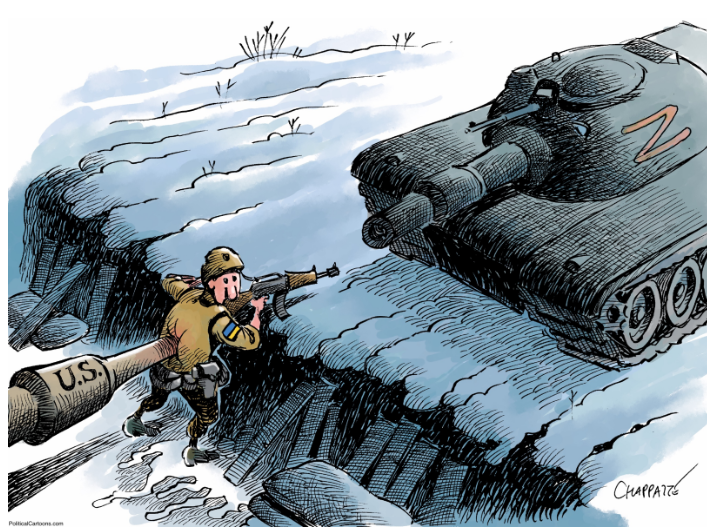
courtesy of Cagle Cartoons, Inc.
Breaking News: Overnight, and following Russian strikes on the Ukrainian capital on May 24, 2026, Russia warned the U.S. that Russia would be launching strikes on Kyiv sites “linked to the Ukrainian military” and for the U.S “to evacuate diplomats and American citizens from Kyiv.”
It has now been four years and three months since Russia – a country with one of the world’s most powerful armies — launched an unprovoked attack and full-scale invasion of small, yet brave, resilient, unyielding Ukraine.
The astounding, heroic resistance of Ukraine against an overwhelming military force is perhaps best illustrated by a recent comparison in The Guardian: “Russia’s invasion of Ukraine, now entering its fifth grim year, has already gone on longer than the entire fight on the eastern front in the second world war.” The author continues, “The Soviets marched from the gates of Leningrad to Berlin in a little over 15 months in 1944-45; today the Russian rate of gain in Pokrovsk in Ukraine is 70 metres a day, in Kupiansk, 23 metres…”
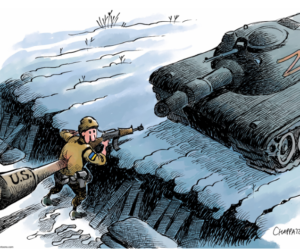
Of course, small Ukraine needs help. The U.S, under the Biden administration, and European countries and organizations such as the EU and NATO have generously assisted Ukraine with arms, financial assistance and — equally important – moral and political support.
By the end of the Biden administration, the U.S. Congress had approved $188 billion in spending for Ukraine.
There has been no new Ukraine aid legislation under the Trump Administration. A percentage of aid appropriated under the Biden Administration is still in the pipeline, although, “on two occasions the Trump administration temporarily paused some deliveries.”
The Council on Foreign Relations (CFR) warned in February of this year, “the lack of new aid commitments means that U.S. aid deliveries are running out.”
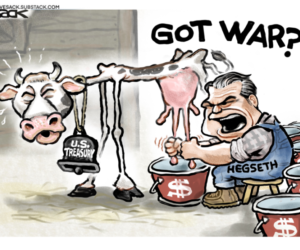
Under a plan known as the Prioritized Ukraine Requirements List (PURL), Trump is selling — yes selling — U.S. weapons to NATO allies who, in turn, transfer them to Ukraine. Under this plan, two-thirds of NATO allies have committed to nearly $5 billion of arms purchases from the U.S. to provide much-needed arms, such as Patriot missiles, to Ukraine.
A recent report at the UK Parliament House of Commons Library charitably calls Trump’s Ukraine policy “a different approach by the US” coming at a time when “the US’s commitment to European security was also frequently called into question, and the US was seeking rapprochement with Russia.”
The report adds, “…Europe has taken steps to assume greater responsibility for its security, including support for Ukraine.” In April, European leaders said that “Ukraine’s security is inseparable from Euro-Atlantic security”.
Others are not quite as diplomatic.
• Jim Rice, at the London School of Economics, calls the “different approach” a “betrayal,” “abandonment” of Ukraine
• Simon Tisdall at The Guardian writes, “Ukraine is the biggest and most consequential of all the American betrayals.”
• The Times of Israel: “Donald Trump, in a geopolitical betrayal of seismic proportions, appears to have switched sides in the three-year-old Russia-Ukraine war.”
• Representative Mike Quigley, citing Putin’s “mass atrocities” in Ukraine, calls Trump’s response a “betrayal of Ukraine” that “sends a clear message to our allies that we cannot be relied on, we will not stand by our word…”
• In a podcast, The Atlantic’s David Frum characterizes Trump’s Ukraine policies as being part of a very different world, “a world of outright hostility to Ukraine, where Donald Trump’s goal seems to be to pressure Ukraine, sometimes risking Ukrainian lives, sometimes dooming Ukrainian lives, pressure Ukraine to a negotiated form of submission to Russia.”
• The Huffington Post: “Trump has largely abandoned [Ukraine] as it fights against Russian dictator Vladimir Putin’s now 4-year-old invasion… [He] has over the years repeatedly praised Putin — he initially called his brutal attacks ‘genius’ and ‘savvy’…”
In contrast, and to their credit, European nations (NATO/EU) have, from the very beginning of the attack until today, steadfastly and unfailingly supported their Ukrainian neighbors, collectively providing more aid and assistance than the U.S. and have assumed greater responsibility not only for Ukraine’s security but also for their own, stating that “Ukraine’s security is inseparable from Euro-Atlantic security”.
In addition, Europe has begun to quietly but steadily shift away from totally relying on U.S. security guarantees, to become “the guardian of its own values, because the partner it once relied upon has chosen a different path…”
On the fourth anniversary of the February 2022 Russian invasion of Ukraine, the G7 leaders not only reaffirmed their unwavering support for Ukraine, but also expressed their intention to play a leading role in the peace process and, as part of the Coalition of the Willing, “to provide robust and reliable security guarantees to Ukraine…[acknowledging] that only Ukraine and Russia, working together in good faith negotiations, can reach a peace agreement.”
Also on the fourth anniversary, NATO Secretary General Mark Rutte reaffirmed NATO’s commitment to stand with Ukraine “today…and throughout the challenges ahead,” and called, Ukraine “a nation of quiet heroes, where both civilians and soldiers bear the burden of war.”
Ukraine is certainly a nation of incredible, quiet heroes. For no other nation – regardless of any amount of assistance provided by others — could have survived the savage Russian military attacks, day after day, week after week, month after month, for four years and three months without the indominable will of its amazing citizens to be free, to exist.
Ukraine is making some headway. According to NATO Secretary General Mark Rutte, Ukraine’s strong defenses are stabilizing the frontlines and even making territorial gains. The reputable Institute for the Study of War (ISW) reports that Ukrainian forces appear to be regaining the tactical initiative in different sectors of the frontline
Not only is Ukraine refusing to die, it will rise free, stronger and more prosperous – even if abandoned by some “friends.”
