









Normally I’d rather boil my eyeballs than read a compendium of quotes from MAGA voters. The New York Times, in particular, likes to torture those of us who dwell in factual reality. Every few months there’s another “focus group” of a dozen or so randos, and whenever I try to parse what they’ve opined I am instantly struck with the sensation that I’ve been seat-buckled for a trip to Mars.
So with great trepidation I peeked at the paper’s latest offering, and…whoa, hang on…what do we have here:
Jose, 62, from Florida says, “I thought…he was going to turn the country around and he was going to be a stellar president. But it’s turned out to be a horror movie. I was so wrong with the vote for him.”
Franceska, 26, from Washington state: “I don’t think I’ve really seen much progress toward even moving toward what he said he was going to do.”
Michelle, 45, from Maryland says, “I feel foolish…all of the things that (anti-Trump family members) pointed out would happen have ended up happening And I looked dumb as hell believing in fairy tales.”
Pamela, 65, from Tennessee: “I’m embarrassed for our whole country that this is what we’re dealing with now.”
I really want to be nice to these people. And I will, later in this piece. It’s noteworthy that eight of the 11 participants voiced “regret” about voting for Trump, and 10 graded performance with a D or F. But first I need to vent. I know you’ll understand.
When Nancy, 55, from Arizona said she’d hoped that Trump, in his “second go-around,” would “have better advisers,” my first response was: Did you not notice how he treated sane advisers during his first go-around? In what universe did you think he’d have “better advisers” this time?
Then there’s John, 62, from Maryland, who graded Trump with an F, but nevertheless praised him for pulling us out of the World Health Organization and the Paris climate agreement, because, in John’s words, “that was accounting for a lot of our budget money.” Good grief. Our annual WHO dues were $111 million, a microscopic sum in a federal budget of $7.4 trillion; and our $1-billion initial commitment to the Paris deal is .0142857 percent of that budget. One can learn these facts with just a few keystrokes. I’ve assigned John a grade of F for critical thinking.
Best of all, however, is Amanda Robbins, a three-time Trump voter from Pennsylvania who has seen the light. She was not in the focus group; an NBC News reporter talked to her recently while she pumped gas at war-inflated prices. She called Trump “a worthless pile of s–” and, with respect to her 2024 vote, “That was my bad.”
She said it, not me.
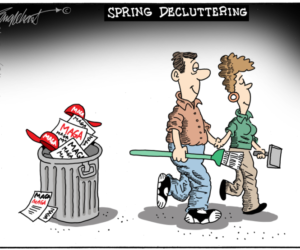
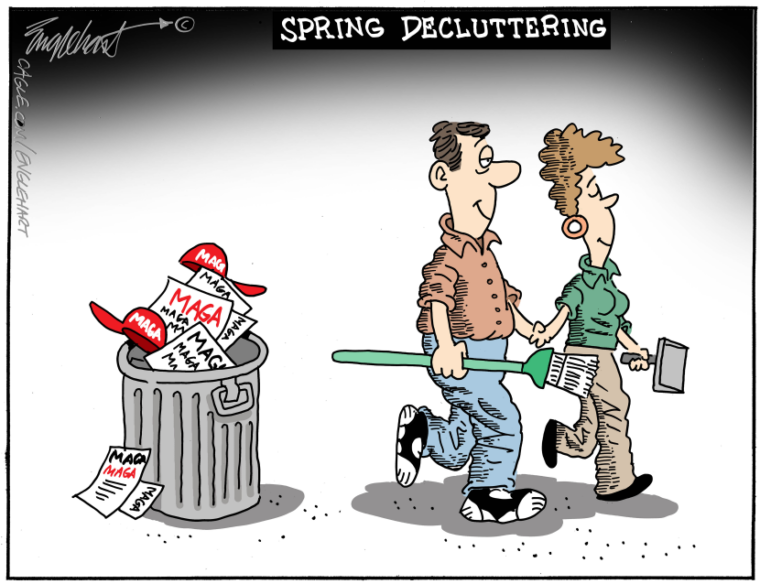
It does us no good to double down on our anger, to dismiss these people with “we told ya so.” This is a time to take the win and welcome them in.
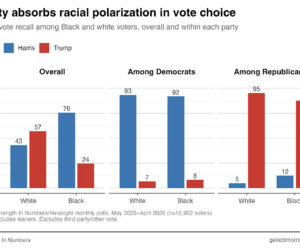
The latest national poll says 20 percent of Trump’s 2024 voters are pissed about the way he has mishandled inflation. 11 percent have bailed on him entirely, and this poll was conducted before Trump decided to stick taxpayers with a billion-dollar bill for his ballroom. In a nation where elections are so often decided by tight margins, those percentage shifts in sentiment are significant. They’re something to build on. Perhaps Democrats can even be prompted to rethink their messaging and broaden their appeal (which itself is a topic for another day).
I agree with Jesse Lehrich, a former Hillary Clinton advisor who writes a newsletter about the future of the Democratic party. He reportedly says it’s “political malpractice” to dump on the MAGA voters who are dumping on Trump: “Yes, it is totally fair to be frustrated that the people voted for a guy that you think is a fascist…but it is a massive win every time someone reaches the point” of defection…Part of the toxicity of the (Democratic) brand is that we are condescending elites who think we are better than everyone else…But when I see a bunch of former MAGA people so disillusioned, I think to myself, “‘Wow, look at how big our coalition can be.’”
In Nazi-occupied France, disparate factions with little in common – conservative Gaullists and insurgent communists – found ways to work together toward a shared objective. In a national emergency, there’s no other choice. Kitty, the focus group’s Pennsylvanian, had the right idea: “At the end of the day…we need to stick together and make our country stronger.”
In that spirit, paraphrasing Victor Lazlo in Casablanca, I say to her, “Welcome to the fight. This time I know our side will win.”
–
Copyright 2026 Dick Polman, distributed exclusively by Cagle Cartoons newspaper syndicate.
Dick Polman, a veteran national political columnist based in Philadelphia and a Writer in Residence at the University of Pennsylvania, writes the Subject to Change newsletter. Email him at [email protected]
Related Cartoons
Dick Polman
Cited by the Columbia Journalism Review website as one of the nation’s top political scribes, and by ABC News’ online political tip sheet as “one of the finest political journalists of his generation, ” Dick Polman is the national political columnist at Philadlephia NPR affiliate WHYY, and has covered or chronicled every presidential campaign since 1988.
A Philadelphia resident, Dick roamed the country for most of his 22 years at The Philadelphia Inquirer. He has been blogging daily since 2006. He’s currently on the full-time faculty at the University of Pennsylvania, as “Writer in Residence.” He has been a frequent guest on C-SPAN, CNN, MSNBC, the BBC, and various NPR shows – most notably Philadelphia’s “Radio