


How the DOJ misled the SCOTUS to gut the Voting Rights Act.
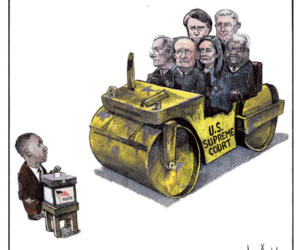
The Supreme Court’s 6-3 decision on April 29 gutting Section 2 of the Voting Rights Act relied in large part on Justice Samuel Alito’s claim that racial disparities in voting are no longer a significant problem. To support this argument, he used data from the Department of Justice (DOJ) to assert that Black and White voter turnout “reached parity in two of the five most recent Presidential elections.” There are several problems with his assertion.
First, the elections cited were 2008 and 2012. What is unique about those presidential elections? America’s first Black president, Barack Obama, was on the ballot.
Second, it’s only two-out-of-five presidential elections, which is less than half. Moreover, the trend reversed itself in the three most recent presidential elections (2016, 2020, 2024). It didn’t just reverse itself: the gap “exploded.” As Kevin Morris, a researcher at the Brennan Center for Justice, writes: the claim “is simply not factual.”
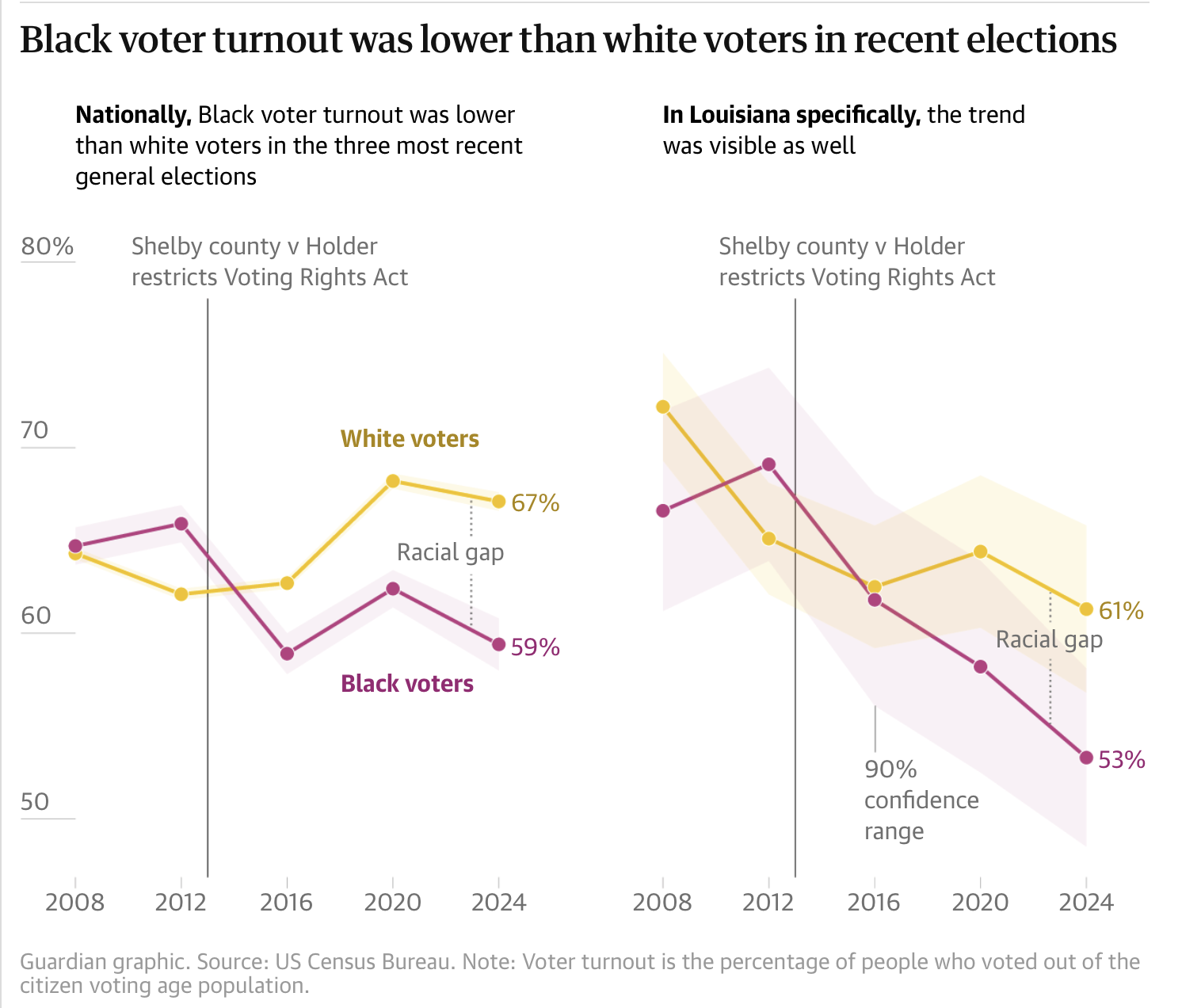
Third: the data that the DOJ included in its brief were designed to mask that explosion. How did DOJ fudge the numbers? The Guardianpublished that analysis on Friday.
The justice department brief that Alito cited calculated Black and white voter turnout in Louisiana as a proportion of the total population of each racial group over the age of 18. Such an approach is not preferred by experts in calculating statewide turnout because the general over-18 population may include non-citizens, people with felony convictions and others who cannot legally vote.
The widely accepted approach is to consider voter turnout as a proportion of the citizen voting age population or the voter eligible population… When the Guardian analyzed turnout numbers in Louisiana using the citizen voting age population, it found that Black voter turnout in Louisiana only exceeded white voter turnout in the 2012 presidential election…
The Guardian also reviewed data from the Louisiana secretary of state’s office, which calculates voter turnout a third way, as a percentage of registered voters. Using that methodology, Black turnout has not exceeded white turnout in any of the last five presidential elections in Louisiana.
The house of cards that is Alito’s argument rests on deliberately misleading DOJ data that no one fact-checked. As Michael McDonald, a political science professor at the University of Florida, told The Guardian: “Someone knew what they were doing” in order to create that misleading picture.
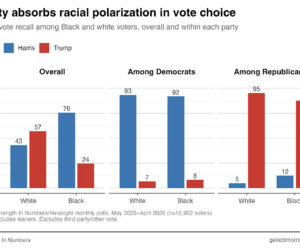
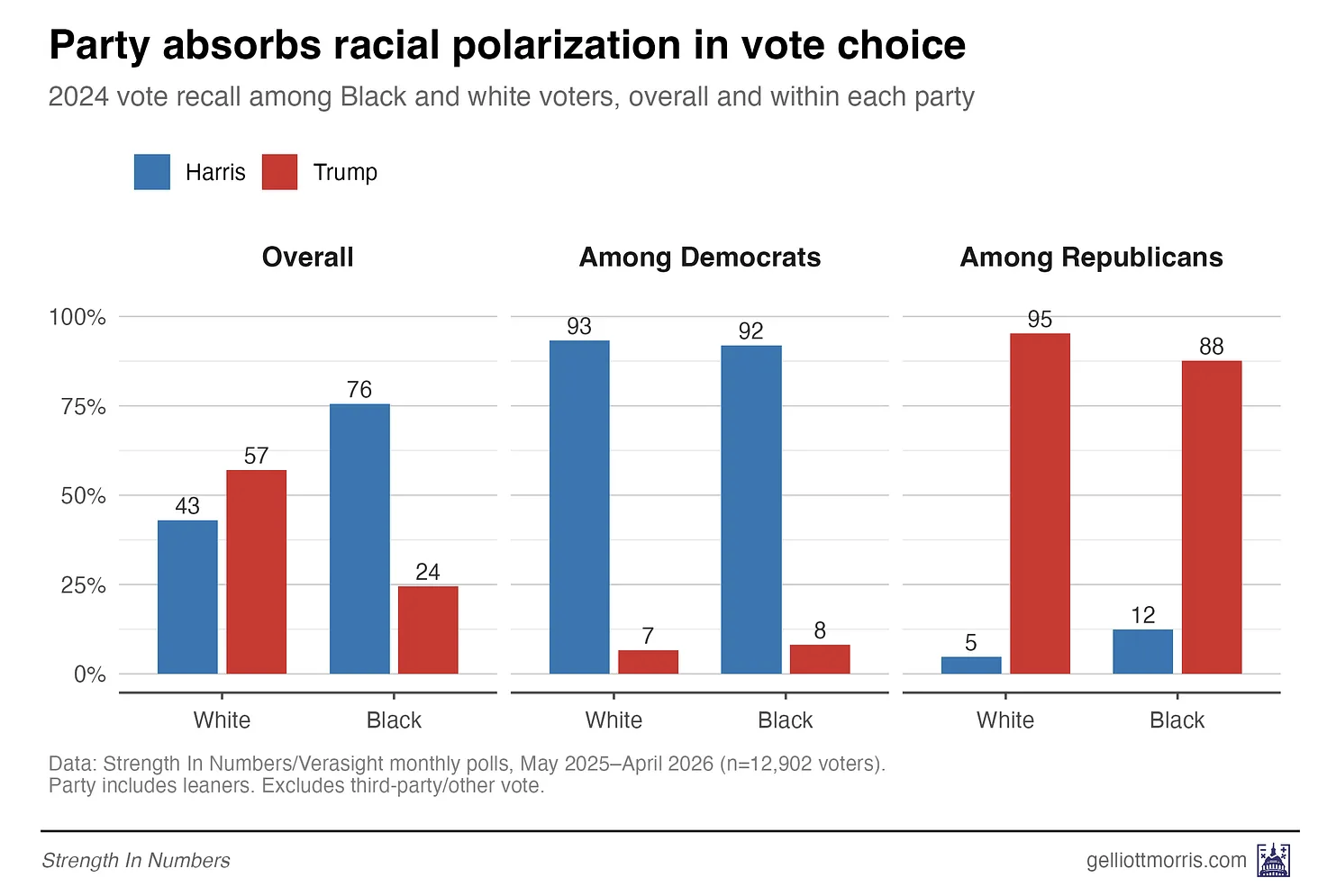
Finally, according to G. Elliott Morris of Strength in Numbers, Alito’s mandate in Callais to examine “vote dilution” masks racial polarization, enabling discriminatory gerrymanders. The requirement to “control for party affiliation” is a major statistical error, he says. In today’s America, “party isn’t a variable that operates independently of race. Rather, political party is largely downstream of one’s race.”
Using Verasight’s polling recall, he shows “a 66-point racial gap in vote choice.”
It’s not like the DOJ has a pristine record of truthfulness. The use of misleading data before the Supreme Court is not an anomaly. A Bloomberg Law article showed that federal judges rebuked the DOJ many times in 2025 for misrepresentations and evasion. The frequency prompted current and former judges to question whether the DOJ should retain its traditional “presumption of regularity” — the judicial doctrine that assumes the government is acting in good faith in court.
Here are a few examples:
- In May 2025, Judge J. Michael Luttig detailed the unconstitutional and extralegal acts taken by this Administration, which were defended by “defiant, contemptuous arguments made by Department of Justice lawyers.”
- Also in May 2025, in the Southern District of New York, the DOJ admitted in a court filing that it had made a “material mistaken statement of fact” to the court and plaintiffs by relying on a May 2025 ICE memo to justify arrests at immigration courthouses.
- In late 2025, an assistant US attorney in the Eastern District of North Carolina, Rudy Renfer, filed a brief that containedfabricated quotes, misstated case law and fake regulatory language (AI slop).
- In early 2026, Chief Judge Patrick Schiltz of the U.S. District Court in Minnesota accused ICE of violating court orders nearly 100 times in January 2026 alone, saying the agency “has likely violated more court orders in January 2026 than some federal agencies have violated in their entire existence.”
- Last month, in the Eastern District of California, Chief US District Judge Troy Nunley fined DOJ attorney Jonathan Yu $250 for wasting the court’s time and undermining “the orderly administration of justice” after Yu repeatedly failed to comply with court orders following a court-ordered release.
- This month, in the District of Rhode Island, US District Judge Melissa DuBose initiated disciplinary proceedings against Assistant U.S. Attorney Kevin Bolan for failing to disclose that a Dominican national held in detention was wanted for murder in the Dominican Republic before she signed a release. “There was a decision made not to be truthful to the court” which represented “a serious breakdown in the ethical codes.”
Just Security has documented more than 200 cases that put in question the DOJ’s “presumption of regularity” as of 19 March 2026. They have found:
- Court concerns over noncompliance with judicial orders: 34 cases
- Court distrust of government information and representations: 90 cases
- Court findings of “arbitrary and capricious” administrative action: 91 cases
This is systemic rot, and it started fresh out of the gate when DOJ fired the head of its Office of Professional Responsibility, established in 1975 in the wake of the Watergate scandal. The 38-year veteran of DOJ had been appointed to his position in Trump’s first term.
Next up: the White House axed at least 17 inspectors general system-wide without the legally required 30-day Congressional notice.
Then they removed the ethics office head, also established in 1975. Then half of the Federal Programs Branch resigned; institutional knowledge out the door.
And Congress has twiddled its thumbs.
It’s critical that Congressional leaders speak out about the politicization of the Justice Department, even if news media have moved on because the story is “old.” An independent DOJ is essential to a functioning democracy, and that makes this story relevant every day of the year.
Look. Republicans had a field day investigating Bill Clinton between 1993 and 1994 when they were the minority party. Take a page from that playbook, Democrats. Demand documents and hearings. Hold regular press conferences. Start with the Department of (in)Justice, but don’t stop there.
Published 08 May 2026 on Substack

Known for gnawing at complex questions like a terrier with a bone. Digital evangelist, writer, teacher. Transplanted Southerner; teach newbies to ride motorcycles. @kegill (Twitter and Mastodon.social); wiredpen.com