
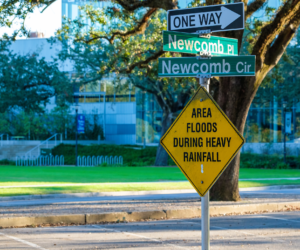








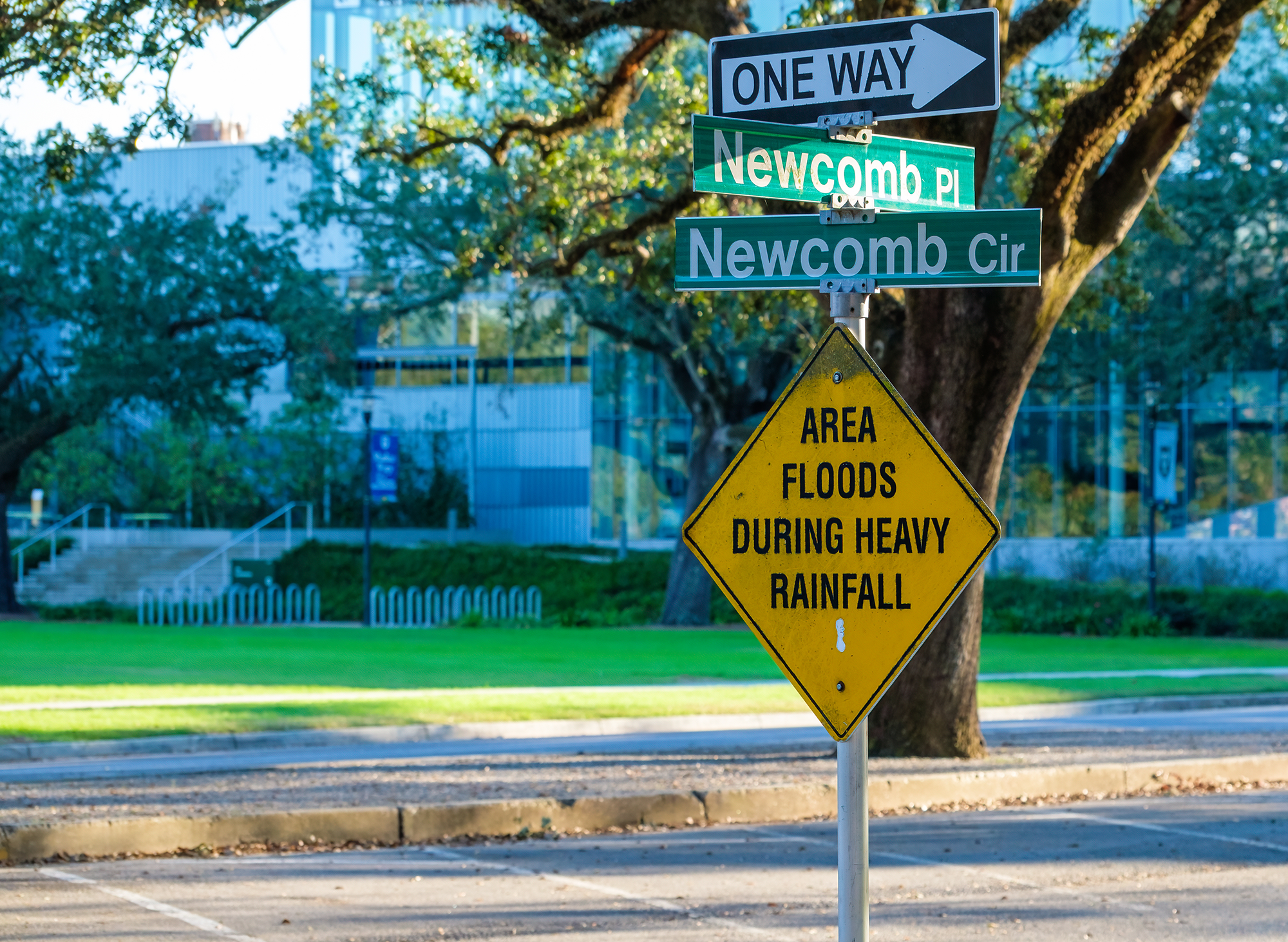
Last week, The Guardian unleashed a tsunami of consternation with its analysis of a scientific perspective from Nature Sustainability about predicted climate change impacts on the city of New Orleans. The headline summed the assessment as New Orleans being past the “point of no return,” and stated that its “relocation must start now.” In other words, if climate change magically ended today, the authors’ assessment is that city would still become an island in the Gulf of Mexico.
The authors called for policy makers to begin thinking about and planning for a “managed retreat” north of Lake Pontchartrain. They detailed the costs of new containment infrastructure and explained how those investments would ultimately fail. Money would be better spent preparing a relocation plan, they argue.
Co-author Jesse Keenan of Tulane University spoke with NPR. He said, “New Orleans has a matter of generations to prepare for a transition north to the mainland and away from the coast.” And in a Tulane University news release, he frames the work thusly: “Transition planning is not only key to maintaining continuity, but it offers significant economic opportunities, from land-building strategies to renewable energy and new housing development.”
The Guardian’s framing, however, was not nuanced. “Now” rather than “within a few generations” is a sledgehammer. Climate change skeptics and New Orleans residentspredictably cried “foul!” You probably would, too, if that headline had named your home.
Nor did The Guardian allude to other cities in the country that are at risk of flooding or drought from ongoing climate change: Denver, Houston, Las Vegas, Los Angeles, Miami, New York City, Phoenix and Tampa-St. Petersburg … a non-exhaustive list.
I understand why the perspective in Nature Sustainability focused on this one city. After all, “Louisiana contains the most exposed coastal zone in the world.” But why did The Guardian reporter make the assessment so emphatically? Oliver Milman, who lives in New York City, is a British journalist and the environment correspondent at The Guardian.
Milman, who describes himself as ‘awkwardly British,’ may have brought to this story something most American environmental journalists lack: a baseline expectation, formed by growing up in a country with a century-long flood management plan, of what governments are supposed to do when the water is rising. London, you see, has the Thames Estuary 2100, a comprehensive strategy to deal with flood risk. It has defined decision points (2035, 2040, 2070) designed to keep the plan relevant.
There is no such comprehensive plan for any US city or for the United States as a whole. New Orleans upgrades levees after a disaster like Hurricane Katrina; Phoenix hopes water conservation will win the day; and Miami raises individual streets to protect against sunny-day high tides. Miami is further hamstrung by climate change denier Gov. Ron DeSantis, who banned the term “climate change” from state energy policy legislation in 2024.
London’s plan exists within a very different political culture, however, one where governing means planning for what is coming, not debating whether it is real. In the United States, we are still having the second argument.
Critics claim, for example, that Louisiana’s problem isn’t climate change but extraction: groundwater for potable water and, of course, oil and natural gas. Why shouldn’t oil companies have to pay their share to keep New Orleans safe from flooding, that argument goes. Certainly reparations may be part of a solution, but extraction effects (what economists call externalities) do not negate the overwhelming flooding problem.
In the United States, coastal cities and Colorado River states are at risk, for example, but they aren’t the only ones. Coastal cities of all sizes are at the mercy of sea level rise.
Arizona, California, Colorado, Nevada, New Mexico, Utah and Wyoming each draws water from the Colorado River to provide sustenance for 40 million people and 5 million acres of farmland. The seven states can’t agree on how to divvy up the ever-shrinking river.
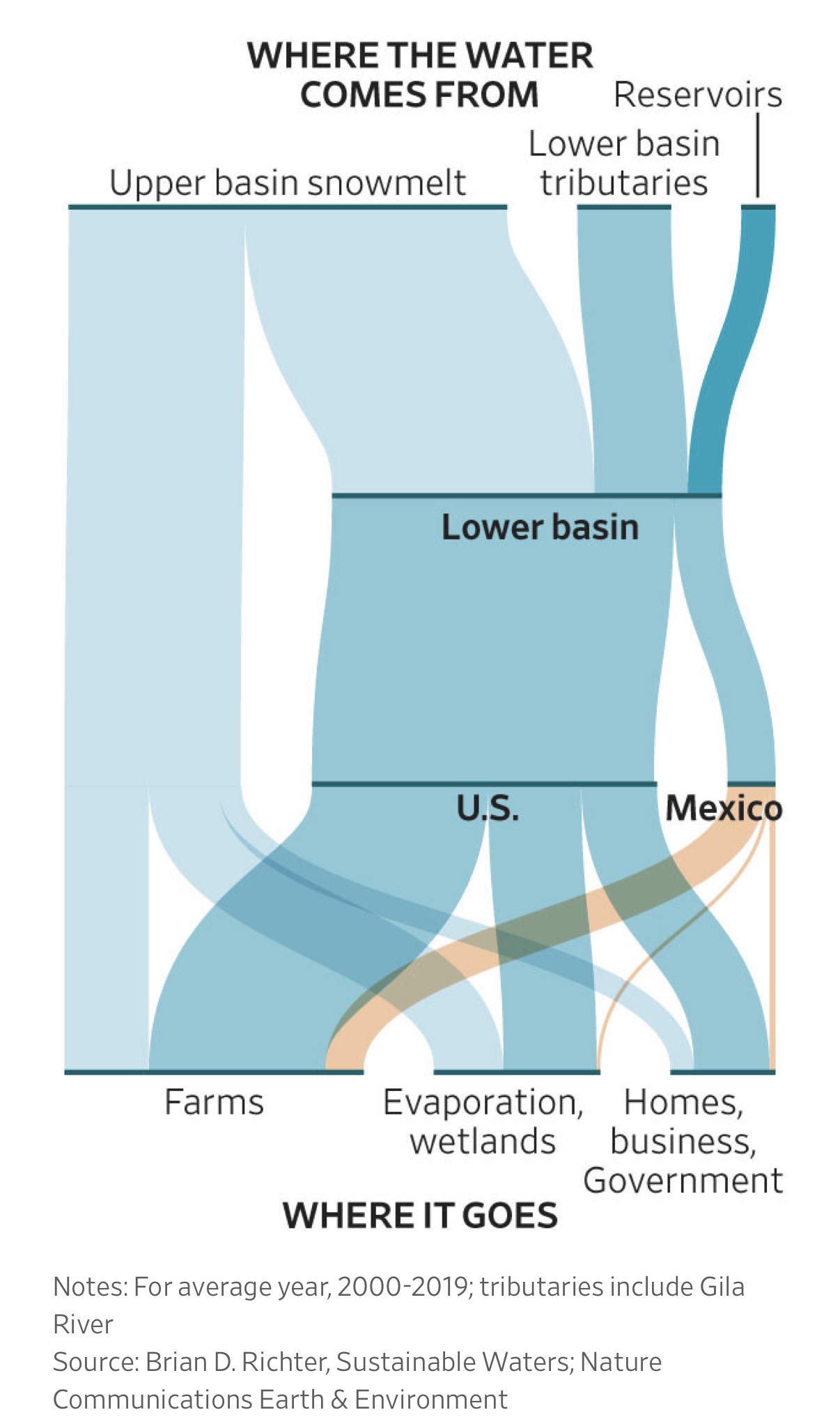
The Wall Street Journal reported Friday that this was “the worst year for snowpack in Colorado and Utah on record.” As a result, reservoirs are at record lows. For example, the snow pack “runoff reaching Lake Powell, the nation’s second largest reservoir, is expected to be just 13% of average, the lowest on record.” The Lake is at about 24% of capacity, barely enough for hydropower.
Because the seven states are at an impasse, the federal government is stepping in. Reactive, in other words. Reuters reported today that the feds are proposing “a new water-sharing ?plan for the drought-stricken Colorado River that could cut up to 40% of current ?supplies to Arizona, California and Nevada.” Note that the current 1922 Colorado River Compact ?gives “California the highest priority for water use.”
The United States is a very big country. Yet drought and flood conditions are usually treated as local or regional stories, not national ones. This fragmentation leads to locally focused discussions about managed retreat, which are fraught with emotion. But the national tax base is often deemed the source for improvements.
Without a national plan, the loudest Congressional delegation gets the prize. The most vulnerable communities get the flood or the drought.
We desperately need a national plan to address these issues. Proactive planning is always less expensive than disaster cleanup, both in absolute dollar terms and lives.
News organizations need to contextualize stories like the New Orleans feature (and avoid click bait headlines). People in Phoenix need to understand how their water problems are the flip side of those in Miami, for example. One plagued by drought, one by floods. The role of the Fourth Estate is to connect dots and frame these stories as the national crisis that it is.
The Guardian will have done us a favor if this story about New Orleans stimulates an honest conversation about the challenges facing our cities this century. The conversations will not be easy; grief at loss, even future loss, is real.

Known for gnawing at complex questions like a terrier with a bone. Digital evangelist, writer, teacher. Transplanted Southerner; teach newbies to ride motorcycles. @kegill (Twitter and Mastodon.social); wiredpen.com