















It is past time for the House of Representatives to vote on the impeachment of President Trump. Not because anyone expects the Senate to convict with a two-thirds majority. Or even for the House to pass an impeachment resolution.
We need every possible member of Congress on the record: does brazen presidential self-enrichment cross a red line?
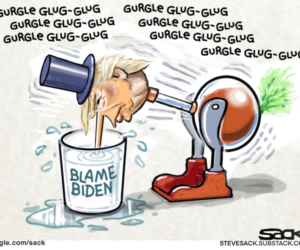
The corruption at the center of this impeachment request is the $1,776,000,000 slush fund, also known as the Anti-Weaponization Fund (Fund), designed for third parties not part of Trump’s original non-adversarial lawsuit against the IRS. Trump sued the IRS for $10 billion because his tax records were leaked, along with others, by a contractor. That man is currently in prison. The leak occurred in Trump’s first term, but he filed the lawsuit in the second term.
Acting Attorney General Todd Blanche, who reports to Trump and previously served as his personal attorney, announced details about the Fund on Monday when both parties withdrew from Trump’s lawsuit without filing a settlement with the judge.
The judge had questioned whether there was truly an adversarial relationship between the two parties: Trump the citizen suing Trump’s executive branch. Critics (raising my hand) are also making this point. This settlement answers that question definitively.
The $1.776 billion Fund, a deeply offensive figure for its co-option of our 250th birthday, will come from a Department of Justice (DOJ) account not authorized by Congress for this specific purpose. It also allows settlement of claims without Congressional authorization. And, crucially, it conflicts with the DOJ directive published by former Attorney General Pam Bondi prohibiting “payments to nongovernmental, third-party organizations that were neither victims nor parties to the lawsuits.”
Claims will be accepted through Dec. 15, 2028, mere weeks before Trump’s term ends. The Fund does not define the terms “lawfare” or “weaponization.” It does not specify how claims will be evaluated. It does not set limits on individual payouts. It is, by design, a mechanism to funnel taxpayer money to Republican allies with no accountability, no transparency and no legislative oversight.
There is more, as is the norm for this President.
The next day we learned about corruption, part two. Blanche announced an extraordinary addendum: the IRS is “forever barred and precluded” from examining the prior tax returns of President Trump, his family and his businesses. Although the President cannot legally pardon himself, Blanche, in effect, wrote him a pardon. This clause was important to Trump the citizen because he reportedly could owe as much as $100 million in back taxes.
The Fund has gotten the most attention from critics of both sides. It is troubling that Vice President J.D. Vance has refused to rule out compensation to January 6th insurrectionists who attacked Capitol police. As law professor and CNN Supreme Court analyst Steve Vladeck writes, impeachment is “the only answer the Constitution actually contemplates for a President who uses public money to enrich the people who unlawfully fought against democracy and for him.”
This is not a minor breach of norms. It is an existential challenge to three foundational principles of our republic.
First, separation of powers. Congress controls the power of the purse. The creation of a nearly $2 billion discretionary fund, by executive action alone, to be administered and disbursed at the pleasure of officials who serve at the president’s will, is a shameless assault on legislative authority.
Second, equal justice under law. No American should be immune from the tax obligations and audit processes that apply to every other citizen. The IRS has never exempted an individual from an audit. It is notable that the Treasury’s general counsel resigned, only seven months after Senate confirmation, after Blanche announced the Fund on Monday.
The IRS mandatory audit program for sitting presidents exists precisely because the office creates extraordinary conflicts of interest. Eliminating that oversight by executive fiat, in exchange for dropping a self-serving lawsuit, is a corruption of the tax code and a mockery of equal treatment. How can it be legal?
Third, the prohibition on self-dealing. Federal law already prohibits the White House from directing the IRS to target or protect specific individuals. Blanche has apparently concluded that a carve-out exists for the attorney general. That interpretation must be challenged in court and, if necessary, closed by legislation.
I recognize that this administration has tested democratic norms repeatedly and that the pace of abuses has made it difficult to respond to each one with appropriate force.
We must not let this one pass.
This audacious settlement is not a gray area. It is an act of self-enrichment by the President of the United States, carried out through institutions he controls, paid for by us, the people he is supposed to serve.
Call your US Representative and demand an impeachment resolution. Call your Senators and support legislation to eliminate the Fund. Talk with your friends and family and urge them to act as well.
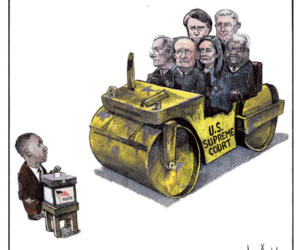
We cannot expect this Supreme Court to save us, given its ruling that the president has absolute immunity from criminal prosecution. Moreover, given the speed at which litigation moves, it’s unlikely there would be any money left in the fund by the time the case reached the Supreme Court.
This post first appeared at Substack.

Known for gnawing at complex questions like a terrier with a bone. Digital evangelist, writer, teacher. Transplanted Southerner; teach newbies to ride motorcycles. @kegill (Twitter and Mastodon.social); wiredpen.com