



Timothy A. Clary/AFP via Getty Images
Stephen Colbert’s final episode as host of “The Late Show” on May 21, 2026, won’t mark the end of his career.
But as a scholar of political satire, I think it offers a chance to reflect on the lasting impact of his comedy, which has spanned his work as a correspondent on “The Daily Show,” his conservative pundit persona on “The Colbert Report” and his reinvention on “The Late Show.”
The best satirists do more than entertain. They influence public discourse and leave lasting marks on political life. This group includes towering writers such as Benjamin Franklin and Mark Twain, alongside performers like Lenny Bruce and George Carlin.
In my view, Stephen Colbert has earned a spot in the top tier. Here are five reasons why.
1. He didn’t just satirize the news – he informed the public
Most satirists offer wry commentary about political events.
Colbert often did something more ambitious: He helped audiences understand them.
Critics have long dismissed political comedy as superficial entertainment, but Colbert’s satire frequently offered valuable information to the public.
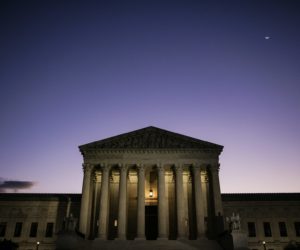
In 2010, the U.S. Supreme Court’s Citizens United decision transformed campaign finance law, tilting political influence toward wealthy people and corporations. As host of the “Colbert Report,” the comedian responded by creating an ongoing series of “Colbert Super PAC” segments. Working with former Federal Election Commission Chair Trevor Potter, Colbert was able to translate the opaque mechanics of campaign finance law into accessible civic education.
It’s hard to fully track the impact of this approach. But a 2007 Pew Research Center study did find that audiences for satirical news programs such as “The Daily Show” and “The Colbert Report” scored high on political knowledge measures, outperforming audiences who only consumed political news from traditional outlets.
That urge to use satire as a vehicle for civic education continued after Colbert became host of “The Late Show” in 2015.
With debates raging over the border wall proposed by the first Trump administration, Colbert brought experts on to the program to break down the engineering, financial and logistical realities of building one that spanned the entirety of the U.S.-Mexico border. Yes, the absurdity of the physics and finances elicited laughs. But Colbert also helped viewers understand why Trump’s promises were implausible.
2. He gave Americans a new political vocabulary
When the world is absurd, the satirist uses ironic wit to make sense of it.
Colbert excelled at distilling the spin and duplicity of politics into memorable soundbites.
On the first episode of “The Colbert Report” in 2005, he introduced the word “truthiness” to describe the tendency to prefer what “feels true” over what the evidence supports. It incisively gave a name to a deceptive political tactic, one that the Bush administration had repeatedly used, from “Mission Accomplished,” to “weapons of mass destruction” and “enhanced interrogation techniques.”
“Truthiness” took on a life of its own. Merriam-Webster named it Word of the Year in 2006.
Colbert continued this rhetorical work on “The Late Show.” For example, in February 2017, after Donald Trump escalated his attacks on the press by labeling major news outlets “the enemy of the American people,” the comedian shifted from parody to diagnosis. He foregrounded the phrase’s authoritarian history, insisting that the rhetoric signaled a meaningful escalation in attacks on First Amendment rights, rather than a passing controversy.
In other words: There was nothing to laugh about here.
3. He blurred the line between satire and direct action
Media scholars have increasingly noted how political comedians now function as hybrid figures who blur journalism, entertainment and civic engagement. According to communications scholar Joseph Faina, Colbert may be one of the clearest examples of that shift.
Colbert’s satirical presidential campaign in South Carolina in 2007 mocked the theater of American electoral politics. He actually attempted to enter the race through official channels, only to be blocked by the South Carolina Democratic Party. But even in his failure to appear on the ballot, he was able to show how party control and media spectacle, not just voter choice, structure the field of viable candidates.
In 2010, he held a rally with Jon Stewart on the National Mall before a crowd of over 200,000 people. Assuming his conservative pundit persona, Colbert blended irony and sincerity, mocking the self-seriousness, sensationalism and outrage-driven news cycles of cable news through his competing calls for “sanity” and “fear.” But the event was also designed to motivate voter turnout in the midterm elections.
That interventionist impulse continued on “The Late Show.” During the 2020 election cycle, for example, Colbert encouraged voting through segments like “Better Know a Ballot.” A riff on his previous “Better Know a District” from “The Colbert Report,” the “Better Know a Ballot” series was designed to educate viewers about ballot access, voting procedures and the practical elements of democratic participation.

Paul Morigi/WireImage via Getty Images
4. He measurably influenced political behavior
Claims about comedians changing politics can easily become exaggerated. But Colbert’s influence has empirical support.
Research by political communication scholars Jody Baumgartner and Jonathan Morris found that exposure to political satire can increase viewers’ sense of what’s known as “political efficacy” – the belief that they can understand and engage with politics. Other studies suggest satirical news audiences are often more politically active than they’re assumed to be.
Colbert is repeatedly cited in these studies as one of the prime examples of a satirist who makes an impact.
Take, for instance, the so-called “Colbert bump,” where candidates who appear on his programs experience boosts in fundraising, visibility and media coverage. Political scientist James H. Fowler found that Democratic candidates who appeared on “The Colbert Report” experienced a 44% increase in campaign donations within 30 days of their appearance.
A similar effect could be seen on “The Late Show.”
After Colbert interviewed Texas state Rep. James Talarico, a U.S. Senate candidate, in February 2026, CBS canceled the segment, claiming – perhaps disingenuously – that the network could be punished for not adhering to the FCC’s “equal time” rule, which requires broadcast stations to offer comparable airtime to opposing candidates.
A taped version of the interview was nonetheless posted to YouTube, where it racked up over 9 million views, helping fuel Talarico’s US$27 million first-quarter fundraising haul, the largest amount ever raised by a U.S. Senate candidate in the first quarter of an election year.
5. He redefined American patriotism
To rank Colbert among America’s most important satirists requires one additional consideration: his role in redefining not only what America stands for, but what it means to be patriotic.
Many satirists lean toward cynicism, portraying politics as hopelessly corrupt and public life as fundamentally absurd. Not Colbert.
As linguist Geoffrey Nunberg argued in his 2006 book, “Talking Right: How Conservatives Turned Liberalism into a Tax-Raising, Latte-Drinking, Sushi-Eating, Volvo-Driving, New York Times-Reading, Body-Piercing, Hollywood-Loving, Left-Wing Freak Show,” conservatives had claimed a monopoly on patriotism as the 20th century drew to a close. At the same time, many of them promoted what’s known as “blind patriotism,” in which any criticism of the U.S. is cast as evidence of insufficient national loyalty.
Colbert’s satire directly challenged that framework.
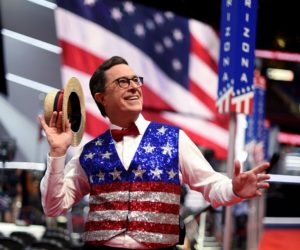
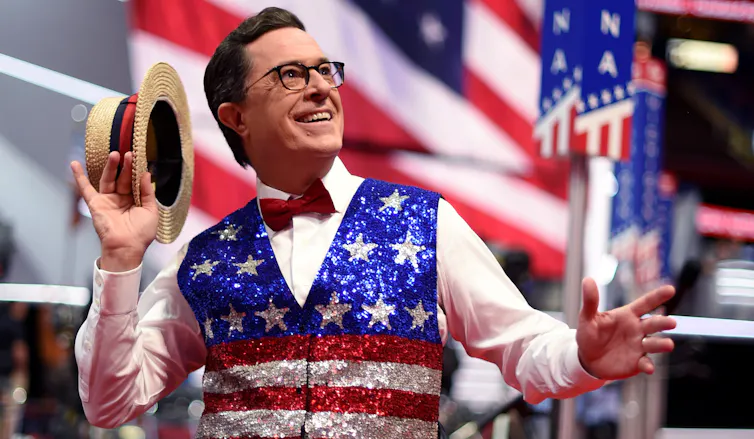
To expose that performative patriotism, Colbert’s persona on “The Colbert Report” wrapped itself in exaggerated patriotic imagery: flags, bombast, overconfidence and chest-thumping nationalism.
But the joke was never America itself. The target was a performance of patriotism that treated dissent as disloyalty, emotional certainty as evidence and partisan identity as civic virtue.
As I argue in my 2011 book, “Colbert’s America,” Colbert’s satire consistently distinguished between nationalism and democratic patriotism. The former demands unquestioning loyalty. The latter demands accountability. For example, through segments like “Threat-Down” on “The Colbert Report,” he satirized the way nationalism often depends on exaggerating fictive dangers and denouncing symbolic, external enemies.
In that sense, Colbert belongs in a distinctly American satirical tradition that stretches back to Benjamin Franklin. The great American satirists have used humor not to reject the national project, but to expose the gap between its ideals and its realities. They reshape how citizens understand power and civic responsibility.
For nearly three decades, Stephen Colbert has done exactly that.
Sophia A. McClennen, Professor of International Affairs and Comparative Literature, Penn State
This article is republished from The Conversation under a Creative Commons license. Read the original article.