
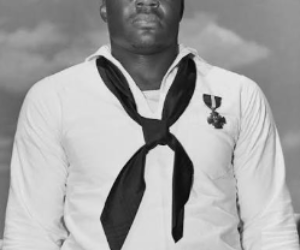








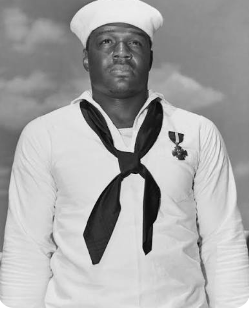
On Martin Luther King Day 2020, at a ceremony at Joint Base Pearl Harbor-Hickam, Hawaii, the U.S. Navy announced that its fourth Gerald R. Ford-class aircraft carrier (CVN-81) would be named USS Doris Miller, after Navy Cook First Class Doris Miller. Miller received the Navy Cross for his actions when Japan attacked Pearl Harbor on December 7, 1941.
(More about the service and heroism of Doris Miller later)
It was the first aircraft carrier to be named after an enlisted sailor, a radical break from the U.S. Navy tradition of naming aircraft carriers originally after Revolutionary War and World War II ships and battles and, more recently, after 5-star admirals, Presidents, and pro-Navy politicians.
It is also the first aircraft carrier in the history of the U.S. Navy to be named for an African American.
As such, the naming would honor both the U.S, Navy’s enlisted sailors and the contributions of African American sailors.
At the time, Acting Secretary of the Navy Thomas B. Modly said, “Doris Miller stood for everything that is good about our nation, and his story continues to be remembered and repeated wherever our people continue the watch today.”
Thomas Bledsoe, a great-nephew of Doris Miller, who has been a prominent supporter of the naming of the USS Doris Miller and a spokesman for the family, praised the news as a historic moment. One that will preserve Miller’s legacy of “courage, sacrifice, and service to our nation.”
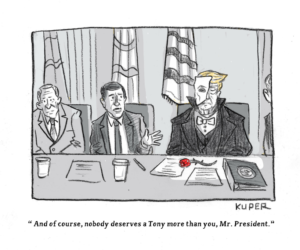
More recently, news reports revealed that Pentagon and Navy officials were considering scrapping Miller’s name from CVN-81 and rename it after Donald Trump, sparking pushback, concern and criticism from members of Congress (including from the Congressional Black Caucus which described rumors of renaming the ship for Trump as a “’dishonor”), the public, and Miller’s family.
In an August appearance on CNN, Bledsoe reacted to the reports. He told Laura Coates, “So, for our family, it was quite a shock to hear that there is conversation about the possibility of renaming the Doris Miller carrier.”
Referring to Miller’s bravery at Pearl Harbor and what the naming of the aircraft carrier means not only to the African American community but for Americans overall, Bledsoe added, “This isn’t just about a name on a ship. It’s about an opportunity and a goal. It’s about a significance in what it means to be an American. And it’s also about how we as a community can grow as one and become one. Towards one goal as a nation is so important.”
In a Sept. 19 column at the Virginian Pilot, Acting Secretary of the Navy Modly once again explained why he had chosen published Sept. 19 in to name CVN-81 after Doris Miller:
…I made the conscious decision to honor these heroes by finding a sailor who distinguished himself despite the circumstances of birth, race, education, upbringing or the limitations of rank, rate or assignment. There were thousands who demonstrated these qualities, but few were more compelling than enlisted African American sailors who served with honor despite the discrimination they endured at home and in the Navy itself. Race did not define these heroes, but race made their journeys to heroism that much more exceptional…
Last week, more principled and more patriotic minds prevailed. A spokesperson for Acting Secretary of the Navy Hung Cao confirmed to that the service has “no intention to change the name of the USS Doris Miller.”
It would not be another case of “Stolen Valor.”
But who is Doris “Dorie” Miller?
Here are some excerpts from “The Unforeseen Legacy of Doris Miller” at the National Museum of the Pacific War:
• Doris Miller was born to Connery and Henrietta Miller, sharecroppers in Waco, Texas, on 12 October 1919. He had to drop out of school to help support his family, working as a cook to supplement the family income during the Great Depression. In 1939, just before his 20th birthday, he enlisted in the United States Navy, and after training in Norfolk, Virginia, Miller became a Mess Attendant, one of the few positions open to African Americans in the Navy…
• On Sunday 7 December 1941, Mess Attendant Third Class Doris Miller was retrieving laundry when the Japanese bombs fell on Pearl Harbor. He arrived on deck, where he encountered his mortally wounded commanding officer and carried him to safety. He proceeded to one of the machine guns and although black sailors never received training on the anti-aircraft guns, he opened fire on the Japanese planes overhead. After the gun ran out of ammunition, Miller assisted in evacuating sailors after the order to abandon ship and was one of the last three men to leave the vessel as it sank. Even after leaving the ship, he helped numerous sailors to safety.
• In May of 1942, Miller was presented with the Navy Cross by Admiral Chester W. Nimitz, Commander in Chief of the Pacific Fleet and Pacific Ocean Areas, making Miller the first black sailor to receive such an honor [below].
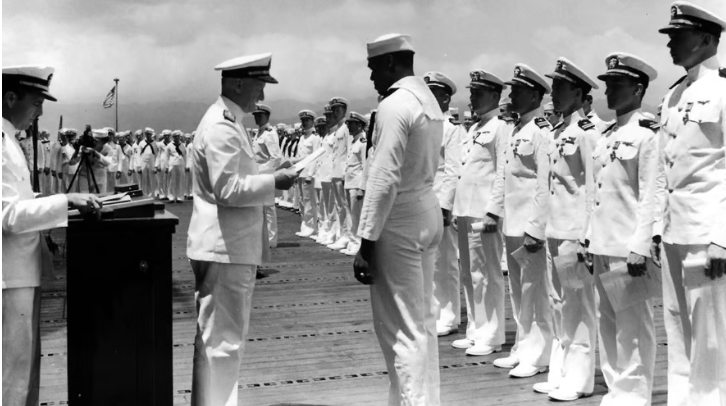
• Doris Miller continued to serve in the Navy as a mess attendant until 24 November 1943, when his carrier, USS Liscome Bay, was hit by a torpedo during the Gilbert Islands Campaign and its bomb magazine exploded, and most of the crew were killed. Miller was “presumed dead” and although his body was never recovered, he was declared killed in action after a year. Miller was 24 years old.
• Doris Miller’s legacy survives today and reminds us of service and heroism in the face of prejudice and hardship, and that the fight for freedom is freedom for all.
No Black service member has been awarded the Medal of Honor for acts of valor during World War II. Lawmakers and civil rights organizations have been working for decades to correct this disparity, including bills to waive statutory time limits and posthumously award the Medal of Honor to Doris Miller.
