
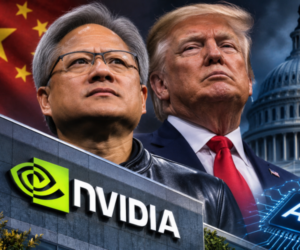
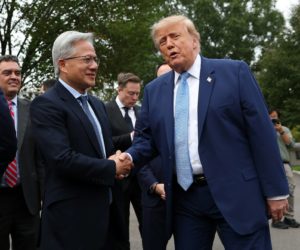



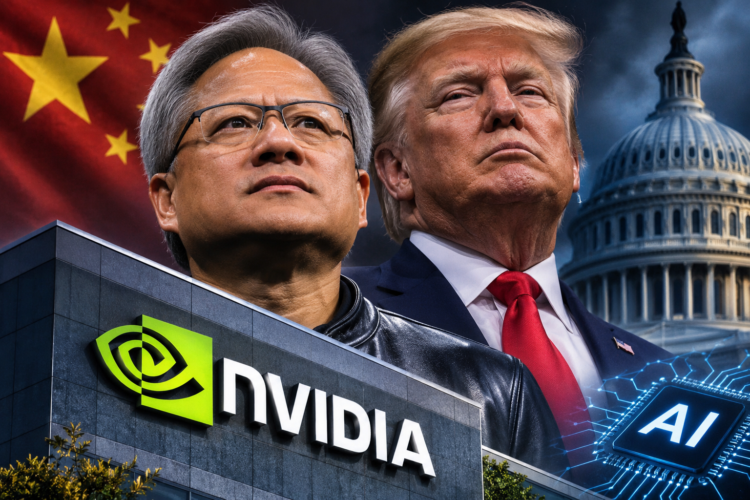
Is the resinstatement of Nvidia CEO Jensen Huang, engineered by Donald Trump, the biggest naitonal security scandal in American History?
That’s the provocative argument made by James Palmer, deputy editor of Foreign Policy magazine, who puts the mushrooming controveresy in a historical context that includes the Iran-Contra scandal.
Whether or not it ultimately earns that distinction, Huang’s return raises a host of disturbing questions about presidential power, potential conflicts of interest, corporate accountability, national security and the urgent need for greater oversight of the artificial intelligence industry.
And it once again raises the question: Are there any institutional boundaries Donald Trump believes he should respect?
Just 11 days after Huange resigned amid revelations of extramarital affairs, including one involving a woman suspected of having ties to Chinese intelligence, Nvidia’s board unanimously voted to reinstate him as president, CEO and board member.
The board cited assurances from several leaves of the United States government that Huang’s return presented no national security risk.
Who provided those assurances? On what intelligence assessments were they based? And why was it necessarty to reinstate Huang before the company’s own investigation was completed?
Trump, characteristically, couldn’t resist taking a victory lap.
“I convinced them,” Trump told CNBC. “I made the deal.”
Therein lies another dimension of this controversy. Trump clearly relishes demonstration that his power extends well beyond the traditional parameters of the presidency. The reinstatement of a corporate executive who presides over one of the world’s most consequential companies becomes another illustration of his ability to bend institutions to his will.
Republicans who privately hope Trump will modify his governing style following the party’s devastating midterm setbacks are likely to be disappointed. Whether traditional conservatives like it or not, Trump remains the public face of American conservatism. And he appears to ahve little inclination to change.
Consider some of the other troubling aspects to this controversy:
None of this automatically proves that Trump manipulated the stock market for personal gain, that the ballroom contribution influenced his decision oir that Huang knowingly compromised American national security.
But it certainly provides ample justsifications for thorough, indepenent investigations.
To their credit, some Congressional Republicans aren’t simply swallowing the administration’s assurances.
“No national security risk? Based on what?” Republican Texas Sen. John Cornyn asked on X.
Republican Utah Sen. John Curtis also questioned which government officials intervened and what evidence justified their conclusions.
The bipartisan reaction is particularly significant at a time when congressional Republicans have so frequently demonstrated a reluctance to challenge Trump.
The administration’s defenders argue that Huang’s leadership is critical in America’s economic and technological competitiveness and that hsi departure threatened the stability of AI. That’s an argument worth examining. But economic importance should not confer immunity from meaningful scrutiny.
There is also a must larger issue here.
Some of the most powerful figures in the burgeoning artificial intelligence industry have gone to extraordinary lengths to cultivave Trump’s favor. An indusry that will increasingly shape how Americans work and even wage wars must not become an industry whose accountability depends on personal relationships its executives maintain with whoever occupies that Oval Office.
Nvidia says its independent investigation will continue, and Huang has pledge to cooperate. Congress must ensure that its own investigations proceed irrespecetive of presidential pressure.
The idea that any corporate executive is too important to be held accountable is dangerous enough. The idea that a president can effectively give a clean bill of national security health on a favored billionaire while investigations remain unfinished is even more dangerous.
Is this the biggest national security scandal in American history?
It’s too early to tell.
But it’s certainly not too early to start demanding answers.

Joe Gandelman is a former fulltime journalist who freelanced in India, Spain, Bangladesh and Cypress writing for publications such as the Christian Science Monitor and Newsweek. He also did radio reports from Madrid for NPR’s All Things Considered. He has worked on two U.S. newspapers and quit the news biz in 1990 to go into entertainment. He also has written for The Week and several online publications, writes a column for Cagle Cartoons Syndicate and has appeared on CNN.