














UPDATE:
A great video on shibboleths here.
Original Post:
While living in Belgium in the early nineties we often visited the charming, picturesque town of Sluis, the Netherlands, situated right on the Belgian border.
We would enjoy its historic sites, buzzling markets, lively shopping and, especially, its culinary treasures.

But I would also (secretly and sometimes not-so-secretly) have fun with my English American wife’s (mis)pronunciation of the name Sluis.
According to the International Phonetic Alphabet (IPA), the Dutch word “sluis” (which means a lock in a canal used for raising or lowering boats to a higher or lower part of the canal) is pronounced as /slœy?s/.
Crystal clear now?
Talkpal AI describes it as follows:
Phonetically, the “ui” sound in Dutch …begins with a rounded front vowel like the French “œ” in “œuf,” gliding towards a close front rounded vowel akin to the German “ü” in “für.” The sound is a diphthong, meaning it transitions smoothly between two vowel qualities within the same syllable.
Others just give up entirely and suggest “slouse” or even “sloose.” The former most closely resembling my wife’s pronunciation.
In this author’s opinion, no phonetic representation can accurately capture the correct pronunciation of Sluis (and of so many other Dutch words.) To truly appreciate (hear) the correct pronunciation of this word please listen to the Wiktionary audio file for sluis here.
Since Dutch (Nederlands) and English are West Germanic languages, since Dutch grammar is not as difficult as, say, German grammar, and since English and Dutch share some similarities in vocabulary, it should be relatively easy for English-speakers to learn Dutch.
And generally it is — except for the pronunciation of “a few” words.
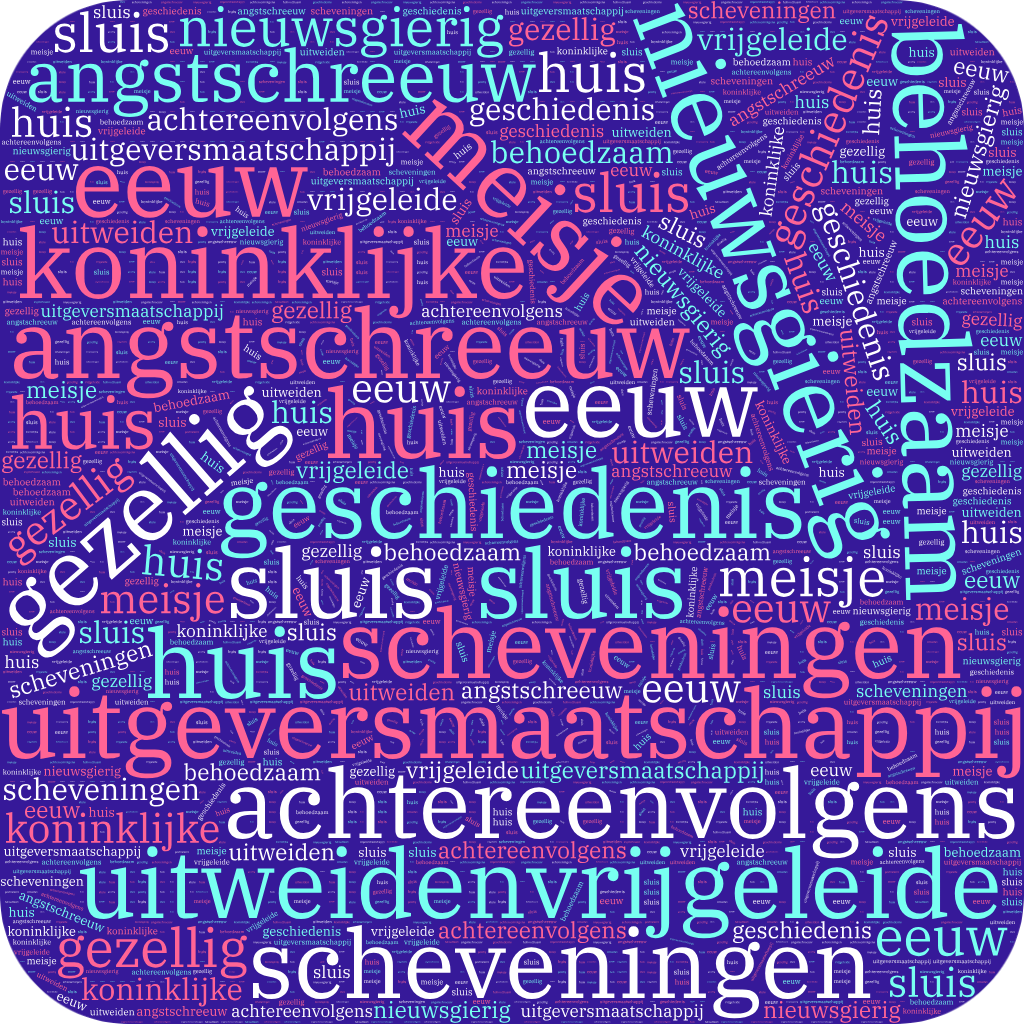
A pronunciation that is notoriously difficult because Dutch abounds with guttural, “throaty” ‘g’ and ‘ch’ sounds, such as in geld (money) and in prachtig (beautiful), respectively. Also, because of frequent complex consonant clusters, such as in angstschreeuw (scream of fear). This one boasting eight consonants in a row), in addition to the “elongated vowel glide” ‘eeu’ that one finds in words such as eeuw (century).
For those looking to truly exercise their throat, tongue and lip muscles, there are plenty of long compound words that exhibit several of the above characteristics. Words such as Eeuwigheidszondag (Eternity Sunday), nieuwsgierig (curious) and, how about uitgeversmaatschappij (publishing house) or arbeidsongeschiktheidsuitkering (disability benefit).
One letter combination that is especially difficult to pronounce for non-native speakers is ‘sch.’ It requires sliding smoothly from a sharp ‘s’ hiss directly into the guttural ‘ch’ throat sound. The latter sound, ‘ch,’ has been described by linguistics as “a voiceless uvular fricative.”
Although German is also a “guttural,” “harsh” language, Germans struggle with this pronunciation because, in German, the initial ‘sch’ is pronounced as the English-like ‘sh’ sound, such as in Schnitzel and in Schatz (treasure).
One such word is Scheveningen, the name of a popular Dutch seaside resort, just West of The Hague (formally known as ‘s-Gravenhage).
The story goes that during the Nazi occupation of the Netherlands in World War II, the Dutch would use the word Scheveningen as a shibboleth, a password, to identify German spies, imposters, and infiltrators in their midst.
Next time you are having difficulties pronouncing Dutch words, remember you are not alone and, more importantly, such a problem may have saved lives during World War II.
===
* The author enjoying delicious Zeeland mussels in small, beautiful Sluis.
** Oranje (Orange) is the the Dutch national color honoring the ruling Dutch royal family, the House of Oranje-Nassau.
