














Data centers were once invisible infrastructure. Now they’re the defining local political fight of the AI era.
In December 2022, I was frantically trying to figure out how to incorporate Chat GPT into my undergraduate technical communication class for engineering students while my more normal friends were blithely unaware of the transformation on the horizon.
A little over two years later, President Donald Trump would announce the Stargate project, a $500 billion public-private AI infrastructure initiative. Its first data center*, with its own power generation, would be built in rural Texas.
Flash forward to July 2026. More than a half million Nashville citizens are objecting to a proposed data center adjacent to the Nashville Zoo. In Utah, Republicans rejected the re-election campaign of state Senate President J. Stuart Adams over his fast-tracking permission for a 40,000-acre hyperscale data center; they also rejected two county commissioners. Texas Gov. Greg Abbott has reversed his joy at the state being the “epicenter” of AI infrastructure with the first Stargate project; now he wants to regulate data center growth.
What happened?
AI happened. As of May 20, 2026, the U.S. had 4,286 data centers; there were 11,400 active data centers worldwide. But these data centers are, in the main, “small” — about 100,000 square feet. Hyperscale data centers – the ones citizens are objecting to – can easily exceed 1,000,000 square feet. The reason for the size? Unimaginable growth in AI.
AI demand for computers and electricity is growing at a compounding rate that strains existing infrastructure. According to Energy Policy, “AI electricity demand [is] increasing by 25–35% annually.”
To grasp the scale of investment driving that demand: since OpenAI released ChatGPT in November 2022, Microsoft, Meta and Google alone have made a $600 billion capital investment, much of it on data centers. Adjusted for inflation, that exceeds the entire cost of the U.S. interstate highway system, according to The Atlantic. “These are the largest single points of consumption of electricity in history,” Jesse Jenkins, a climate modeler at Princeton, told The Atlantic.
As an example of the mind-numbing size of these hyperscale data centers, let’s look more closely at Utah, where Canadian entrepreneur Kevin O’Leary proposed building a data center on 40,000 acres in a rural part of the state (population of 65,000). How big is that? “roughly the size of two Manhattans or about 2,000 Walmart Supercenters.”
Known as the Stratos Project, its energy requirement (they would build a power plant) is “more than double the energy the entire state of Utah uses in a year.”
In early May, Box Elder County commissioners approved the project after escaping an unhappy, local crowd and voting in a back room. There was no environmental impact statement. The facility would obtain water by “re-direct[ing] an existing agricultural water right for industrial use.” That water rights application drew almost 4,000 comments asking for it to be rejected.
A statewide protest led the Governor, via executive order in May, to immediately set a “higher bar for data center development in Utah.” Last month, Stratos announced it would cut the project in half, and it is still moving forward.
Unfortunately, permissive permitting and state competition for business investment have already combined to increase the price of electricity for existing consumers.
The Union of Concerned Scientists found that in 2024, $4.3 billion in electrical utility costs associated with data centers were passed on to consumers in Illinois, Maryland, New Jersey, Ohio, Pennsylvania, Virginia and West Virginia. This is not new power generation. This is how much it cost to simply connect new data centers to the existing power grid.
Local fights are proliferating just as fast as project applications. For example in March, a proposed data center in Appomattox County, Virginia, sparked local opposition. Avio, a Connecticut tech company, wants to build “Project Hercules,” a 452-acre, $3 billion center. Dominion Energy would be tasked with delivering 250 megawatts of electricity and the infrastructure to support it. One megawatt of energy can power 200-670 homes on average.
In northeastern Pennsylvania, Archbald Borough (population 7,000) is “facing the most data center campus proposals of any municipality” in the Commonwealth. The project consists of six data center campuses on acreage that is “slightly smaller than Manhattan” or equivalent to 51 Walmart Supercenters. According to the Washington Post, “most of the seven-person Archbald Borough Council has resigned” due to local pushback, which emphasized power, water and nature (clearcutting trees).
How much power do they use?
By 2028, data centers could consume up to 12% of total electricity in the United States, up from 4.4% in 2023… the equivalent of adding eight New York City’s [sic] to the country.
Hyperscale data centers may generate their own power. Just ask the folks in Mississippi about the high-pitched noise and air pollution associated with massive methane gas turbines sending electricity to Colossus AI data centers in Memphis, which supports Elon Musk properties. The Southern Environmental Law Center has sued the Mississippi plant for Clean Air Act violations. Citizens have also joined together in a class action lawsuit against Elon Musk’s xAI and SpaceX.
Then there’s the demand on the water supply and resultant increases in water bills. In fact, voters polled recently ranked water issues and electric bills as a tie in their list of concerns about hyperscale data centers. Sticking with Colossus AI, The Atlantic reports that according to public records, “the address for Colossus used more than 11 million gallons in September alone, as much as 150 homes use in an entire year.”
Most data centers use water-based, evaporative cooling systems, drawing their supply from local municipalities; in other words, they use potable water. Unlike typical municipal water use, which is recycled through wastewater treatment plants back into the local ecosystem, evaporated water is simply gone — lost to the water cycle entirely.
According to a University of Georgia report, “Larger data centers can each use up to 5 million gallons per day, or about 1.8 billion gallons annually, a usage equivalent to a town of 10,000 to 50,000 people.” Thus citizens reasonably worry about water-use restrictions, “especially during a drought.”
Some large data centers tap into the groundwater with their own wells or through a municipal well. Increased pumping can lower the aquifer groundwater levels, requiring retrofitting of most or all wells in the region. This is particularly worrisome in rural areas where homes have wells and septic systems, not municipal water and sewer, and farms have well-based irrigation systems.
Others pull their water from rivers, lakes or reservoirs, either directly or via municipal sources. These sources, too, are subject to drought restrictions and can yield stress on the aquatic ecosystem. Some farms irrigate their crops using surface water, generating yet another conflict when the resource is stressed.
A rapid approval process can also fail to account for the full impact on state budgets. For example, Georgia is expected to lose $2.5 billion in fiscal 2026 due to data center tax breaks. There are 32 states with tax incentives on a silver platter that could find themselves in a similar shortfall. These tax breaks come despite the paucity of long-term jobs: approximately 150 per data center on average although a large complex like Archbald (six data centers) might employ as many as 900 people.
Taken together, these factors have produced a deeply skeptical public.
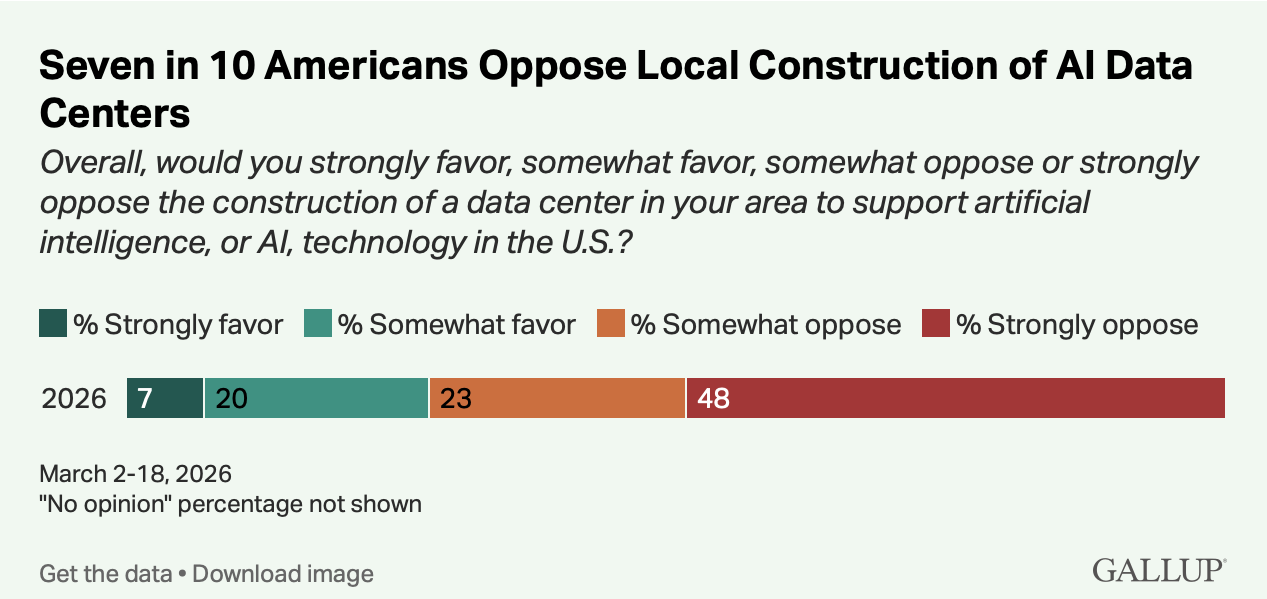
There are multiple externalities associated with large data centers. The breadth of these concerns has produced some strange bedfellows. Sen. Bernie Sanders (I-VT) and Gov. Ron DeSantis are allies in the fight against uncontrolled data center growth. Sen. Sanders has introduced a bill, along with Rep. Alexandria Ocasio-Cortez (D-NY), to impose a national moratorium on data center permitting. Gov. DeSantis signed a bill protecting Florida consumers from shouldering the burden of increased electrical bills associated with hyperscale data centers.
One externality that deserves attention is their reliance on fossil fuels as the foundation of their energy generation. In Louisiana, there are plans for three natural gas plants that would be “among the largest in this hemisphere” when complete. The client? Meta.
The International Energy Agency estimates that “data-center emissions could more than double by 2030—becoming one of the fastest-growing sources of greenhouse gases in the world.”
It’s not just the scale of the data centers that has escalated. It’s the number of applications. And the opposition. “Data center opponents have blocked or delayed projects worth nearly $130 billion in 2026,” according to NBC News. That represents 75 projects blocked in the first quarter; that’s as many as were blocked in calendar 2025. Most have not generated national news reports.
Rural America is the new frontier for data center development. According to the Pew Research Center, “87% of existing data centers are in urban areas, but 67% of planned data centers are in rural ones.”
What we are seeing appears to be more than a flash in the pan of opposition.
There are opposition groups in 49 states, twice as many as last year. One message could be: don’t try to build this behind our backs, given the historic lack of transparency.
Turning back to Utah as an example of persistence, residents in rural Box Elder County are appealing a ruling that they cannot put a resolution on the November ballot opposing the Stratos Project.
Then there’s Gov. Abbott of Texas this month:
“Any AI data [center] even thinking about coming here, they got to bring their own money, bring their own power, reuse their own water, and do it in a way that reduces the cost of electricity for residents across our state,” Abbott said. “We must prohibit them from building AI data centers in rural Texas neighborhoods, and we must eliminate the tax break they are getting.”
An opposition movement that began in zoning board meetings and online petitions has become something more durable: a bipartisan political force reshaping elections, state budgets and the AI regulatory landscape. The federal government is all in, just like Silicon Valley. The rest of the country is not and has drawn a line to protect everyone’s backyards.
There’s one more salient question that seems ignored by media, D.C. and Silicon Valley. What if the computational infrastructure is almost obsolete?
For example, in 2026 alone, companies have committed $650 billion to classical AI computing; that is, data centers built on the same computational architecture that has dominated since the 1950s. Meanwhile, peer-reviewed research published in Science suggests classical computing architecture may face fundamental limits. IBM, which quietly announced a $10 billion quantum computing investment in June, has said as much itself.
The critical, yet unasked, question is whether the data centers being rushed through zoning boards today will become stranded assets before they are paid off. Citizens fighting for their water supply, their electric bills and their rural landscapes may be winning battles over infrastructure that the tech industry itself may abandon all too soon.
And if history is any guide, communities left holding abandoned infrastructure will bear the cost of cleanup long after the industry has moved on.
*What is a data center? It is a large facility that uses a lot of computer servers to store, process and distribute digital information. Data centers support most of modern life in the U.S.: cloud computing (Google Drive and Microsoft Office); streaming (Netflix and YouTube); AI (ChatGPT and Claude); social media (Facebook and Bluesky); ecommerce (Amazon and eBay); as well as using your smartphone (texts), online banking (transfer funds), health care services (e-check-in) and your favorite e-greeting card service (Blue Mountain and Hallmark).
This first appeared at Substack.

Known for gnawing at complex questions like a terrier with a bone. Digital evangelist, writer, teacher. Transplanted Southerner; teach newbies to ride motorcycles. @kegill (Twitter and Mastodon.social); wiredpen.com