









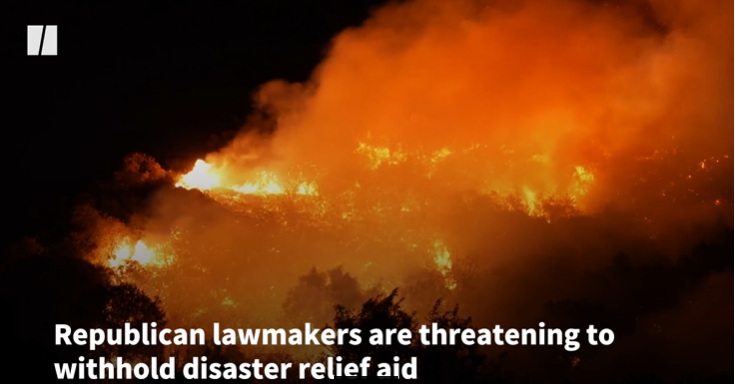
Screenshot: The Huffington Post
UPDATE:
On Monday, after threatening to slap tariffs on Canada because of the country’s (mis)handling of the wildfires, Trump imposed an additional 50 percent tariff on certain Canadian goods (ranging from “wine to hockey sticks to cement,”) in response to alleged “discriminatory” trade measures by Canada. Apparently, the new tariffs are unrelated to the fires, albeit “Trump has been given options on the wildfire tariffs.” (The Hill)
Original Post:
Whenever a major natural disaster strikes the Unites States, our neighbor to the North responds generously, swiftly and effectively — no questions asked, no conditions set, no disagreements recalled, no recriminations voiced, no threats made.
Whether responding to major wildfires, hurricanes or floods, Canada has immediately and consistently deployed emergency responders, medical teams and military personnel across the border, in addition to specialized aircraft, vessels and equipment.
Just some recent examples:
• During the devastating 2000 wildfire season when nearly seven million acres of land and forests burned from Texas to Montana, more than 1,300 Canadian personnel were dispatched to the U.S. to help fight fires.
• Again, during the 2020 California wildfires, hundreds of Canadian firefighters deployed to California to assist in fighting them.
• Most recently, in January 2025, Canadian firefighters once again worked shoulder to shoulder with their American counterparts to fight and suppress the devastating wildfires in the Los Angeles and San Diego areas. Air tankers from Quebec and crews from Alberta and British Columbia assisted in the fight.
More significant, more consequential, is how Canada, almost instinctively, came to help the United States after the 9/11 terror attacks.
In addition to numerous humanitarian, diplomatic, security and short-term military actions, our neighbor became one of our staunchest allies and supporters during the 12-year war in Afghanistan — a war that became Canada’s longest war and where more than 40,000 Canadian Armed Forces members served, 158 of them never to return home.
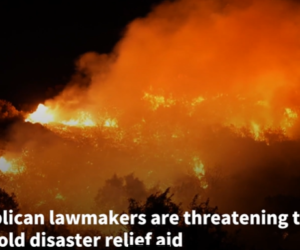
Today, as hundreds of wildfires are raging across Canada –- nearly 200 of them blazing across the province of Ontario alone -– heavy smoke from the fires is drifting across the north-eastern U.S. affecting air quality, causing discomfort and posing potential health hazards.
As it always has, the United States is helping our neighbor in this time of crisis. However, such help is not being rendered without an unhealthy dose of recrimination, assigning blame and plain pettiness.
In a Truth Social post on Friday, , President Trump accused Canada of “willful Negligence” because, allegedly, they are not properly maintaining their forests.
Readers will remember how Trump, while surveying the devastating 2018 Palisades, California, wildfires, citing a conversation with his Finnish counterpart, suggested that the U.S. could prevent catastrophic forest fires by “raking and cleaning” the forest floors.
While judicious forest management – not just “raking forest floors” – and land use are important, a large number of scientific studies have shown that climate change is driving an increase in the frequency and severity of the type of weather likely to lead to fires; that there is “an ‘unequivocal and pervasive’ role for global heating in boosting the conditions for fire.”
It is well-known how dismissive the Trump administration is over man-made climate change, a reality Trump referred to as a “con job” in a 2025 speech to the United Nations.
Prime Minister Mark Carney of Canada did not immediately address the accusations on Friday, but he suggested that the United States should do more to combat climate change.
Adding (potential) injury to insult, Trump continued on Truth Social that such willful negligence is “becoming a yearly occurrence, costing the United States Billions of Dollars, which cost of this pollution must of necessity be added to the TARIFFS Canada is currently paying.”
It is not clear that he has the legal authority to impose such a “TARIFF.”
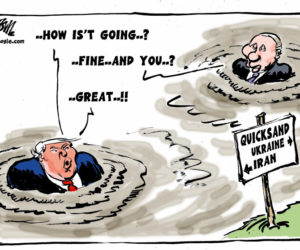
It is common knowledge that Trump has a combative (retributory) relationship with our neighbor to the north, colored by his political, ideological and personal grievances and ambitions, including his oft-repeated, deranged wish to make Canada our 51st state. The Huffington Post describes it as his “personal obsession with alienating Canada, a fellow member of NATO and one of the country’s most steadfast allies for decades before Trump’s second term.”
We should not be surprised at Trump’s reaction to Canada in that nation’s time of need. We have all-too-often seen how his political grievances and differences, partisanship, and personal grudges have negatively affected disaster policies and relief efforts towards our own blue states.
The Washington State and California wildfires, Hurricane Maria in Puerto Rico, among other examples. should ring a bell.
Equally ignominious has been the rush by MAGA Republicans to pile on with baseless accusations, harangues, and unbecoming threats.
Although shocked and offended, Canada’s government officials have largely stayed above the fray with perhaps the strongest response coming from Ontario’s Premier Doug Ford. He called Trump’s tariff threats “absolutely unacceptable,” and asked American lawmakers to “send support” rather than complain, poignantly referring to these politicians as having “a very short, short memory.”
Others have been more direct.
Replying to Senator Bernie Moreno’s (R-Ohio) pledge to introduce a bill to sanction Canadian officials found “responsible” for the fires, Tim Gray, executive director of Environmental Defence Canada, a leading Canadian environmental advocacy organization, said:
The false rhetoric about the cause of wildfires is not constructive. It helps to further underscore the sense Canadians have that the U.S. has lost its way…When California was burning last year, we didn’t try to pass laws falsely blaming the U.S. for fires. We sent water bombers, airplanes that drop water on fires, and teams that helped to put out the fires.
The cloud of acrid smoke is now beginning to clear over the U.S., but a darker, more toxic cloud continues to shroud the relations of two peoples with so much in common, of two nations traditionally joined at the hip.
