
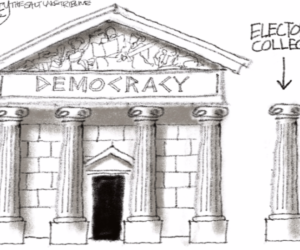










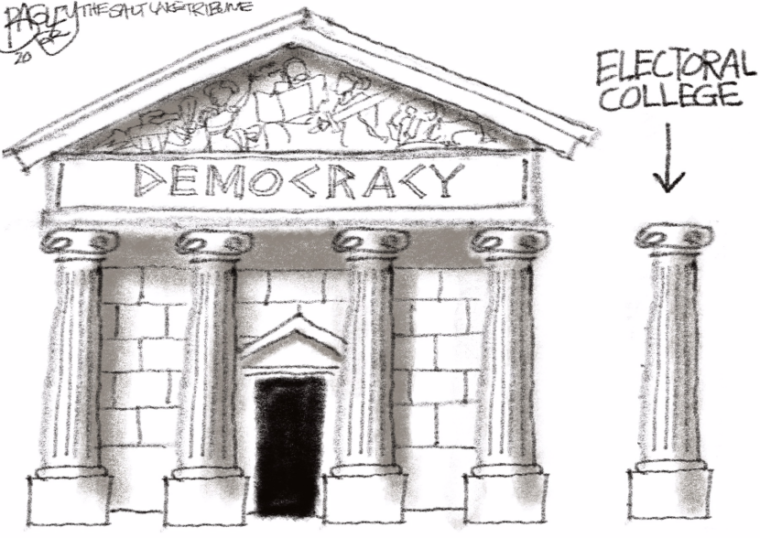
The Electoral College, a remnant of the slave-holding powdered-wig era, has long been denounced in the polls by a landslide majority of Americans.
In 1961, Tennessee Senator Estes Kefauver called it “a loaded pistol pointed at our system of government.” In 1967, the American Bar Association called it “archaic, undemocratic, complex, ambiguous, indirect, and dangerous.” In 1968, presidential scholar James MacGregor Burns called it “a game of Russian roulette, and one of these days we are going to blow our brains out.”
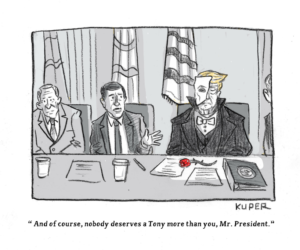
Burns got that right. Four times we’ve hired presidents who lost the popular vote, none more disgracefully than in 2016, when a demagogic fascist who came up short by nearly three million votes took possession of the Oval Office and launched his mission to subordinate us to the murderous dictator in Russia. Last week he was asked, “Do you believe Putin is a friend to America?” Benedict Donald blew our brains out with this response: “I can’t speak to America.”
In a just world, the abiding rule would be so simple: The candidate with the most votes wins.
Nationwide, everyone’s vote would be equal to everyone else’s. If you were a blue citizen of red Alabama, your vote would actually count for something. If you were a red citizen of blue California, your vote would actually count for something. A national popular vote system would be true democracy. The Electoral College flunks it.
And now, thanks to the stunning blue tsunami, there may be a way to work around that hoary old relic.
If you haven’t heard of the National Popular Vote Interstate Compact, bear with me. The idea, which has been kicking around for 20 years, is that states would pledge to give all their electoral votes to the candidate who wins the national popular vote. Before the midterms, states that totaled 222 electoral votes had already signed on. But next year, with Democrats controlling the governorships and legislatures in Pennsylvania, Arizona, Michigan, Nevada, and Wisconsin, the Compact could tally 283 electoral votes (assuming all five sign on). That would be more than enough to ratify the national popular vote winner.
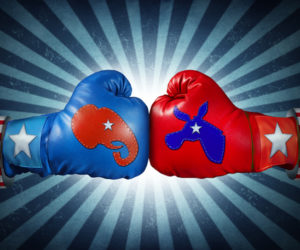
In this century Republicans have twice scored presidencies for popular vote losers (George W. Bush was the other one; he took the opportunity to launch a war in Iraq based on lies), so of course Republicans love the Electoral College. And rest assured if the Compact became a real thing, they’d gum up the works by peppering the courts with lawsuits.
In the meantime, we’re tethered to the Electoral College, mindlessly violating the fundamental principle that each citizen’s vote should be equal, seemingly fated to be hostages to the distant past. The original deal was cut partly to mollify southerners who feared domination by the more populous North and thus sought to protect slavery. That was a big reason why sparsely populated rural states got the same number of senators as the more populated metropolitan states – and why, today, a disproportionate share of the 538 electoral votes go to states that would have less clout in a true democracy.
Wyoming, with 590,000 people, has three electoral votes (two senators and one House member), while Pennsylvania, with 13 million people, has 19 electoral votes (two senators and 17 House members). Do the math. In Wyoming that’s 196,000 people for each elector, while in Pennsylvania that’s 684,000 people for each elector.
Some of the new blue-run states could balk at joining, if only because the prospects for 2028 look brighter in the wake of the MAGA’s midterm decimation. There are also the legal and constitutional issues, which are predictably maddening. The Compact, if ultimately forged by states with a majority of Electoral College votes, is a lawsuit waiting to happen. Correction, lawsuits. A lawyers’ feeding frenzy.
Because, on the one hand, the U.S. Constitution says states can award their electoral votes however they want: “Each State shall appoint, in such a Manner as the Legislature thereof may direct, a Number of Electors.” So score that one for the EC’s enemies!
On the other hand, the same Constitution says elsewhere that “No State shall, without the Consent of Congress…enter into any Agreement or Compact with another State.” So maybe an electoral deal would first require the OK of Congress. The word Compact is right there in the founding document. So score that one for the Electoral College’s defenders!
In truth, the provision I quoted in the previous paragraph only refers to states that cut their own deals in order to wage war…OK, now I’m peering down the rabbit hole and risking nerd overload. Let’s leave that to the lawyers.
At minimum, it’s a welcome development the Electoral College is up for vociferous debate as never before. The popular vote loser has been elected five times; try to name another western nation with such a preposterous track record. It brings to mind a tweet that was posted in 2012, declaring that the Electoral College is “a disaster for democracy.”
So wrote a private citizen named Donald Trump.
Finally we agree on something.
Copyright 2026 Dick Polman, distributed exclusively by Cagle Cartoons newspaper syndicate. Dick Polman, a veteran national political columnist based in Philadelphia and a Writer in Residence at the University of Pennsylvania, writes the Subject to Change newsletter. Email him at [email protected]