
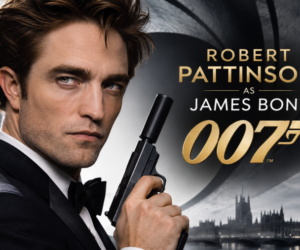











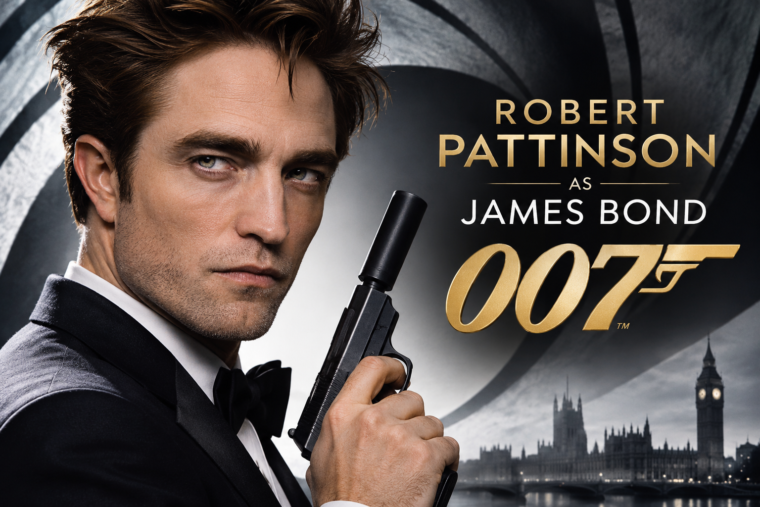
The name is Pattinson. Robert Pattinson.
And, at 40, the newly announced James Bond may be exactly what the world’s most famous fictional secret agent needs: a fresh face capable of bringing 007 into a new era without abandoning the qualities that made him a cinematic legend.
Pattinson, best known to some audiences for Twilight and The Batman, has reportedly negotiated a three-film deal. Whether he’ll make more remains uncertain. But why not? If he’s still convincing at 50 there’s no reason Bond should be forced into retirement.
What’s particularly intriguing is Pattinson’s appearance. He bears a striking resemblance to the lean, dark-haired Bond envisioned by creator Ian Fleming, who commissioned an illustration of his character for a newspaper comic-strip adaptation. Fleming’s Bond wasn’t necessarily the muscular action hero audiences eventually came to know.
And perhaps that’s the point. Every successful Bond has reflected something about his era.
Sean Connery established the gold standard: dangerous magnetic, sophisticated and occasionally ruthless. His Bond could deliver a devastating punch, straighten his tuxedo and order a martini without missing a beat.
George Lanzeby, the Australian model who succeeded Connery in On Her Majesty’s Secret Service (1969), remains one of Hollywood’s what-ifs. His manager reportedly convinced him that Bond was becoming outdated in the era of hippies and changing attitudes. Lanzby walked away after one movie. Ironically, his performance, originally given a thumbs down, has gained considerable respect over the decades, particularly for his emotional vulnerability. His final scenes were haunting. Now in his 80s, he was recently on Facebook welcoming Pattinson to an exclusive club and wishing him well.
Roger Moore took Bond in another direction. His seven films emphasized sophistication, raised eyebrows, elaborate gadgets and humor. Moore’s Bond seemed almost amused by the dangers surrounding him. He could save the world without taking himself terribly seriously.
Timothy Dalton, who followed Moore, tried to return Bond to Fleming’s darker literary roots. His two films, The Living Daylights and License to Kill, presented a more intense, less playful agent. Legal disputes delayed the next installment for years, and Dalton eventually stepped aside. His interpretation, once considered too grim by some, now looks remarkably ahead of its time.
Pierce Bronson almost became Bond in 1986, until NBC unexpectedly revived his canceled television series, The Remington Files. His contractual obligations cost him the role. When he finally took over in Golden Eye in 1995, he brought back some of Connery’s toughness and Moore’s elegance. His four films helped restore Bond’s box-office appeal.
Then came Daniel Craig, whose five-film run transformed Bond into a bruised, emotionally complicated and often brutally violent character. Craig’s Bond bled, suffered, loved and ultimate4ly died in No Time to Die. He gave the franchise psychological depth, but much of the old-fashioned escapist fun disappeared.
Which brings us to Pattinson.
He seems capable of combining Fleming’s mysterious, calculating secret agent with a more contemporary sensibility. He can project intelligence, vulnerability and menace without relying entirely on physical intimidation. And his performances suggest he possesses an understated humor that could restore some of Bond’s missing charm.
There’s another enormous change. For decades, the Broccoli family carefully guarded the franchise. Now Amazon MGM Studios has creative control, with director Denis Villenueve preparing the next film.
That raises an important question: Will Amazon preserve Bond’s distinctive personality, or turn him into another endlessly expandable corporate enterprise?
Pattinson’s casting offers good reason for optimism. He isn’t simply another handsome actor being handed a tuxedo and a license to kill. He’s demonstrated an ability to reinvent himself, something bond himself has repeatedly needed to survive.
At 40, Pattinson is hardly an aging secret agent. Roger Moore was 34 when he made his Bond debut.
Three films could establish Pattinson as a memorable 007. More could make him one of the greats.
The real challenge isn’t whether Pattinson can become James Bond.
It’s whether James Bond can become Robert Pattinson’s Bond.
My bet is that he can.

Joe Gandelman is a former fulltime journalist who freelanced in India, Spain, Bangladesh and Cypress writing for publications such as the Christian Science Monitor and Newsweek. He also did radio reports from Madrid for NPR’s All Things Considered. He has worked on two U.S. newspapers and quit the news biz in 1990 to go into entertainment. He also has written for The Week and several online publications, writes a column for Cagle Cartoons Syndicate and has appeared on CNN.