
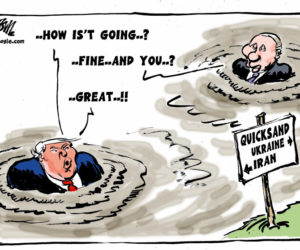





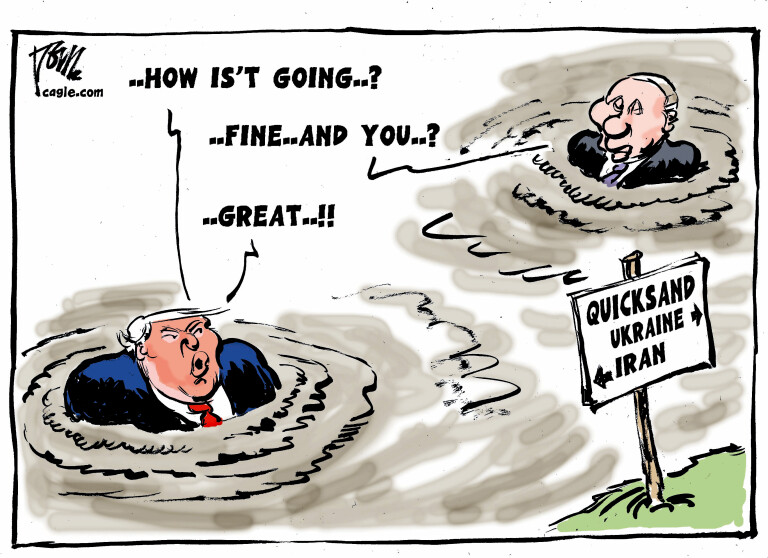
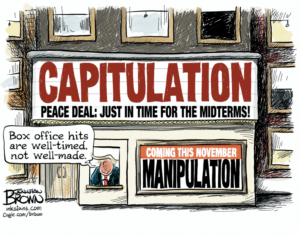
 Trump said it would never happen. The war with Iran would be short and over quickly. But it stops and starts, is over and begins again. No matter how much the U.S. bombs, Iran still controls the Strait of Hormuz with drones. And that means the price of oil and gasoline remains high.
Of course, America could destroy Iran’s oil industry, factories, desalinization plants, and entire economy. But Iran could still dominate the Strait of Hormuz and 20 percent of the world’s oil supply. It seems strange that President Trump and our top military brass appeared unaware of Iran’s ability to prevent ships from passage in the Strait of Hormuz. But we had made no plans to counter Iran’s control of the Strait. And our negotiations with Iran to end the war are stymied by the future of the Strait, Iran’s nuclear materials and support for its proxy forces.
Discussions with Iran about a permanent end to the war seem to go on and on with a Memorandum of Understanding that means nothing. As of early June, no solution had been devised to end the conflict, with intermittent attacks by both sides. It appeared as if a stalemate had occurred, with both sides claiming victory. Iran’s Revolutionary guards needed the U.S. as an enemy, giving them a reason for being. Trump kept saying that the conflict would end soon with a peace treaty signed, but nothing happened. After a U.S. helicopter was shot down by Iran in mid-June, Trump resumed the bombing, threatening more barrages. Then he suddenly called them off again claiming a deal was imminent. The world waited, wondering if Trump’s words meant anything. No matter what happened, Iran would be able to control the Strait. Was it possible the war would end in a tie, or even a victory for Iran? We should keep in mind that Trump had originally asked for unconditional surrender from Iran, giving up its nuclear material, opening the Strait, regime change, and to stop building long-range missiles. Based on those terms, Trump achieved nothing from the conflict.
Some analysts believed Iran had actually won the war because of their newfound control of the Strait. At some point, it was likely that Iran would charge tolls for passage through the Strait. and resolve all the other outstanding issues. But it was possible that Iran might demand too much, particularly in terms of their nuclear development and funding to rebuild all that had been destroyed. While the Gulf nations might pay Iran most of the necessary funds, the nuclear issue still had to be resolved.
The MoU and ceasefire between Iran and the U.S. was made public on June 19, 2026. Analysts reviewing the documents agreed for the most part that Iran had won, with Trump giving away the store. For simply agreeing to start negotiations on its nuclear program and temporarily opening the Strait without tolls, Trump ended the blockade on Iran’s ports, stopped the bombing, allowed Iran to trade its oil, worked towards dropping all sanctions, and committed to helping Iran acquire $300 billion to rebuild. Trump must have forgotten his art of the deal. An article by Hussein Banai in June 2026 Foreign Affairs noted that the cease-fire with Iran was a stalemate. And he believed this was the best that America would be able to do.
It’s clear that Trump has failed to achieve the goals he put forward for this war of choice. The reality is that the war will end with the regime in Teheran intact and in the grip of the Islamic Revolutionary Guard Corps: the Strait of Hormuz will remain under threat of Iranian attacks; Iran will continue to possess significant drone and missile stocks; the regime will maintain the capability to be a state sponsor of terror; many sanctions will be lifted and billions of dollars in unfrozen assets will flow to Iran. In other words, the Iranians have achieved their key strategic aims- regime survival above all- while the Americans have achieved none of theirs. The war leaves Iran battered, but more powerful and with more cash at its disposal, while it leaves America weaker.
Trump’s handling of the war along with his chosen advisors points out the incompetence of the top layers of our government. There were no strategic plans to handle various contingencies, and Trump was not smart enough to deal with matters on the fly. Trump has been anxious for a settlement, knowing that the American people had been overwhelmingly against the war, and Iran is aware of that. An analyst noted that once Iran had shown its ability to control the Strait and Trump’s unwillingness to use American ground troops to dislodge them, the war was over with Iran winning. Trump would follow with further concessions to Iran, the only question being the timing and the sweetener for Trump that Iran would have to add. But however it was presented to the American public, Iran had won the war with the revolutionary regime remaining in place and Trump conceding money to Iran even before the negotiations started. The final deal will harm America’s interests for decades. It may be our worse strategic defeat ever.
The MOU did not stop Iran from targeting ships in the Strait again and America restarted its bombing campaign in mid-July, blockading Iran’s ports as well. The hot war was on again. With the war having resumed, intelligence officials predicted that the Pentagon’s funding for the Iran conflict would surpass $100 billion. www.robertlevinebooks.com

Political junkie, Vietnam vet, neurologist- three books on aging and dementia. Book on health care reform in 2009- Shock Therapy for the American Health Care System. Book on the need for a centrist third party- Resurrecting Democracy- A Citizen’s Call for a Centrist Third Party published in 2011. Aging Wisely, published in August 2014 by Rowman and Littlefield. Latest book- The Uninformed Voter published May 2020