










It is not widely known that several countries officially use the U.S. dollar as their national currency.
One of those countries is Ecuador.
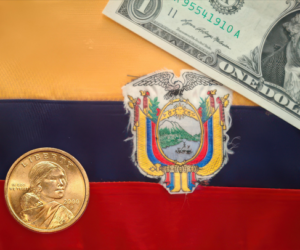
Experiencing rampant inflation/devaluation and a massive economic and fiscal crisis, Ecuador officially adopted the U.S. dollar as its legal tender in January 2000.
When the “dollarization” was announced, the official fixed conversion rate was 25,000 sucres per US dollar (USD). An exchange rate that had steadily climbed — sometimes not-so-steadily –- from 2 sucres per USD in 1898, to 13 sucres per USD when I was a young boy living in Ecuador in the late 40s, to nearly 12,000 sucres per USD on the eve of dollarization.
Generally, dollarization has significantly benefitted Ecuador’s fiscal situation and its economy.
Some of the key benefits have been the end of hyperinflation; lower interest rates; a modest growth in GDP per capita;; greater monetary, economic, and financial stability; a significant increase in the minimum wage, especially “a remarkable and sustained reduction in poverty.”
On the 25th anniversary of Ecuador’s dollarization, in an interview with the Ecuadorian newspaper El Espreso, currency expert Steve Hanke tells the newspaper, “Overall, Ecuador’s dollarization has worked very well. It is the longest-lived currency regime in Ecuador’s history. It has produced the longest period of economic stability in Ecuador’s history. “
A year later, Gabriela Calderon de Burgos writes at El Universo:
Since adopting the dollar on January 9, 2000, the country has enjoyed the longest period of monetary stability in its republican history. Ecuador’s dollarization is a success story little known outside the country and little appreciated within it: economic stability coexisting with high political volatility.
There have been some drawbacks. Among them:
The loss of “seigniorage.” Essentially the loss of the profit Ecuador or its central bank would make from printing money or minting coins — from “creating money.”
Related to this is a certain loss of (financial) sovereignty, “effectively relinquishing control of its monetary policy to the U.S. Federal Reserve,” as Sonia A. Carpio Vinueza writes in “Impact of Dollarization in Ecuador’s Economic Performance.”
There is also the “cost of cash”: Buying and importing physical U.S. bank notes and minting its own centavo coin. More on coins later.
Perhaps the greatest drawback, in this author’s opinion, is what could be described as an unforeseen, certainly unintended — yet very serious – consequence: The dramatic increase in drug cartels, drug trafficking, and associated crime and violence in a country that traditionally was one of the safest and most peaceful in the Southern Hemisphere.
Ecuador does not produce cocaine. However, located between two of the world’s top cocaine producers, Colombia and Peru, dollarization has been a factor in turning Ecuador into “an international hub in the global drug trade.”
Existing ports and facilities for the export of petroleum, bananas, shrimp, etc. are now also used as “export platforms” by transnational drug cartels.
Without exchange barriers, dollarization has facilitated the flow of funds between drug producers, exporters and consumers and improved the liquidity of funds making it extremely easy to launder illicit assets.
However, the United States is vigorously helping Ecuador in its fight against drug cartels through joint military operations, intelligence sharing, and advisory support.
Now, finally, to the Sacagawea Dollar
While El Banco Central de Ecuador (the Central Bank of Ecuador) physically imported billions of U.S. Federal Reserve dollar bank notes directly from the U.S. during the dollarization process, it was a different story with coins.
Because it would have been prohibitively expensive to fly tons of U.S. coins from the United States, Ecuador decided to mint its own coins, except for the dollar coin.
The Ecuadorean coins are minted in the same denominations as U.S. coins and are called centavos (de dólar) de Ecuador. However, they only have value inside Ecuador. U.S. coins circulate freely and abundantly alongside the centavo coins.
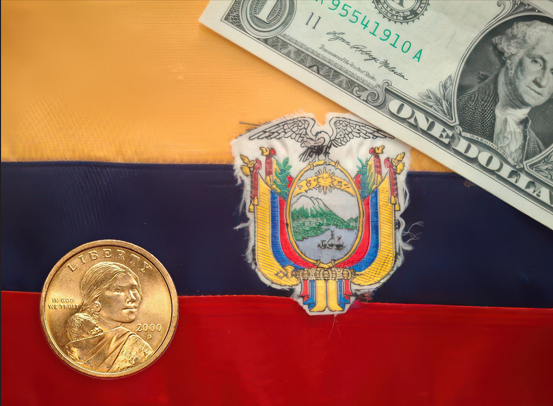
Ecuador stuck with the U.S. dollar coin: the Presidential dollar coins and the Sacagawea dollar coin.
Approximately 150 million of these coins -– most of them Sacagawea dollars — were shipped to Ecuador between 2002 and 2017. The Sacagawea dollar began to be minted in the U.S. in 2000, became extremely popular in Ecuador, and continues to be used in cash transactions.
The Sacagawea dollar – minted until 2008 – is a golden color coin featuring Sacagawea carrying her infant son on the front, and a soaring eagle on the back.
Sacagawea* was a member of the Native American Lemhi Shoshone tribe. As a guide and interpreter, she played an important role in the 18th century Lewis and Clark expedition. Her image resembles that of an Ecuadorean Indian woman, perhaps one reason for the coin’s popularity in Ecuador.
An excellent March 2017 Miami Herald article by Jim Wyss, “Where did all the Sacagawea dollar coins go? In Ecuador…” explains the popularity of the Sacagawea dollar in Ecuador.
==
* To learn more about Sacagawea, please click here.
