







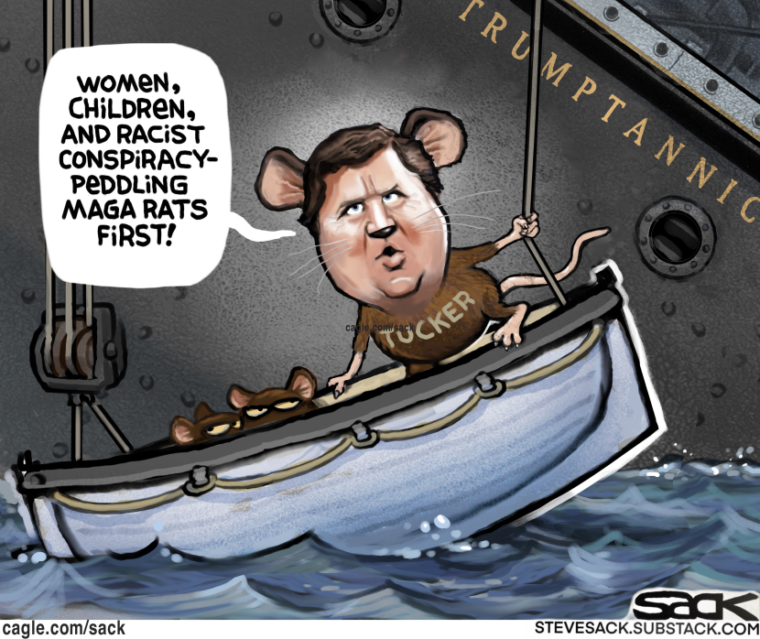
Is Tucker Carlson a threat to Donald Trump and the Republican Party?
The answer may surprise both Carlson’s supporters and Trump’s defenders.
The real question isn’t whether Tucker Carlson can build a successful third party or become president. He probably can’t. Third parties have a miserable track record in American politics, and Carlson has shown little interest in the nuts and bolts of organizing one.
But he doesn’t have to win to become a serious problem for Donald Trump and Republicans.
Carlson has become one of Trump’s most relentless conservative critics. Day after day, he posts videos speaking directly to millions of viewers, arguing that the Trump administration has betrayed the America First movement. Much of his criticism centers on foreign policy, particularly Israel and America’s role overseas, but it has broadened into a wider indictment of Trump’s leadership.
Then came one of the most unexpected moments in recent political media: Carlson sat down for a lengthy interview with Hunter Biden. The interview wasn’t an endorsement of Biden. It was something perhaps more significant. Carlson demonstrated a willingness to step outside the traditional Republican-versus-Democrat script in search of common ground.
Whether one agrees with Carlson or not, it signaled he’s trying to build something different from simply being another conservative commentator.
The Trump camp reportedly views Carlson as something of a political fly – more of an annoyance than a genuine threat. That may prove to be true.
Or it may prove to be a dangerous miscalculation.
Carlson isn’t trying to persuade Democrats or even political moderates. Most of those voters are unlikely to follow him. His audience is overwhelmingly conservative, populist and high skeptical of the Republican establishment.
In other words, he is fishing in Trump’s pond. That’s what makes this different.
Suppose Carlson convinces only a small percentage of loyal Republican voters that Trump and today’s GOP have abandoned the principles they once claimed to represent. Those voters don’t have to switch parties. They don’t even have to vote Democratic.
They can simply stay home. Or vote for a third-party candidate. Or leave the top of the ballot blank. In a closely divided nation, that can be enough.
American elections are often decided by razor-thin margins in a handful of states and congressional districts. A movement that peels away just two or three percent of reliable Republican voters could determine control of Congress — or even the White House.
History offers a reminder.
Ross Perot never came close to becoming president in 1992, yet his independent campaign reshaped the election. Political scientists still debate exactly how much he affected George H. W. Bush’s defeat, but almost no one disputes that a well-known outsider can dramatically alter the electoral landscape without winning.
Carlson may be attempting something similar on the right.
Can he succeed? Having a massive online audience isn’t the same as building a political organization. Donald Trump (a.k.a “Teflon Don”) has repeatedly demonstrated an extraordinary hold over Republican voters, surviving controversies that would have ended almost any other political career.
Carlson could discover criticizing Trump is far easier than persuading Trump’s supporters to abandon him.
But dismissing Carlson because he is unlikely to become president misses the point.
The greatest danger he poses is not leading a victorious third party. It is encouraging enough disillusioned MAGA voters to conclude that neither Trump nor the Republican Party deserves their support.
That’s a much lower bar.
And if Tucker Carlson clears it, he won’t have to win a single election to help Republicans lose one.
The Trump team may be right that Tucker Carlson will never become president. They could be wrong if they think that’s the only way he can hurt them.
In American politics, sometimes the most dangerous opponent isn’t the one who wins. It’s the one who convinces just enough of your own supporters to walk away.
Copyright 2026 Joe Gandelman, distributed exclusively by Cagle Cartoons newspaper syndicate.

Joe Gandelman is a former fulltime journalist who freelanced in India, Spain, Bangladesh and Cypress writing for publications such as the Christian Science Monitor and Newsweek. He also did radio reports from Madrid for NPR’s All Things Considered. He has worked on two U.S. newspapers and quit the news biz in 1990 to go into entertainment. He also has written for The Week and several online publications, writes a column for Cagle Cartoons Syndicate and has appeared on CNN.