








The Iran War may be doing more damage to U.S. dollar dominance than to Iran itself. And that helps explain Trump’s Saudi deference.
Once upon a time, Henry Kissinger and Saudi Prince Fahd bin Abdulaziz Al Saud signed a secret agreement that “promised military aid and equipment in exchange for the Kingdom investing billions of dollars of its oil-sale proceeds in U.S. Treasurys,” according to Paul Donovan, chief economist at UBS Global Wealth Management.
That time was 1974, on the heels of the 1973 OPEC oil embargo and the 1971 demise of the gold standard. Saudi Arabia was flooded with dollars; the U.S. wanted to prevent another embargo. Both countries had a reason to increase their mutual alignment. And the dollar had been the de facto global reserve currency since the end of World War II.
As oil-producing countries nationalized their reserves, western oil companies lost major ground. In 1970, they owned 85 percent of global oil reserves. By 1980, it was only 12 percent.
Eventually, the Kingdom began accepting only dollars for its oil, and soon the dollar was the dominant currency in the global oil trade. There was a bit of U.S. “cajoling” involved, of course. Today, 80 percent of global oil is traded in dollars, which helped solidify the dollar as the world’s reserve currency.
What does it mean to be a global reserve currency?
A global reserve currency is one that is “held in large quantities by a government or institution, in order to conduct international trade, investments or other interactions on the global market.” It becomes the currency used to value items or service for trade.
In the case of the dollar, it began with the Bretton Woods Agreement of 1944. Instead of linking to gold, world currencies (at least 44 of them) would be pegged to the dollar which could then be traded for gold. But in 1971, the gold standard went kaput and the global trading system changed to one of trust. The U.S. has the world’s largest economy and has been historically considered the most stable government in the world, which leads to trust. That stability is cracking, and there is competition in that first title, as well.
In wonky terms, it means the U.S. should get more favorable interest rates when it borrows money (think $40 trillion in debt). Theoretically, U.S. sanctions against Russia and Iran put pressure on other nations to avoid trade with them. However, U.S. sanctions can also increase tensions between nations, which lowers the desire to conduct trade in dollars. Of course, we can quietly waive sanctions due to poor planning on our part.
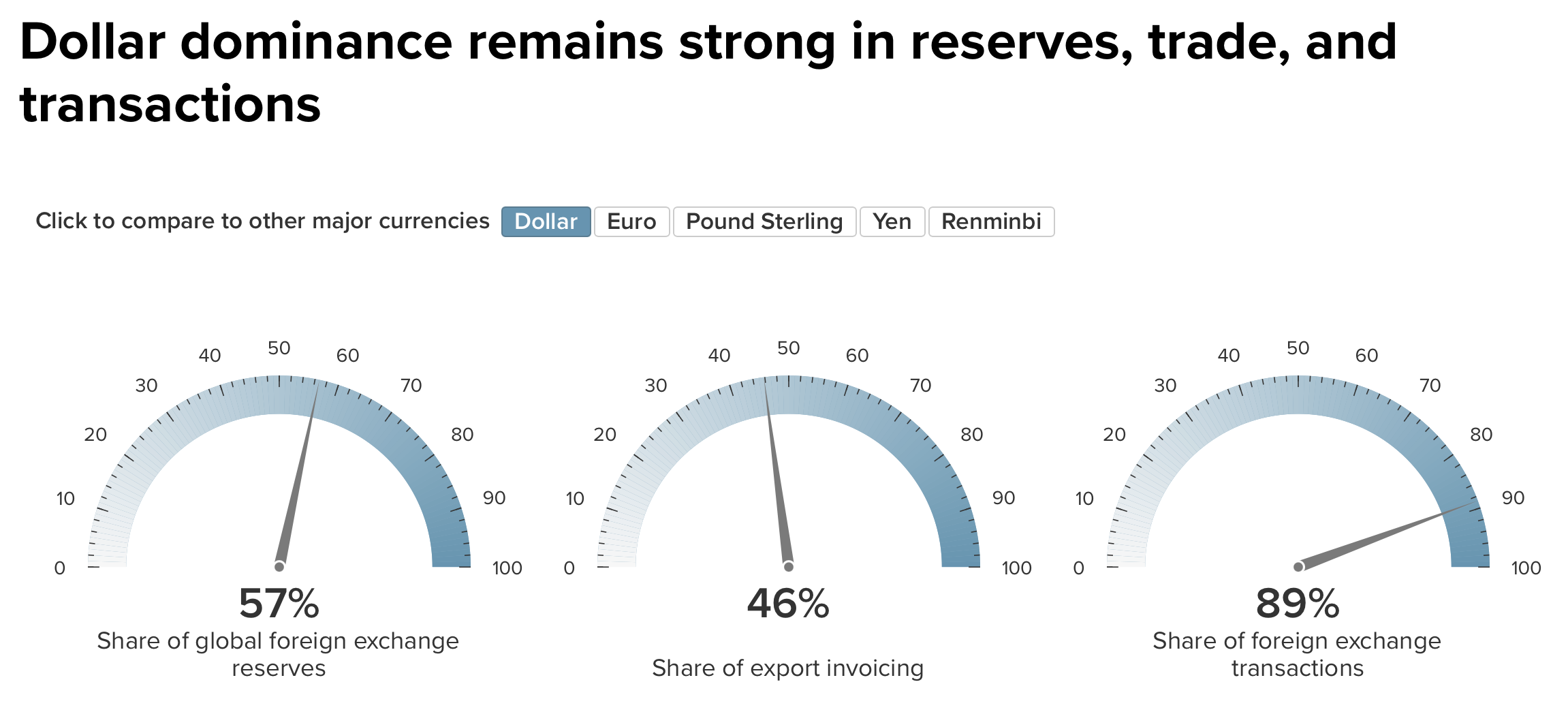
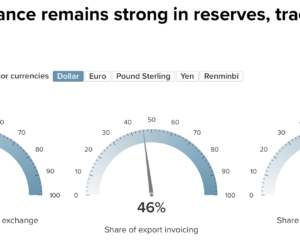
In the third quarter 2025, the dollar’s share of global foreign reserves was only 56.9 percent, down from a peak of 72 percent in 2001 and at its lowest level since 1995. That fall from its peak is known as de-dollarization, a decrease in the use of the dollar for global trade, finance and central bank reserves.
Currently the Euro is the distant second place reserve currency. Although countries like Russia, Iran and, to a lesser extent, Saudi Arabia are trading in the Chinese yuan, it remains in the back of the pack. For now.
Trump’s foreign policy hiccups: Iran
According to Fortune, Deutsche Bank analysts noted in March that petrodollars date to the 1970s with Saudi Arabia pricing oil in dollars and investing the surplus in U.S. assets. (The U.S. agreed to sell military weapons as well and provide on-site security, which included keeping the Strait of Hormuz open for shipping.) The note pointed out that trade through the Strait of Hormuz does more than power cars and trucks. It’s important for natural gas, fertilizer and “helium, which is critical to chipmaking.”
Trump’s gamble in his war of choice in Iran has not gone according to his plan, but arguably it has gone according to Iran’s. For all intents and purposes, the Strait of Hormuz remains closed to ship traffic. For example, on Aug. 23, one tanker and two dry bulk carriers made it through the Strait. On Aug. 8, 10 ships made it through, but only two were tankers. Before the U.S.-Israeli Iran War (launched on 28 February 2026 under the designation Operation Epic Fury), about 130 ships passed through each day.
A reminder that before the war, one quarter of the world’s seaborne oil passed through the Strait.
The Iran War has illustrated a weakness with the U.S. strategy of stationing forces around the world, including the Middle East. Just as Ukraine has shown its defiance against Russia’s invasion, Iran has taken the war to U.S. land targets through the Middle East.
According to Brookings, Iran has successfully attacked more than 200 targets in Bahrain, Iraq, Jordan, Kuwait, Qatar, Saudi Arabia and the United Arab Emirates. The U.S. underestimated the efficacy of Iran’s airborne defense.
Attacks on these sites had disruptive effects beyond the physical damage they caused, because they forced U.S. personnel to evacuate many additional locations that were deemed too vulnerable to further strikes.
This collection of Middle East bases crystalized after the 1979 Iranian Revolution and Soviet invasion of Afghanistan, according to Brookings. The value of disbursed regional assets proved itself in the 1991 Gulf War. Now, however, they are an Achilles heel, because they are “too close to Iran.” For Iran, they are legitimate targets because the U.S. uses that land and air space to launch attacks.
When 80 percent of the world’s oil is traded in dollars and the U.S. shoots itself in the foot regarding the 25 percent of the maritime petroleum supply that moves through the Strait of Hormuz, what does that do to the petrodollar? To the dollar as the global reserve currency of choice?
China has already traded places with the U.S. as Saudi Arabia’s largest oil customer. Although those transactions still rely on the dollar, analysts point out that the “door is open.” Ironically, the U.S. shift from importer in the 1970s to exporter in the 2020s means that higher global oil prices are now a benefit to, not a drag on, the dollar. However, increased prices hurt consumers at the pump (and increase inflation).
Russia, too, turned to China in light of U.S. sanctions early in the Obama Administration, a penalty for its annexation of Crimea. Iran strengthened its relationship with China after the U.S. reimposed sanctions during the first Trump Administration.
David Wight, a historian at the University of North Carolina at Greensboro, told Fortune, “I think that the increasing aggressiveness of the United States in multiple fields—both in terms of sanctions and in terms of warfare—has caused more countries to kind of wonder, ‘Do we want to be completely tied or dependent on the dollar if things go sour for whatever reason?’”
Trump’s foreign policy hiccups: tariffs
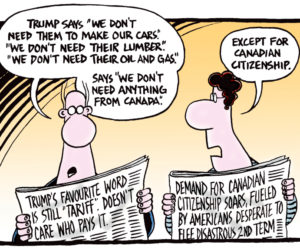
Although Wight does not specifically mention tariffs, he does acknowledge “aggressiveness.” And Trump’s tariffs are clearly aggressive, whether we are discussing the illegal tariffs from 2025 or the yet-to-be-censured-by-SCOTUS illegal tariffs in 2026 (hello, Canada).
The tariffs and war have one thing in common: both are discretionary decisions that Trump has made against the advice of most experts in the country, as well as the western world, such as economists and military specialists.
It’s clear from the bond market that Trump’s economic policies are having a negative effect. Treasury published this quarter’s buyback schedule at the beginning of August then two weeks later overrode it. Treasury Secretary Scott Bessent jumped in mid-month, an unprecedented intrusion, to buy back Treasury notes to shore up the dollar’s value. It had limited success.
Analysts at the Swiss private bank Julius Baer said that the buybacks have contributed to a weaker dollar, with investors turning “to gold and silver as potential stores of value.”
The Council on Foreign Relations argues that ending the Iran War and the Strait of Hormuz as a choke point to trade would reduce pressure on the bond market. Will economic conditions, such as inflation and employment, soften to the point where the Federal Reserve would consider lowering, not raising, interest rates? That’s not the International Monetary Fund forecast: they project increased global inflation and slower economic growth.
When our debt load rises, we have to issue more bonds, which means demand has to increase for them to hold their value. Will demand for the U.S. dollar continue to decline due to Trump’s actions, and if so, how deeply? How will that affect the cost of the rising interest bill on the national debt?
Let’s return to Saudi Arabia
There’s a lot of macroeconomics pressure going on, from interest rates and bond values to petrodollars and reserve currency. However, Trump is spending a lot of time and energy with the country that helped set up the petrodollar in the first place. Why? In part because the allyship between the two countries is strained due to Trump’s war of choice in Iran.
However, last year, the U.S. and Saudi Arabia signed a $142 billion arms deal, the largest such deal in history, according to Trump. More than a dozen U.S. firms will be supplying air and missile defense, weapons and equipment. It was part of a $600 billion investment that includes tech partnerships.
Notably, the U.S. exports about one-third of its arms to the Middle East. The U.S. is by far the world’s largest weapons dealer, handling 42 percent of the world’s major-arms exports from 2021–2025, according to the Stockholm International Peace Research Institute.
Recently, Trump has agreed to a 30-year nuclear deal that calls for the construction of AP1000 reactors in the Kingdom, a project that would benefit Westinghouse, jointly owned by Canada-based Cameco and Brookfield Asset Management. Congress has not weighed in; failure to do so means it goes into effect.
Note that both deals with the Saudis represent an ongoing infusion of a lot of dollars that have zero to do with petroleum. However, they keep Riyadh, and other Middle Eastern countries, inside the dollar system.
One final hedge
Trump recently announced a vague and questionable deal featuring Venezuelan oil reserves. The proposal seems to fly in the face of the Venezuelan constitution. Should it move forward, however, it would further enhance the U.S. position as an oil exporter. Whether oil prices go up or down, the effect would be dollars flowing into the U.S. (Never mind that we have no idea how many Venezuelan oil dollars have been flowing into the U.S. from existing arrangements nor where those dollars have landed.)
Would the Venezuelan deal be enough to offset the negative impacts of Trump’s protectionism (tariff wars) and sanctions (Russia, Iran), each of which leads to de-dollarization? And is it intended as a buffer in the oil world should Saudi Arabia loosen its ties to the dollar?
It’s a wonky question but one with long-term ramifications. Should de-dollarization continue, and the dollar find itself with real competition for the role of chief global reserve currency, that is a situation from which recovery is unlikely. After all, it used to be the pound.
This article first appeared on Substack.

Known for gnawing at complex questions like a terrier with a bone. Digital evangelist, writer, teacher. Transplanted Southerner; teach newbies to ride motorcycles. @kegill (Twitter and Mastodon.social); wiredpen.com