
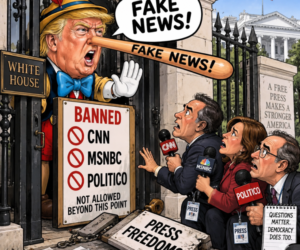






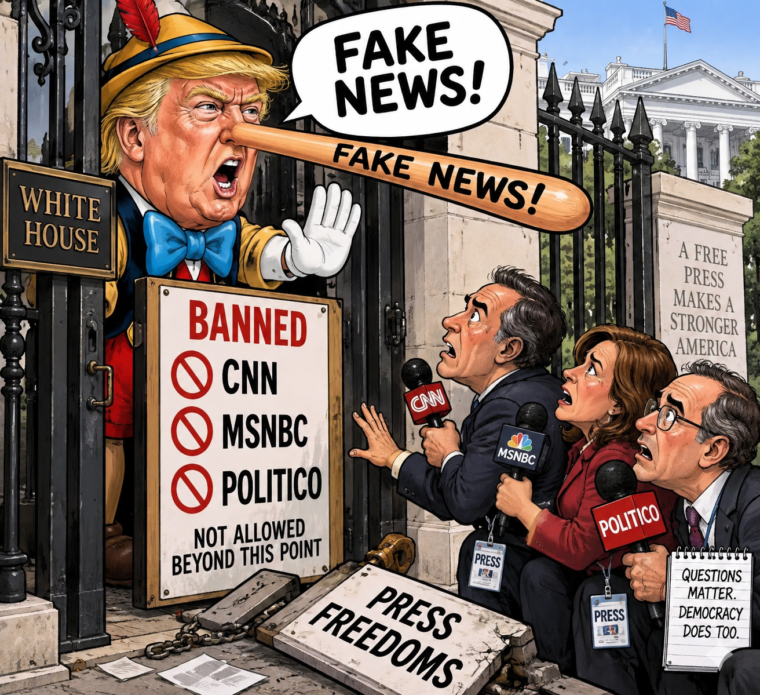
Donald Trumps escalating war on journalists who write or say critical things has now escalated even more. Journalists from CNN, MS Now and Politico arrived at the White House and learned their White House press credentials had been deactivated. In response, news organizations–including Fox News–have suspended Trump pool coverage, something he needs to get his message out as one poll shows his approval rating in the 20s.
Major television networks on Monday agreed to suspend their pooled coverage of President Trump after the White House refused to allow CNN to serve as a pool representative on Monday.
The move is an extraordinary escalation of an unfolding showdown between the Trump administration and the White House press corps, which began last week when the president barred journalists at CNN, MS NOW and Politico from entering the White House grounds. Those three outlets said on Monday they would sue to regain access.
Despite Mr. Trump’s years of lawsuits and threats against the news media, archrival news organizations have rarely undertaken this kind of collective action.
Five networks — ABC, CBS, CNN, Fox News and NBC — have long shared the responsibility of providing television coverage of presidential events, splitting the financial costs and distributing footage that is carried by news organizations worldwide. The networks perform their duties on a rotation, and CNN had been slated to provide coverage for Mr. Trump’s travel on Monday to the United Nations General Assembly.
It is extremely unusual for a president to travel or hold public events without being accompanied by representatives from the television pool. The president’s activities on Monday are still expected to be covered by print, radio and wire journalists, along with still photographers.
“Effective today, the TV pool will not be covering events designated as pool coverage of the President,” Bryan Boughton, the Washington bureau chief at Fox News, wrote in a note to television pool members on Monday, which was obtained by The New York Times. (Mr. Boughton is the acting chair of the television pool consortium; the networks rotate the chairmanship on a quarterly basis.)
“This follows the White House’s position preventing CNN from fulfilling its assigned pool duties,” Mr. Boughton wrote. “There will be no replacement pool put in place. All other pool coverage will continue as normal.”
“We will provide updates as this situation develops,” he added.
The five networks later issued a joint statement, writing: “The public has a vital interest in receiving accurate, independent information about its government. No administration should restrict a news organization because it objects to its reporting.”
On Friday, President Trump caught some of his own aides off-guard when he abruptly announced a ban on the three news outlets, saying he was fed up with what he described as “purposely negative stories.” Journalists from the three organizations had their badges confiscated when they arrived at the White House complex on Saturday.
Presidents have been feuding with the press almost as long as there have been presidents and a press to feud with. Harry Tru7man famously lashed out at newspapers and columnists he believe treated him unfairly. John F. Kennedy became so angry at the New York Herald Tribune in 1962 that the White House cancelled its subscriptions and returned its complimentary copies. Barack Obama’s administration battled Fox News, at one point becoming embroiled in a dispute over excluding the network from an interview with a Treasury official–until the other television networks pushed back. Presidents have complained about reporters, frozen them out and tried to manage cover for geneerations.
But Donald Trump’s confrontation with the press has gone considerably further. During his first term, his White House suspended CNN correspondent Jim Acosta’s press credential after a contentious news conference. CNN sued, and the credential was restored. The administration restricted the Associated Press after it refused to adopt Trump’s preferred “Gulf of America” terminology, prompting another first amendment lawsuit. The Pentagon imposed sweeping new restrictions on reporters, and when major news organizations refused to accept the new credentialing rules, many surrendered their Pentagon badges. The New York Times challenged those restrictions and won important relief i federal court, although the legal battle over Pentagon press access has continued.
Now the confrontation has escalated again. Trump has barred CNN, MS NOW and Politico from the White House, explicitly citing what he calls their “fake news” coverage. CNN had been scheduled to provide television pool coverage of the president, but the other major networks–ABC, CBS, NBC and Fox News–declined to replace it. The result is an extraordinary standoff: the television pool says it will not provide pooled video coverage of Presidential events while CNN is prevented from performing its assigned duties.
CNN, MS NOW and Political have now sued, arguing that the White House engaged in unconstitutional viewpoint discrimination by stripping their journalists of access because the president dislikes their reporting. There is substantial precedent supporting that argument: federal courts previously ordered the Trump White House to restore credentials to journalists in the Acosta and Brian Karem disputes, and a federal district judge ruled in the Associated Press case that the government could not disadvantage the AP because of its editorial choices. But victory is not guaranteed. An appeals court put that AP ruling on hold while the case proceeded, and courts have recognized that the president has considerable discretion over access to small, space-limited events and the composition of the press pool.
The crucial question in the new case is likely to be whether the White House was exercising legitimate control over press access or punishing certain news organizations because of their viewpoints and coverage.

Joe Gandelman is a former fulltime journalist who freelanced in India, Spain, Bangladesh and Cypress writing for publications such as the Christian Science Monitor and Newsweek. He also did radio reports from Madrid for NPR’s All Things Considered. He has worked on two U.S. newspapers and quit the news biz in 1990 to go into entertainment. He also has written for The Week and several online publications, writes a column for Cagle Cartoons Syndicate and has appeared on CNN.