
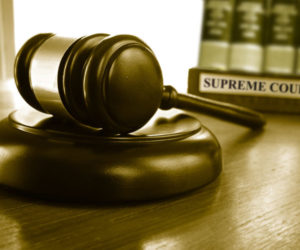











In a major defeat for President Donald Trump and Deputy Chief of Staff for Policy and Homeland Security Advisor Stephen Miller, the Supreme Court voted 6-3 to reaffirm more than 100 years of legal precedent and national tradition that babies born on American soil are automatically American citizens.
The 6-3 decision is a blow to Trump, who had lobbied the court to uphold his Day 1 order and attended oral arguments in the case, becoming the first sitting president to do so.
Chief Justice John Roberts wrote: “Citizenship, then and now, was the right to have rights — to freely participate in our political community. The Framers of the Fourteenth Amendment extended that promise to every free-born person in this land. We keep that promise today.”
Justices Clarence Thomas, Neil Gorsuch and Samuel Alito dissented from the decision. Thomas and Gorsuch wrote that neither the Constitution nor federal law “guaranteed citizenship to persons who were not domiciled in the United States.”
Clarence Thomas has now become the most predictable Justice on the Supreme Court.
Thomas argued that domicile, or the place of legal permanent home, of a child’s parents is the appropriate indicator of a child’s citizenship, given the nation’s history and tradition.
Trump had argued that children born to unlawful immigrants and temporary visitors, like tourists and foreign students, do not qualify for citizenship under terms of the 14th Amendment, which was enacted after the Civil War to address the status of former slaves and their descendants.
Immigrant advocates and civil liberties groups challenging the policy change warned that it would harm hundreds of thousands of children born every year to non-citizen parents and create a bureaucratic nightmare for older Americans, who would no longer be able to prove citizenship simply with a birth certificate.
“The court’s decision reaffirms a fundamental American promise — if you are born here, you are a citizen. A president cannot change the Constitution by executive fiat,” said ACLU legal director Cecilia Wang, who argued the case before the court. “Our brave clients and our legal team stand with millions of people around our country who spoke up for one of our most cherished rights. The Constitution’s guarantee of birthright citizenship stands strong.”
An estimated 255,000 children born every year to non-citizen parents would have lost legal status under the order, according to the Migration Policy Institute. Some may have faced difficulty establishing citizenship in any country, effectively being born as “stateless.”
Trump and some Republicans are now suggesting they may try to get around the court ruling by getting Congress to pass a law or even try for a constitutional amendment.
A constitutional amendment attempt is likely to fail. It would require two-thirds approval in both the House and Senate followed by ratification from three-fourths of the states–38 states. Given U.S. political divisions, that’s an super high hurdler and there’s little evidence that such a coalition exists.
The congressional route also faces major obstacles.
Congress can indeed pass immigration laws but it can’t simply override the Constitution with an ordinary law. Since today’s Supreme Court ruling reaffirmed that the Citizenship Clause of the Fourteenth Amendment protects birthright citizenship, any law contradicting that interpretation would almost certainly face immediate constitutional challenges.
On the political front:
So where are we now?
Republicans are promising to keep fighting, whether through Congress or even a constitutional amendment. But that’s easier to promise than to accomplish. Amending the constitution is one of the toughest acts in American government, and passing an ordinary law that contradicts the Supreme Court’s reading of the Fourteenth Amendment would almost certainly send Congress right back into court.
The political battle will continue. The legal one, at least for now, appears largely settled.
The decision should have been 9-0.
At least a dozen of the men who debated and voted on the Fourteenth Amendment in 1866 would NOT have been citizens under Trump’s EO.
They were not voting to disqualify themselves as Americans.
Insane, ahistorical and un-American argument. https://t.co/61mpJrPgln
— Terry Moran ?? (@TerryMoran) June 30, 2026
So 3 judges says the POTUS can change the Constitution with an EO?
So they agree a Dem POTUS can end the 2nd Amendment?
— Alex Cole (@acnewsitics) June 30, 2026
Add this to the list of things that will not get 60 votes in the senate. https://t.co/XGftlcImfU
— Jake Sherman (@JakeSherman) June 30, 2026
Apparently keeping the exact same laws which have been in effect since the Founding (barring the Dred Scott period pre-Civil War) is “a tremendous betrayal of the Republic.”
It’s hard to imagine how these people call themselves “conservatives” when their demand is so radical. https://t.co/lvT5iO61mQ
— Aaron Reichlin-Melnick (@ReichlinMelnick) June 30, 2026
The NEW @GOP priority: make everyone who was born here from parents who came illegally a noncitizen and deport them.
This is their mantra. This is their number one task.
And so now we know the deal: Make America White Again.
That’s it. That’s the agenda.
— jimmy williams (@Jimmyspolitics) June 30, 2026
ID 80905585 | Supreme Court ©
Zimmytws | Dreamstime.com

Joe Gandelman is a former fulltime journalist who freelanced in India, Spain, Bangladesh and Cypress writing for publications such as the Christian Science Monitor and Newsweek. He also did radio reports from Madrid for NPR’s All Things Considered. He has worked on two U.S. newspapers and quit the news biz in 1990 to go into entertainment. He also has written for The Week and several online publications, writes a column for Cagle Cartoons Syndicate and has appeared on CNN.