






(Note: The reader should be readily able to distinguish fact from fiction)
The Purple Heart is the oldest U.S. military decoration.
It is presented to service members who have been wounded or killed as a result of enemy action. It must be earned, as almost two million brave military men and women have done since the Revolutionary War, quite often at the sacrifice of one’s own life.
The medal originated during the Revolutionary War, thanks to the personal efforts of George Washington who established the Badge of Military Merit to be awarded to Continental Army troops who displayed unusual acts of “gallantry, extraordinary fidelity and essential service.”
During its nearly 250-year existence, the Purple Heart, perhaps more than other military decorations, has reflected and continues to reflect the changing nature of warfare and, more importantly, the changing character of the nation that sends its men and women into harm’s way.
However, neither the changes in warfare nor in the character of our nation have ever turned this noble military decoration into an honor that can be transferred or given away.
One of those recipients is then-Army Maj. Louis E. Dorfman III who was awarded the Purple Heart in May 2009 for wounds received in Iraq “when 26, 110-millimeter mortars rained down on his position…[and] while wounded himself, helped fellow wounded soldiers obtain treatment before allowing any treatment for his wounds.”
In August 2016, during a campaign rally, a veteran identified by Trump’s campaign as retired Army Lt. Col. Louis Dorfman, gave his Purple Heart award (the original medal or a replica) to then-Republican presidential nominee Donald Trump.
Trump graciously declined to accept the medal, explaining that the veteran had earned it through his own bravery and sacrifice and thanked the veteran for such.
The Nobel Prize for Peace — one of five original Nobel Prizes — is awarded to the person “who shall have done the most or the best work for fraternity between nations, for the abolition or reduction of standing armies and for the holding and promotion of peace congresses.”
First presented in 1901, the Peace Prize has been awarded in recognition of “many different kinds of peace work and concepts of peace.”
Since World War II, “the Peace Prize has principally been awarded to honor efforts in four main areas: arms control and disarmament, peace negotiation, democracy and human rights, and work aimed at creating a better organized and more peaceful world.”
The first Nobel Peace Prize was jointly and equally awarded in 1901 to Jean Henry Dunant “for his humanitarian efforts to help wounded soldiers and create international understanding” and to Frédéric Passy “for his lifelong work for international peace conferences, diplomacy and arbitration.”
Since then, the Nobel Peace Prize has been awarded 106 times to 143 Nobel Prize laureates: 112 individuals and 31 organizations.
The 2025 Nobel Peace Prize was awarded to Venezuelan opposition leader María Corina Machado, “a brave and committed champion of peace…a woman who keeps the flame of democracy burning amid a growing darkness…for her tireless work promoting democratic rights for the people of Venezuela and for her struggle to achieve a just and peaceful transition from dictatorship to democracy.”
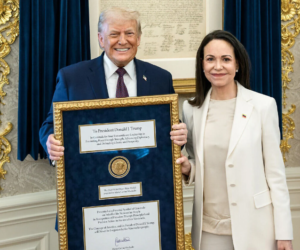
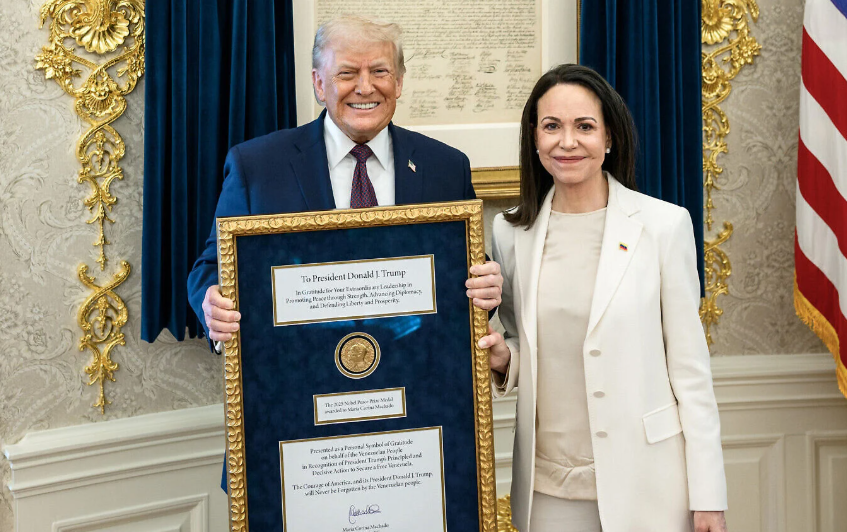
During a White House meeting on January 15, 2026, Mrs. Machado gave her Nobel Peace Prize medal to President Donald Trump saying it was a recognition of his commitment to her country’s freedom.
Finally receiving his Nobel Peace Prize, President Trump thanked Machado for her “wonderful gesture of mutual respect,” but equally respectfully declined to accept the medal as it was hers and only hers, acknowledging and supporting the Nobel Organization’s position that the Peace Prize cannot be shared with others, nor transferred once it has been announced.
The Norwegian Nobel Committee has found it necessary to subsequently clarify that “the Nobel Prize and the Laureate Are Inseparable” and that “The medal and the diploma are the physical symbols confirming that an individual or organisation has been awarded the Nobel Peace Prize. The prize itself – the honour and recognition – remains inseparably linked to the person or organisation designated as the laureate by the Norwegian Nobel Committee.”
CODA:
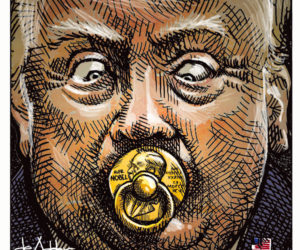
In a news analysis piece at the New York Times on Friday, David Sanger skips all the niceties, pretense and lampooning and gets right to the point on the Machado-Trump Nobel Peace Prize spectacle.
He writes:
In truth, it was a pretty hollow event for both of them. Mr. Trump can hang the medal on the wall, but to the rest of the world — and in the records of the Nobel committee — he cannot legitimately call himself a Nobel laureate.
That was made clear a few hours later by Kristian Berg Harpviken, the director of the Norwegian Nobel Institute, who archly noted that “receiving the symbols of the Peace Prize does not make anyone a Peace Prize laureate.” This has been tried before, he noted, including once in 1943 when Knut Hamsun, who won the Nobel literature prize in 1920, sent it to the Nazi propaganda minister, Joseph Goebbels. (Mr. Hamsun, who often espoused admiration for Hitler, mailed the medallion to Goebbels. But it was lost after Goebbels committed suicide in 1945.)
Sources:
The Purple Heart – The Story of America’s Oldest Military Decoration and Some Soldier Recipients
https://www.war.gov/News/News-Stories/Article/Article/1650949/the-purple-heart-americas-oldest-medal/
https://www.thepurpleheart.com/roll-of-honor/profile/default?rID=89f26f92-a5c1-4619-b0da-69c27d90a348
