















 Right now the conventional wisdom of many writers (including yours truly) is that the recent Congressional debate over Iraq, though shamelessly staged by the GOP as a way to define the Democrats, hurt the Democrats more than it hurt the Republicans.
The Republicans argued “stay the course” and those who want to leave want to “cut and run” (although it came to light that a top general was working on a possible time table, in a news story leaked by official sources, seemingly to cushion the GOP’s hard line position about staying the course without allowing a light at the end of the tunnel). Meanwhile, amid conflicting Senate resolutions, the Democrats message seemed to be “change the course but we can’t really decide yet on how.”
But DID it help the Republicans? Perhaps now, reports the St. Louis Post-Dispatch:
After two weeks of politically-charged debate on the Iraq war, Democrats emerged divided and in disarray.
But pollsters and political experts said the debates did little to alter the fundamental threat to GOP election prospects come November: Voters are still unhappy about the conflict, and they blame the Republican president and the Republican-controlled Congress.
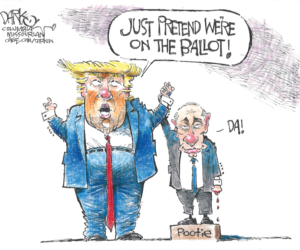
And those two issues – the war and George W. Bush – promise to be defining issues in this fall’s campaign, even though the president is not on the ballot.
“It’s the elephant in the living room,” independent pollster John Zogby said of the war. Candidates can talk about a bevy of popular middle-class issues all they want, but voters will want to hear about Iraq, he said.
Will “stay the course” — a phrase which implies not changing too many things — be enough? MORE:
It almost doesn’t matter what Democrats say on the subject, another pollster said, because the issue is already such a negative for Republicans.
To be sure, “the resolution put the Democrats in a box” as weak on terror and showcased the GOP’s unanimity on the subject, said Del Ali, an independent pollster who works for the St. Louis Post-Dispatch.
But, he said, “If things don’t change in Iraq, I don’t think it matters how lame the Democrats are. I think you’re going to see some incredible house cleaning.”
The Democrats “can be as divided as they want,” Ali added. “Any other year, most voters would say `I don’t know where they stand. I’ll go with the devil I know.’ The problem now is they can’t stand the devil they know.”
(The Devil? I thought he was working HERE…)
Just ask Rep. Chris Shays, R-Conn., a popular moderate who has been battered this year by voters furious about his staunch support of the war. Shays is hardly alone among Republican candidates dragged down by voter discontent over the war and other issues.
And the Democrat who was backed into the tightest political corner last week over Iraq was Sen. Joseph Lieberman, a hawkish Connecticut Democrat. He was in a political bind not because he favored withdrawal but because he opposed it.
Connecticut voters, left-leaning and fervently anti-war, have been abandoning Lieberman in droves as he faces a stiff primary challenge from an anti-war Democrat. The one-time presidential and vice-presidential contender’s future is now so uncertain that he has refused to rule out running as an independent if he loses the primary.
“The Democratic base is against the war and expects its candidates to be against the war,” said Zogby.
That doesn’t just mean criticizing Bush or saying, “we would do the same thing better,” Zogby said. It means telling voters “what’s the exit strategy.”
So it’s not just the issue of “the war” and being for it or against it that may motivate many voters.
It’s going to be the bigger issue of SPECIFICITY:
–If you want to stay the course, HOW do you intend to MAKE THE COURSE more EFFECTIVE?
–If you want to CHANGE the course, HOW do you intend to MAKE A CHANGE THAT IS MORE EFFECTIVE.
Seen in this light, simply labeling Democrats and/or others who question the war or seek some kind of a time frame for U.S. involvement as wanting to “cut and run” (an inaccuracy of many of their positions as well truly smelly and reprehensible political demonization) may NOT cut it.
Or will it?
And will the war issue, as tough as it may seem for Republicans, not be as formidable as it seems due to Democratic weakness and bungling?
There are already indications the Republicans are looking for weak links in the Democratic Congressional chain to prevent a Democratic takeover of the House.
The Democrats could easily counter that Republican counter-effort if they had a world-class political organization that could completely counter or surpass the GOP in terms of organization, the latest political technology, database, skill in using the radio audio culture, political strategists as tough (and ruthless) as the GOP’s and consistency of message and ability to match the GOP in using news cycles to its advantage.
And if I had wheels I’d be an ice cream truck.

Joe Gandelman is a former fulltime journalist who freelanced in India, Spain, Bangladesh and Cypress writing for publications such as the Christian Science Monitor and Newsweek. He also did radio reports from Madrid for NPR’s All Things Considered. He has worked on two U.S. newspapers and quit the news biz in 1990 to go into entertainment. He also has written for The Week and several online publications, writes a column for Cagle Cartoons Syndicate and has appeared on CNN.