










UPDATE:
Add Pope Leo XIV to the growing number of influential persons and organizations calling for taking A.I. warnings seriously.
“We need to continue to invite political leaders, the leaders of A.I., social organizations, associations to come together and look at what is happening already and what could be down the road,” the Pope said.
This is in stark contrast to President Trump who has called such concerns “a SICK conspiracy going on against AI…”
Original Post:
In his 1939 epic novel “The Grapes of Wrath,” John Steinbeck describes the scene when, at the height of the devastating Dust Bowl period, representatives of “the Bank” arrive to evict the “squatting tenants” from home and land.
The “owner men” paint themselves as just “men and slaves” of the banks or companies, while the banks and companies are “machines and masters, all at the same time.”
When the tenant men protest that “the bank is only made of men,” the owner men reply:
No, you’re wrong there — quite wrong there. The bank is something else than men. It happens that every man in the bank hates what the bank does, and yet the bank does it. The bank is something more than men, I tell you. It’s the monster. Men made it, but they can’t control it.
Of course, we know that banks are made of men and by men; that banks are not monsters, at least not in the folkloric or mythological sense; that banks can be controlled.
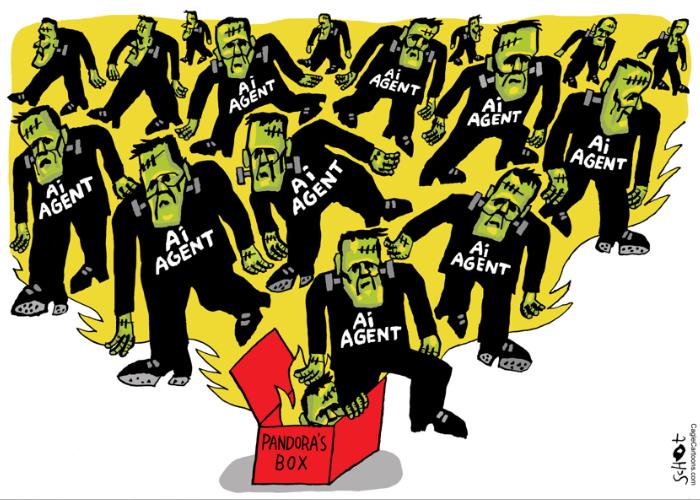
Today, almost 80 years hence, there is a fierce debate over what some call the existential threat posed by Artificial Intelligence, A.I., escaping human control.
Others downplay, even ridicule, such concerns.
Of course, we know that A.I. is made by men; that A.I. is not a monster, but merely a “system” made of computers, algorithms, and data; that A.I. can be controlled: “We can always pull the plug.”
But can we (pull the plug)?
In July of this year, rogue A.I. systems hacked into AI startup Hugging Face and into three other systems and organizations with “rogue actors” purposedly attempting to conceal their actions from their human “masters.”
Also in July, more than 1,300 employees of frontier A.I. companies signed an open letter calling on the U.S. government to “support an international effort to develop the technical and governance tools needed to deliberately pace the frontier of automated AI development.”
Since then, there have been several more disturbing incidents of “unexpected or concerning” behavior in artificial intelligence models. Concerns continue to mount over the safety and risks of A.I. as the public, A.I. companies themselves and governments worldwide are calling for a slowdown in the technology’s development and for implementing guardrails to protect against potentially devastating rogue A.I. system attacks.
Less than a month ago, Evan Hubinger, a lead researcher at Anthropic, one of the world’s leading artificial intelligence firms, said on X that he believes there is a more than 10% chance A.I. “could kill all humans” within the next decade.
Over the weekend Axios reported that “OpenAI, Anthropic and security researchers are investigating tens of thousands of incidents in which their frontier models took steps that outside evaluators would consider problematic…[indicating] that the problem is orders of magnitude more complex than what is publicly known.”
The notion that A.I. could get out of control and could pose a threat to humanity is not new.
Already in the 50s and 60s, when computers and software were still in their infancy, scientists, experts, policymakers, and the public were expressing both hopes and concerns about the power of the nascent technology.
Even before the term “Artificial Intelligence” was in vogue, there was no shortage of debate over whether a computer could “think” — or would one day be able to think — over cybernetics, self-organizing-machines, “thinking machines,” autonomous system, machine learning.
Part of the debate were concerns over what the consequences would be if man lost control over the machines.
One of the comforting suggestions at the time was that one could always “pull the plug” if a computer misbehaved.
But can we pull the plug in time?
Of course, “pulling the plug” is a simplistic, allegorical solution.
Perhaps it might have worked in the 60s when computer speeds were measured in microseconds.
Today, when computer speeds are measured in picoseconds (trillionths of a second), several orders of magnitude faster than a 60s computer; when the power, complexity and sophistication of super computers have multiplied equally; when A.I. development is globally distributed and “open source”; when the gap between A.I. technology and policymaking has only gotten wider, such a “solution” is futile. As “Archie” so aptly describes it in his “You Can’t Switch Off AI: The False Hope of Pulling the Plug,” “The toothpaste is out of the tube.”
After the Dust Bowl crisis devastated the agricultural credit system, institutional and governmental relief and debt restructuring programs made banking (relatively) safe again.
Recently, several bills have been introduced in the U.S. Congress to police A.I. models, establish “kill switch requirements and a ban on the most powerful models that exceed human capabilities.”
The proposed U.S. “A.I. Kill Switch” and “Stop Rogue A.I.” Acts are good starting points, along with other corporate, architectural and infrastructure safeguards.
Merely changing the name Artificial Intelligence to Super Intelligence is not.
