



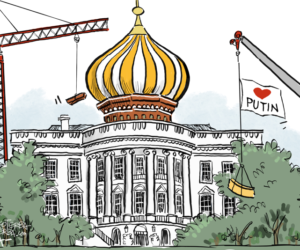
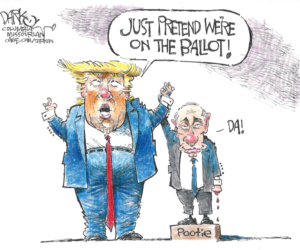

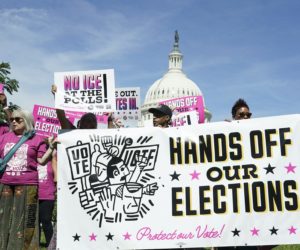
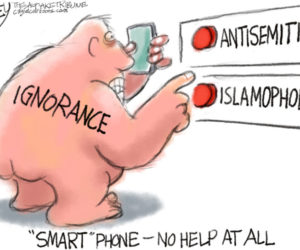







There will be a lot of ketchup thrown on White House walls tonight. A huge truck of it will be arriving any minute.
The Supreme Court, in a 7-2 decision, has stopped the USPS from implementing Donald Trump’s new restrictions on voting by mail.
The new onlne newspaper The Washington Sun:
The Supreme Court on Monday halted the U.S. Postal Service from going forward with a rule pushed by the Trump administration to restrict and change the process for mailing ballots in November’s election.
The 7-2 decision clears the way for states to use mail ballots under their current process, avoiding last-minute requirements that some election officials said would disenfranchise voters. Justices Clarence Thomas and Samuel Alito dissented.
The high court sided with voting rights groups and nearly half the states, which said it would cause a mad scramble for states to comply and, in some cases, it would be impossible within the timeframe of an election now 50 days away.
“Applying the rule in the 2026 elections would be arbitrary and capricious in violation of the Administrative Procedure Act because state and local election officials do not have sufficient time to reasonably implement the rule before the elections,” Justice Brett Kavanaugh wrote in his opinion Monday.
The Trump administration had asked the justices to lift a lower court ruling that blocked key parts of the USPS rule through Election Day on Nov. 3.
The rule stems from an executive order President Donald Trump signed in March that sought to redefine the federal government’s role in the mail-in ballot process. The president has said the policies will help safeguard elections from noncitizen voting — though noncitizen registration is illegal and rare, according to experts.
The rule requires states to submit the name, address and a unique barcode number of every eligible voter to a USPS portal, and then check that each outgoing ballot matches an entry on that list.
The USPS said in its final rule that each outgoing ballot envelope must be scanned individually, with a member of election staff present to oversee the entire process.
It also included an approval process for ballot envelopes, which many states have already purchased for their primaries, along with upgrading systems to comply with a new Intelligent Mail barcode, or IMb, for every ballot.
Justice Brett Kavanaugh, a Trump appointee, concurred with the ruling in a statement that said, “there is at least a fair prospect that the final rule falls within the Postal Service’s statutory authority.”
“But applying the rule in the 2026 elections would be arbitrary and capricious in violation of the Administrative Procedure Act because state and local election officials do not have sufficient time to reasonably implement the rule before the elections,” Kavanaugh added. “For that reason, I concur in the denial of the application for stay.”
Two of Kavanaugh’s fellow conservatives on the nine-justice court, Justices Samuel Alito and Clarence Thomas, dissented from the decision to reject a stay of the injunction against the Postal Service rule, which was issued in late August.
That rule, which implemented an executive order issued by Trump in March, established new standards for ballot envelopes and required states to create lists of voters who were eligible to obtain mail ballots.
Monday’s decision by the Supreme Court only prevents the Postal Service’s rule from being used in November’s elections. It is possible that the court will allow the rule to be used in future elections.
But this isn’t really a story about the Post Office. It’s another chapter in Donald Trump’s long-standing war with mail-in voting–a method of voting that he has attacked repeatedly while insisting, without evidence, of widespread fraud, that mailed ballots are an invitation to mail theft. This time the administration tried to use executive power to impose new requirements involving voter-eligibility lists, and specially approved ballot envelopes. The White House calls measures such as these election security. Voting-rights groups call them voter suppression. And states have a simpler objection: since when does a president get to rewrite the rules for how they run their elections?
The last question may be Trump’s biggest problem. Courts have already blocked portions of his election agenda, and now a Supreme Court with a 6-3 majority–including three justices Trump himself appointed–has refused, by a 7-2 vote, to let the Postal Service restrictions take effect while the case continues. That doesn’t mean Trump’s broader campaign to change election rules is dead. Other battles over citizenship requirements, voter identification and federal power remain very much alive. But it does mean that, at least in this round, Trump asked the courts to let him move ahead and got an answer he isn’t particularly famous for enjoying: No.
Any other result would’ve been a miscarriage of justice. There is simply no constitutional role for the federal executive branch in administering elections. https://t.co/UtHYBNJfQi
— Barb McQuade (@BarbMcQuade) September 14, 2026
BREAKING: Tonight’s Supreme Court ruling is a victory for the millions of American citizens who rely on mail voting. The Trump administration tried to use the postal service to interfere in our elections: it failed. 1/2
— Brennan Center (@BrennanCenter) September 14, 2026
?BREAKING: Supreme Court REJECTS Department of Justice effort to restore U.S. Postal Service mail-in voting rule.
A huge victory for voting rights and free and fair elections. A defeat for Trump and his scheme to rig the elections. https://t.co/J78WAbT9s0
— Marc E. Elias (@marceelias) September 15, 2026
OMG! Supreme Court rebuffs Trump's attempt to break mail-in voting 7-2
We @DDFund_ were proud to file a brief in support of this outstanding outcome for LULAC & working with CLC
Also a VERY important signal of how Trump's other election sabotage efforts will be treated pic.twitter.com/dzTdKYudKM
— Norm Eisen (@NormEisen) September 14, 2026
BREAKING: Supreme Court REJECTS Trump’s effort to interfere with absentee ballots. pic.twitter.com/HwcnYvTYF0
— Senator Adam Schiff (@SenAdamSchiff) September 15, 2026
The Supreme Court rejected President Donald Trump’s controversial plan to change how mail ballots are sent to voters across the country, rebuffing a proposal that election officials warned would have had catastrophic consequences if allowed to take effect for this year’s… pic.twitter.com/QYkkPt41LB
— CNN (@CNN) September 14, 2026
Glad the Supreme Court made the right decision to protect our democracy, but it’s still scary that it wasn’t unanimous. Two justices, Alito and Thomas, completely willing to shred our Constitution. https://t.co/700ACLv6ss
— Andy Kim (@AndyKimNJ) September 15, 2026
This close to the election we need stability, not disenfranchisement and confusion. I’m glad a majority of the Supreme Court Justices rejected Trump’s mail-in ballot scheme that would have created chaos and denied many Americans the right to vote. I still encourage Washingtonians… https://t.co/X9kBMseAta
— Sen. Maria Cantwell (@SenatorCantwell) September 15, 2026
BREAKING: The Supreme Court has DENIED the Trump regime's emergency request to enforce new mail-ballot restrictions ahead of the midterm elections.
The ruling leaves in place a preliminary injunction blocking the U.S. Postal Service from requiring states to submit voter… pic.twitter.com/skQ8rzFJjB
— MeidasTouch (@MeidasTouch) September 14, 2026
BREAKING: The Supreme Court prevented a U.S. Postal Service regulation concerning mail-in ballots from going into effect, casting a decisive blow against President Donald Trump’s hopes of exercising federal control over the midterm elections. https://t.co/WkkSAYYijO
— NBC News (@NBCNews) September 14, 2026
BREAKING: The Supreme Court prevented a U.S. Postal Service regulation concerning mail-in ballots from going into effect, casting a decisive blow against President Donald Trump’s hopes of exercising federal control over the midterm elections. https://t.co/WkkSAYYijO
— NBC News (@NBCNews) September 14, 2026
ID 157618772 ©
Ifeelstock | Dreamstime.com

Joe Gandelman is a former fulltime journalist who freelanced in India, Spain, Bangladesh and Cypress writing for publications such as the Christian Science Monitor and Newsweek. He also did radio reports from Madrid for NPR’s All Things Considered. He has worked on two U.S. newspapers and quit the news biz in 1990 to go into entertainment. He also has written for The Week and several online publications, writes a column for Cagle Cartoons Syndicate and has appeared on CNN.