













It was a beautiful, sunny day in the historic colonial city of Ambato, Ecuador. A beautiful, “flowery” city immortalized by the iconic poem “Ambato Tierra de Flores” (Ambato Land of Flowers) written in 1948 by Gustavo Egüez Vaca. Also, a city that played a critical role in Ecuador’s War of Independence against Spain in the early 19th century.
Located high in the central Andean valley, on the banks of the tranquil Ambato River, the city of Ambato (at the time with a population of 32,000) was the ideal place for my sister (eleven years then) and I (nine years old) to enjoy the last days of our summer vacation.
Accompanied by our nanny, we had gone to the Ambato River to wade in the shallow, gently flowing waters. Our nanny kept a close eye on us from the rocky bank.
Suddenly, we heard shouting and saw some rocks sliding down the steep banks. Perhaps because I was in the river, I do not remember feeling any shaking but did notice the river water becoming quite turbulent. Then we heard people shouting terremoto (earthquake) and saw our nanny flailing her arms, motioning us to get out of the river.
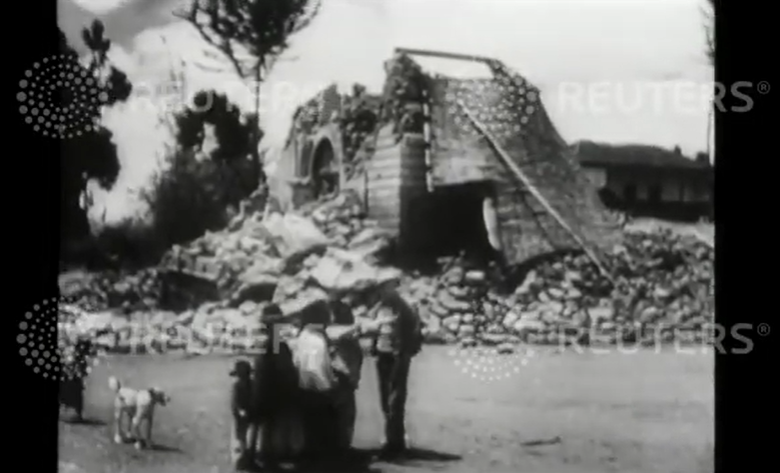
Once we climbed the banks of the river, we saw the sheer destruction and grasped what had happened.
On August 5, 1949, exactly 77 years ago, at 2:08 PM Ecuador time, an earthquake measuring 6.8 on the Richter Scale (XI on the Modified Mercalli Intensity scale) struck Ambato and the surrounding province of Tungurahua.
It was one of the strongest and most devastating earthquakes to hit earthquake-prone Ecuador (located on the “Pacific Rim of Fire”, a region of high seismic activity) in centuries and the second deadly earthquake to hit Ambato. A 1698 earthquake of 7.2-7.9 magnitude virtually destroyed the former Ambato settlement, “Old Ambato,” only to be rebuilt again in its present location.
In terms of casualties, destruction and immense human misery wreaked throughout the region, the 1949 earthquake was certainly one of the worst:
• More than 5,000 people were killed. In one of the most heavily hit towns, Pelileo — where no homes were left standing — only 300 of 3,500 survived.
• Roughly 20,000 were injured, 100,000 were left homeless, and approximately 225,000 people were displaced.
• Entire towns and villages were flattened in a 7,500-square mile area, some sinking into huge craters.
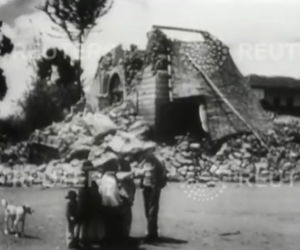
• About a third of Ambato was destroyed including its beautiful colonial center and the historic Matriz Church. A large percentage of the homes still standing had to be demolished.
• Massive landslides from the Andes mountains buried entire villages, blocked rivers and destroyed roads or rendered them impassable.
A few days after the earthquake, a Life Magazine issue described the tragedy as follows:
Like a nation reeling after a total war, Ecuador last week was digging out of ruins left by the worst earthquake to hit the Western Hemisphere in a decade…[leaving] flattened villages and towns over a 1,500 mile area along the eastern Andes.
In the cities, buildings tottered and fell on terrified people as the earth rolled beneath them: thousands more were buried by rockslides thundering down the mountains which buried towns and villages…to mountainous Ecuador it was a catastrophe which had wiped out more than 5,000 lives and much of the nation’s richest food producing area.
Perhaps one of the saddest aspects of the tragedy was that many people — forewarned by a moderate foreshock minutes before the main shock – rushed into churches seeking refuge or to pray. One of these churches, Ambato’s Iglesia Matriz, collapsed when the main earthquake hit, killing 70 children and a priest.
On that day in August 1949, our parents picked us up from the river very soon after the earthquake hit.
As we drove through the few streets that were passable, the extent of the disaster quickly became apparent.
We drove to our house that was still standing, but not safe to stay in. Our family spent the next few days in temporary shelter but soon moved to more permanent quarters…others were not as fortunate.
With significant help from other nations, including from the U.S., from international aid organizations and from the Ecuadorean government, Ambato was largely rebuilt relatively fast. It would take surrounding devastated towns much longer to rebuild. One of these towns, Pelileo, was totally rebuilt at a new site, a little more than a mile from its previous location.
A Festival of Fruit and Flowers (Fiesta de la Fruta y de las Flores) was held in Ambato on June 29, 1950, to help morale and the revival of Ambato.
It went a long way to economically, psychologically and culturally help the recovery of Ambato and to celebrate the resilience and tenacity of its people. It is now an annual celebration.
Edgar Landivar writes at Neomano, “Despite everything, the city of Ambato and its people demonstrated remarkable resilience and capacity for recovery, and their story serves as a reminder of the strength of the human spirit in times of adversity.”
Iglesia Matriz de Ambato, was replaced by an iconic, white cathedral, Iglesia La Catedral. in 1954.
Remember the 1948 poem, “Ambato Tierra de Flores”?
In 1949, after the earthquake, it was given its iconic upbeat rhythm and melody of a “pasacalle” by the renowned Ecuadorean composer Carlos Rubira Infante.
To this day it is the unofficial anthem for the beautiful, resilient city of Ambato.
