











UPDATE:
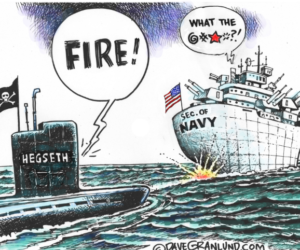
Appearing before the House Armed Services Committee on Wednesday and before the Senate Armed Services Committee on Thursday, Secretary of Defense Hegseth defiantly defended the firings of more than a score of senior military and civilian leaders, including most recently Navy Secretary John Phelan and Chief of Staff of the Army General Randy George, below.
Hegseth faced sharp questions from Democratic (and some Republican) lawmakers, not just on the firings of but also on his reportedly blocking the promotion of four Army officers to one-star generals, two of them Black and two women.
On Wednesday, Representative Derek Tran, an Army veteran and California Democrat challenged Hegseth both on the dismissals and on the potential racial bias.
And on Thursday, Senator Jack Reed of Rhode Island, the top Democrat on the Senate Armed Services Committee “suggested the defense secretary had failed to recognize the accomplishments of women and people of color in the military.”
Representative Don Bacon, Republican of Nebraska, told Hegseth, “You have the constitutional right to do these things, but it doesn’t make it right or wise…”
Representative Austin Scott, Republican of Georgia, said, “Secretary Hegseth, I respect you…I do want you to know I disagree with the firing of General George.”
Hegseth’s responses were vague and self-serving:
• “…the only metric is merit.”
• The firings are a bid to “change the culture of the department…”
• “Out of respect to these officers, I don’t discuss the nature of the removal.”
• Previous Pentagon leaders “were focused on social engineering, race and gender in ways that we think were unhealthy for the department.”
• “It’s very difficult to change the culture of a department that has been destroyed by the wrong perspective with the same officers that were there.”
The Secretary, however, minced no words when attacking lawmakers who disagree with him. “The biggest adversary we face at this point are the reckless, feckless and defeatist words of congressional Democrats and some Republicans,” he said.
Original Post:
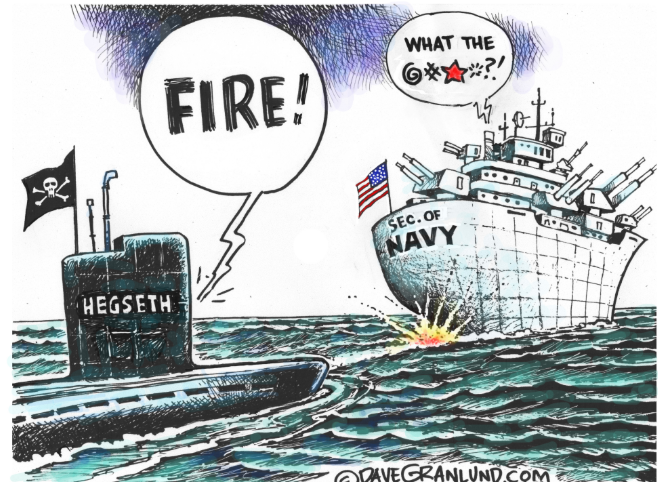
On Wednesday, Secretary of Defense Pete Hegseth unceremoniously fired US Navy Secretary John Phelan as part of the ongoing radical shakeup of the US military organization. The firing takes place during a war in which US naval forces are playing a critical role around the Strait of Hormuz and in the entire region.
It is the latest firing, forced resignation, dismissal or “early retirement” of high ranking military officers and personnel since the Trump administration took office in 2025. It is preceded by the recent dismissal of Army Chief of Staff General Randy A. George on April 2, also at a time when the U.S, military is engaged in combat operations in the Middle East.
While Phelan has no previous military or defense experience (he is from the private investment and banking world and “a personal friend and neighbor [of Trump] who raised millions of dollars for his campaign”), General George is a warrior and a patriot with almost 40 years of meritorious military service that includes Operation Desert Shield, Desert Storm, Operation Iraqi Freedom, and Operation Enduring Freedom. Service for which he has been highly decorated.
More than two dozen generals and admirals, including military lawyers and even the head of the Army Chaplain Corps, have suffered a similar fate to that of General George since Pete Hegseth became Secretary of Defense.
When one adds up the years of invaluable military experience lost with the dismissal of just a dozen of these officers, one comes up with nearly 500 years.
Half a millennium of military experience squandered!
Why? Because of offering frank assessment and objective advice? Because of speaking truth to power? Because of being affiliated with DEI programs? Because of alleged “woke” ideology? Because of other ideological differences? Because of personality clashes? Or, worse, because of race or gender?
Lawmakers from both parties have voiced concern over the firings, worried that such dismissals will affect military morale and effectiveness. That such “could undermine trust in military leadership and lead to a culture of ‘yes men’ unwilling to provide honest advice to civilian leadership.”
Referring to the firing of General George, Georgia Republican Representative Austin Scott said, “If our top general officers are removed without justification from their positions for providing honest, objective advice – which is something I always knew Gen. George to do – then I fear it’s going to have a trickle-down effect. It’s going to be devastating.”
Democratic Senator Chris Murphy, a member of the Senate Foreign Relations Committee, posted on X, “It’s likely that experienced generals are telling Hegseth his Iran war plans are unworkable, disastrous, and deadly…”
Addressing Hegseth’s plan to end the requirement that members of the military be vaccinated against the flu – more broadly “Pete Hegseth’s plan to corrupt our armed forces” – Paul Krugman uses the term “Cultifying the U.S. Military.” What does he mean by that? Krugman explains, “I mean creating an environment in which professional integrity, military discipline, and historical precedent are destroyed in service to the personality cult of Donald Trump and his enforcer, Pete Hegseth.”
Perhaps no one has expressed such concerns better than Retired Lt. Gen. Mark Hertling who, after the firing and early retirement of Lt. Gen. Jeff Kruse, director of the Defense Intelligence Agency, and Air Force Chief of Staff Gen. David Allvin, respectively, wrote at The Bulwark “Donald Trump, Gen. Kruse, and the Perils of Yes Men.”
Writing that “[t]here are good reasons the best leaders don’t surround themselves with sycophants,” Gen. Hertling warns that “the peril of yes men is not that they flatter leaders—it’s that they betray them.”
Reflecting on the lessons of history, Hertling points out how “the opposite approach—surrounding oneself with flatterers—has often led to true strategic disaster” and how, for example, “Hitler’s coterie of sycophants echoed his delusions until his armies collapsed on the Eastern Front.”
Citing his own military career and the experiences of other great military leaders, Hertling writes:
Dissent is not a luxury; it is a strategic necessity. It is not disloyalty; it is the highest form of allegiance. Strategic leaders must cultivate a culture in which disagreement is possible without fear of reprisal. Because the surest way to endanger a mission, a military, or a nation is to demand silence when candor is needed most.
He emphasizes, “The measure of strong leadership is not how many people say ‘yes’ without conviction, but whether a leader creates the space for people to say ‘no’ with courage…When leaders protect dissent, they gain clarity. When they punish it, they guarantee blindness.”
Hertling concludes with the words, “Great leaders understand this. But perhaps no one understands it better than the soldiers who have lived through the consequences of plans made in echo chambers.”
Apparently the Commander in Chief and his Secretary of Defense do not understand.
