











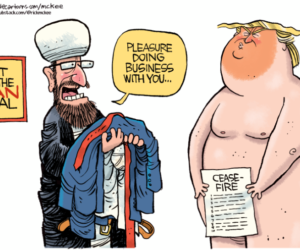



On Easter Sunday, writing on Truth Social, President Trump threatened to destroy Iran if its leaders did not open the Strait of Hormuz. Two days later, he threatened to annihilate Iran and its 93 million people. Five days later, another Sunday, at 9:49 pm Eastern, he posted an AI-generated image of himself as Jesus Christ healing the sick (“I thought it was me as a doctor), after having earlier berated Pope Leo for being “WEAK on crime.”
But wait, as they say, there’s more.
Tom Nichols detailed in The Atlantic Trump’s hour-by-hour posts on April 12th as he “jabbed at his phone until dawn” and showed clear signs of “distress.”
On Tax Day, Trump posted an image of Jesus embracing him. And now Trump has declared that Iran has a “New Regime President” who is “much less Radicalized and far more intelligent than his predecessors.” Except there has been no change in the office. Iran’s president today was president on February 27th.
There is nothing normal about Trump’s behavior. There is nothing normal about this behavior from a parent or grandparent, much less a president.
Coming at Trump’s state of mind from a different angle, Peter Baker wrote, at The New York Times, that Trump’s Truth Social posts “have left many with the impression of a deranged autocrat mad with power.” That includes Republicans such as Ty Cobb, a first-term lawyer who called Trump “clearly insane,” and former White House Press Secretary Stephanie Grisham who has recently written that Trump is “clearly not well.”
Julian E. Zelizer, a Princeton historian and editor of a book on Trump’s first term, told Baker that Trump is “a president who naturally disregards any guardrails or sense of decorum” and “feels much freer, even than Nixon, to unleash his inner rage and to act on impulse.”
Impulsivity is contraindicated for someone with the nuclear codes in their hands.
These analyses land in the midst of a call for Trump to be removed from office by enacting the 25th Amendment, which was ratified by the required three-fourths of states on February 10, 1967. It differs from impeachment (the president did something bad) because it focuses on mental, physical and/or emotional fitness.
The 25th Amendment has four key sections but the one on everyone’s minds is the last one, the weakest and as yet unused one.
It provides a process to remove the President from office other than impeachment. The “Vice President and a majority of either the principal officers of the executive departments [the cabinet] or of such other body as Congress may by law provide” would present a “written declaration that the President is unable to discharge the powers and duties of his office (emphasis added).”
Impeachment is difficult. Removal via the 25th Amendment even more so.
Impeachment requires a majority vote in the House of Representatives and a two-thirds majority in the Senate for “high crimes and misdemeanors.” This has happened to three presidents in the House but none were convicted by the Senate. The House voted to impeach twice during Trump’s first term, making him the third and fourth impeachments.
Removal via the 25th has not happened nor has it been attempted. It requires the Vice President to take the lead in the event of a President who is unable to execute the requirements of the office; a majority of a second body to concur; and two-thirds of both houses of Congress to also agree.
It has not been invoked, despite President Nixon’s unraveling during Watergate, President Reagan’s cognitive decline in his second term or President Biden’s struggles the last year of his term. Cabinets and vice presidents have remained mum whether the press did or not.
That’s not surprising. It is naive to think that a majority of any cabinet would vote to remove their president due to declining mental acuity. There is an inherent conflict of interest: it ends their authority and power. In this Administration, in particular, loyalty appears to be the overriding requirement to be appointed to and hold a cabinet position. This cabinet will not put brakes on the president.
Even in the mid-1960s, in a time much more bipartisan than today, Congress was unable to agree on what an alternative-to-the-cabinet body might look like. This undefined Congressional body renders the 25th Amendment as a method of presidential removal an impotent one.
Nevertheless, on April 14, 2026, Democrats introduced legislation to create a commission which could invoke the 25th Amendment to remove Trump from office. Congress would invoke the Commission only in emergency situations and would direct it to “determine his/her ability to execute the powers and duties of the office and report its findings to Congress.”
Much of the public might agree that a need exists. In a February Reuters/Ipsos poll, three-in-five Americans believed that Trump had “become erratic with age.” Overwhelmingly, four-in-five believe “elected officials in Washington, D.C., are too old to represent most Americans.” About 57% disapprove of Trump’s performance in office.
However, Congressional Republicans have shown no interest in curbing Trump’s encroachment on Congressional powers, from managing the purse to declaring war. To expect them to step up and support The Commission on Presidential Capacity to Discharge the Powers and Duties of Office is wildly optimistic. Thus, the Commission that Democrats are proposing is unlikely to pass and would certainly be vetoed by Trump, who would never sign legislation designed to limit his own power. But the principle behind it, that presidential fitness requires an independent check, not just the loyalty of appointed subordinates, is worth fighting for long after Trump has left the stage.
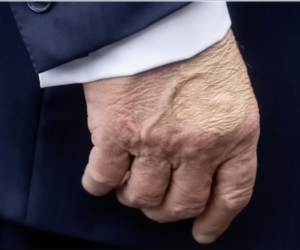
Democrats might be accused of partisanship because they did not raise an issue during Biden’s term after his poor debate performance while ill. However, comparing Biden’s presidency with Trump’s is false equivalence, not just because of Trump’s rhetoric and behavior. There’s also the matter of his persistently bruised hand since August 2025 and throughout 2026. This is unlikely the result of handshaking and not a one-time glancing blow against a table, as explained away by the White House. The bruising raises the possibility of unknown health alongside the demonstrated behavioral ones.
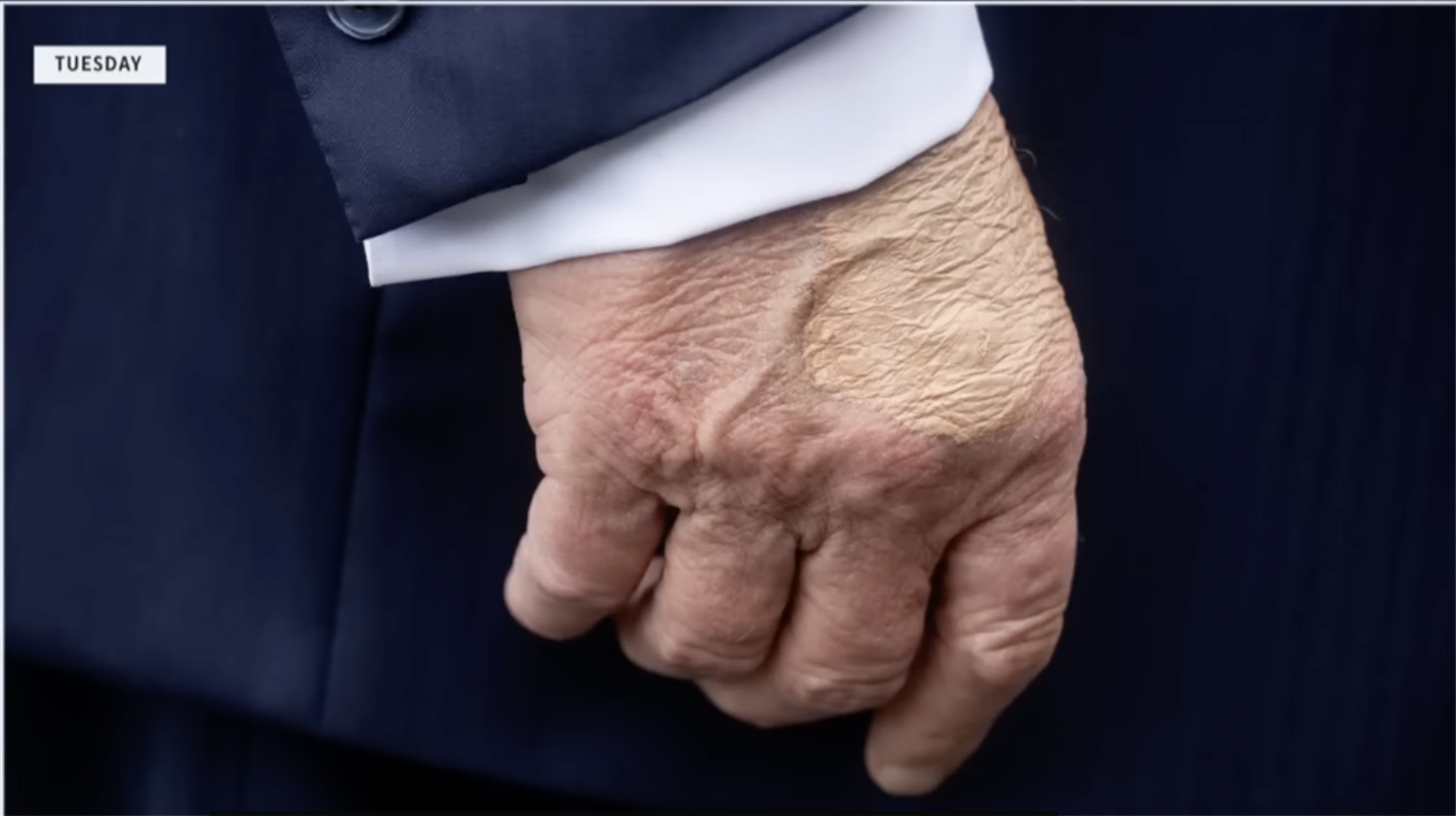
Look. We do not know what is wrong with Donald Trump. We know his erratic behavior has escalated. We know his hand has been persistently bruised for months without credible explanation. We know his cabinet will not act, the Republican Party will not act, and the amendment intended to address this moment has a foundational flaw.
What we do not know is how much worse it will get before November. Americans must take a page from the Hungarian voter playbook: turn out in record numbers and vote.
~~~

Known for gnawing at complex questions like a terrier with a bone. Digital evangelist, writer, teacher. Transplanted Southerner; teach newbies to ride motorcycles. @kegill (Twitter and Mastodon.social); wiredpen.com