









Lest you think that certain things only apply to Republicans, think again as you read this Washington Post editorial. Here are the key parts(read it in full later):
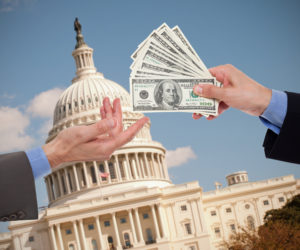
THE BEST CASE for Senate Minority Leader Harry M. Reid (D-Nev.) is that he was sloppy about financial disclosure rules in accounting for a real estate deal on which he made a $700,000 profit. The more unattractive case is that the senator’s inaccurate description of the investment was an effort to disguise his partnership with a Las Vegas lawyer who’s never been charged with wrongdoing but whose name has surfaced in federal investigations involving organized crime, casinos and political bribery since the 1980s. As of now, the evidence points toward sloppiness; Mr. Reid’s friendship with Jay Brown isn’t exactly a secret in the state. But either way, an Associated Press report about Mr. Reid’s dealings doesn’t cast the senator in an attractive light. Neither does his response to the AP story, which indicates a casual disregard for the importance of accurate reporting of lawmakers’ financial affairs.
And, indeed, there are two aspects to the big and small scandals (scandals of the dollar and scandals of the flesh) that explode upon the media and political scenes: the specifics of what happened and the response to what happens when the curious or outrageous event comes to light.
If the first is bad but the second is handled adroitly, the politico might be able to move on. If the first is bad and the second is bad, you have a story with “legs” or at least the one that gives the politico a kick in the you-know-what.
Reid (who hung up on an AP reporter and should have known better) has helped keep the story alive by the second. MORE:
“Everything I did was transparent,” Mr. Reid said at a news conference Wednesday, after the story broke. “Everything is fully disclosed to the ethics committee and everyone else. As I said, if there is some technical change that the ethics committee wants, I’ll be happy to do that.”
Mr. Reid’s professions of transparency and full disclosure are transparently wrong. His investment was not reported in a manner that made clear his partnership with Mr. Brown. It’s true — under the inadequate financial disclosure rules — that even if Mr. Reid had listed the newly formed corporation, Patrick Lane LLC, that wouldn’t have by itself demonstrated Mr. Brown’s involvement. Nonetheless, that Mr. Reid no longer owned the land, but instead had sold it for an interest in the Patrick Lane corporation, was not some mere “technical change,” as the senator would like to brush it off. It’s an essential element of financial disclosure rules, the purpose of which is to know how and with whom public officials are financially entwined.
This is the final stretch in a vital election so what’s unfolding now is what makes many independent voters stay independent voters. Some members of Reid’s party are responding in a way different to how they would respond if he was R-Nev and not D-Nev. And some Republicans and talking heads now suggest that this somehow negates, defuses, or lessens the gravity of the parade of Republican financial (and now flesh) scandals that have taken place since the Republican controlled Congress morphed into the very kind of Congress Republicans (and many voters) thought they had replaced under the politically-late Newt Gingrich. Answer to that: not one iota.
As the Post (which cannot be accused of being under the control of Rupert Murdoch) editorial points out: these kinds of questions about the financial dealings of elected officials are important. If it involves error, then they need to get their act together individually and as a group. If it’s something intentional, then they must be held accountable, whether they had a D or an R in front of their name.
And then there is another fact: Americans can (and many will) demand and expect answers and a high standard of disclosure and accountability from someone like Mr. Reid AND at the same time on election day ensure the United States again operates under divided government so that at least one chamber of Congress provides oversight and a power-check on an out-of-control executive branch.
But politicos of neither party get a pass on demands that they operate above board. And the problems of a member or members of one party don’t eradicate or mitigate the problems of another party — particularly one that holds all the power levers. Just in case some folks forgot: Power=trust bestowed on politicos by voters.

Joe Gandelman is a former fulltime journalist who freelanced in India, Spain, Bangladesh and Cypress writing for publications such as the Christian Science Monitor and Newsweek. He also did radio reports from Madrid for NPR’s All Things Considered. He has worked on two U.S. newspapers and quit the news biz in 1990 to go into entertainment. He also has written for The Week and several online publications, writes a column for Cagle Cartoons Syndicate and has appeared on CNN.