

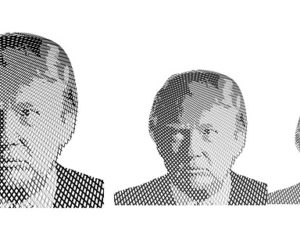







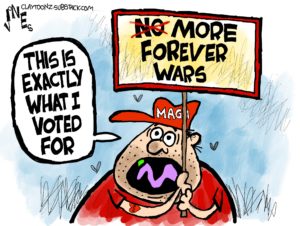
 I seem to remember that our brave president found a way to forego military service during the Vietnam War. I wouldn’t call him a draft dodger, but the poor guy found a podiatrist who said that bone spurs on his feet would prevent him from being a soldier and he never served in the military. Five deferments! Subsequently, he called soldiers who fought for our nation suckers and losers. Now he’s asking these suckers and losers to go to war on his orders against Iran. What a hypocrite.
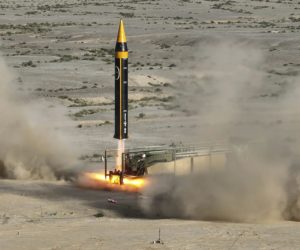
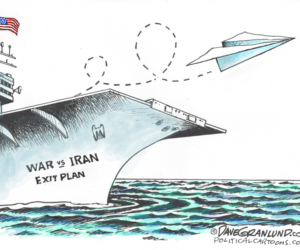
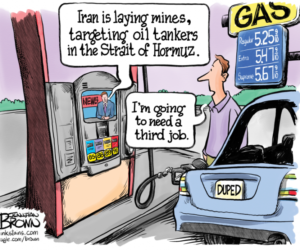
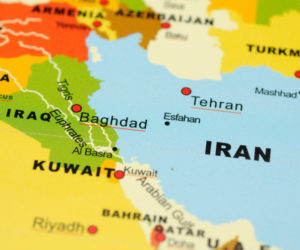
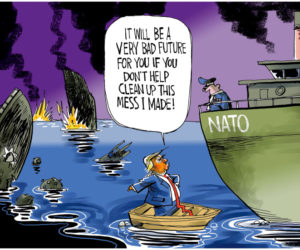
Many Americans believe that the Iran War, which was started in February 2026 in conjunction with Israel, is being used by Trump to deter attention from his domestic problems, particularly the Epstein files and inflation. He hasn’t defined the action as a war, but as a military operation, since a war would need Congressional approval. Initially, he said the operation would only last a short while and would not involve boots on the ground. But at the same time, he was moving additional troops into the Middle East. Trump kept saying he was negotiating with Iran for a cease fire, but Iran denied that, and Israel wanted the war to continue, hoping to take control or destroy Iran’s enriched uranium and eliminate their long-range missiles. Trump kept threatening Iran with greater destruction, but that seemed to have no effect on their third level leadership, the upper levels having been already killed. The vast majority of Americans appeared opposed to the war.
With the cost of oil soaring and driving inflation, Trump has still refused to consider renewable energy. While he may believe that climate change is fake, the Iran War and the high price of fossil fuels should have made him acknowledge renewable energy as a smart alternative. Solar, geo-thermal, wind-driven energy and nuclear sources are all cheaper than oil and natural gas and their production of energy cannot be held hostage by other nations. Yet Trump has agreed to have the U.S. government pay the French energy company, Totalenergies, almost a billion taxpayer dollars to cancel the 10 wind farms they were building off the East Coast and partially finished. The windfarms would have provided energy to over one million homes and businesses in New York and New Jersey, and 300,000 residences and businesses in the Carolinas. Instead, the wind projects will be stopped, and Total will invest the same money in fossil fuel exploration and extraction.
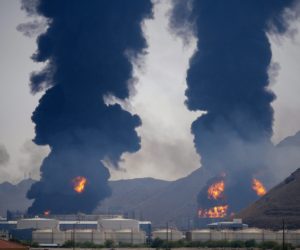
An analysis revealed that for the cost of a prolonged war with Iran or any other Mid-East nation, America could make oil irrelevant for our economy by building renewable sources of energy. We would then not have to worry about closure of the Strait of Hormuz, the cutting of oil production or destruction of oil wells or tankers. The burn rate of conducing the Iran War was estimated to be about $12 billion for the first 10 days (though the numbers vary). And Trump is considering escalation of the war to open the Strait and take Iran’s nuclear fuel. This would entail boots on the ground. It would be cheaper to build renewable sources of energy for America, which would be permanent. We would also not suffer any casualties nor kill civilians. The money spent on the war could also be used to build 10-20 million affordable housing units, ending the housing shortage and homelessness. It would also create millions of construction jobs. Another option would be to use the funds to shore up defense spending, with improved missile defenses along with better missiles and drones which we are rapidly depleting. Is the war really necessary, or can we force the Iranians into a cease fire and surrendering of their uranium without much further depletion of our military stores.
www.robertlevinebooks.com

Political junkie, Vietnam vet, neurologist- three books on aging and dementia. Book on health care reform in 2009- Shock Therapy for the American Health Care System. Book on the need for a centrist third party- Resurrecting Democracy- A Citizen’s Call for a Centrist Third Party published in 2011. Aging Wisely, published in August 2014 by Rowman and Littlefield. Latest book- The Uninformed Voter published May 2020