
Harry Cohen, the founder and autocratic president of Warner Brothers, once said he had a way of judging whether a movie would be a success. “I have a foolproof device for judging a picture,” he said. “If my fanny itches, it’s bad. If my fanny doesn’t squirm, it’s good.”
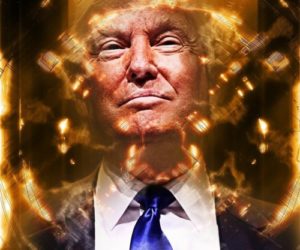
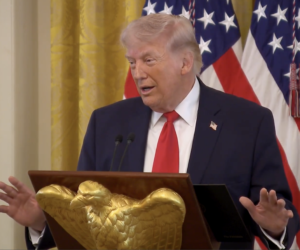
Donald Trump said the war will be over “when I feel it in my bones.” Funny? Bones? It’s all about valuing a gut feeling.
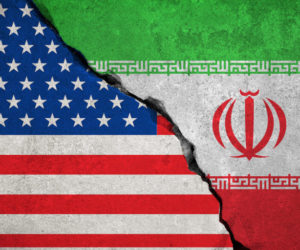
Yet wars are generally not about gut feelings but intricate pre-war planning, trying to advance a winning strategy, overall goals, and what to do if war plans go awry. The question is whether the U.S. entered this war with a coherent strategy for what victory would look like and how escalation would be controlled. By most accounts, Trump believed Iran would fold easily and quickly.
Bob Woodward portrayed Trump as someone who distrusted his military and advisors and often went with instinct – his gut. He saw Trump as impulsive and not focused on strategic planning.
Presidents typically hear out their generals, policy makers and others before taking military action. Trump ignored Joint Chief of Staff Chairman Dan Caine, who told him an American attack could cause Iran to close the Strait of Hormuz. When CIA Director John Ratcliffe heard Israel’s argument that the military operation would lead to regime change, he called it “farcical.”
Those who reportedly most influenced military action against Iran included Trump’s son-in-law Jared Kushner, special envoy Steve Witkoff, Saudi Crown Prince Mohammed bin Salman, the execrable Secretary of War Pete Hegseth and Israeli Prime Minister Benjamin Netanyahu.
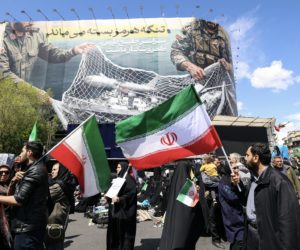
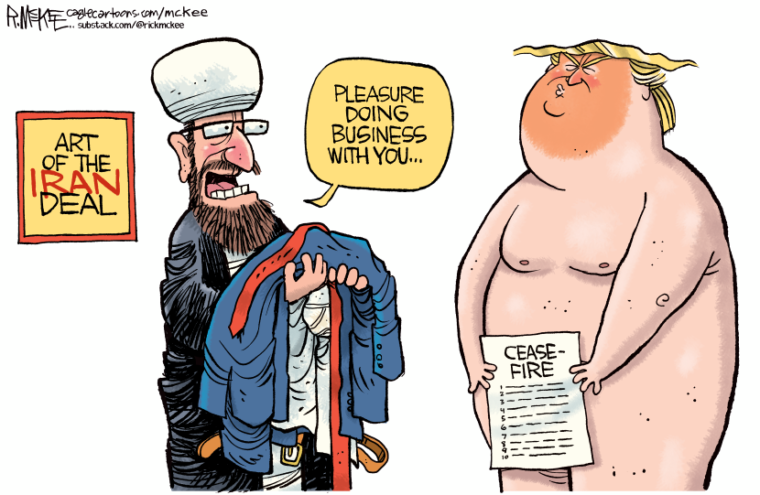
Trump reportedly doesn’t read – his daily briefing has been via video clips of explosions, Fox News, etc. but not detailed briefing papers. The ongoing debate over Trump calling Iran’s 10-point proposal to end hostilities a “workable basis on which to negotiate” is whether Trump is trying to blur the line between diplomacy and concessions.
The Bulwark’s Charlie Sykes wrote: “Trump’s climb-down from Armageddon was not a TACO (Trump Always Chickens Out] — it was a complete strategic defeat. Despite the predictable bluster and claims of ‘complete and total victory,’ Trump abandoned his war objectives and left Iran in a stronger strategic position than before the war began.”
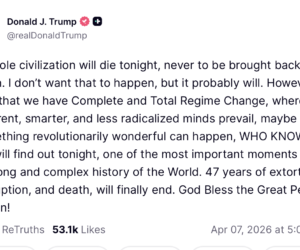
Trump has conducted foreign policy via military and posts on Truth Social. Theodore Roosevelt called the presidency the “bully pulpit.” With Trump, the emphasis is on bully. He has threatened NATO and administration officials even threatened the anti-war Pope. His threat to destroy Iranian civilization was a step too far for many, including Republicans.
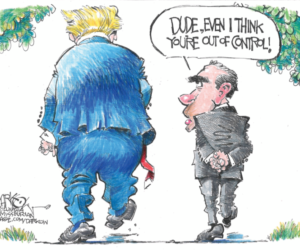
“How can any person that is mentally stable call for an entire civilization of people to be murdered, to be wiped out, to never come back again”? asked MAGA’s excommunicated Marjorie Taylor Green. “That’s not tough rhetoric, that’s insanity.”
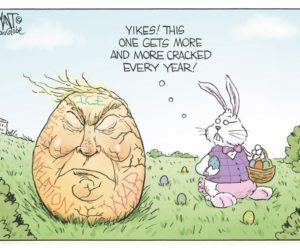
Indeed, some call Trump mad and fear he’s now the antithesis of Ulysses Grant, who said: “Although a soldier by profession, I have never felt any fondness for war.”
There are fears that Trump enjoys his new, dominant military role on the world stage a little too much.
Is Trump conducting this war “by the seat of his pants?”
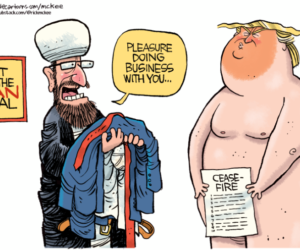
Trump’s famous book was “The Art of the Deal.” Perhaps it’s time to publish an updated version: The Art of the Schlemiel.
–

Joe Gandelman is a former fulltime journalist who freelanced in India, Spain, Bangladesh and Cypress writing for publications such as the Christian Science Monitor and Newsweek. He also did radio reports from Madrid for NPR’s All Things Considered. He has worked on two U.S. newspapers and quit the news biz in 1990 to go into entertainment. He also has written for The Week and several online publications, did a column for Cagle Cartoons Syndicate and has appeared on CNN.