

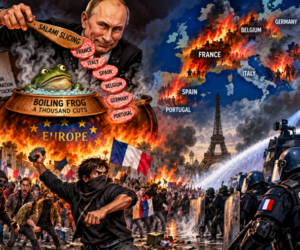






France is in the throes of a political storm that could upend the Fifth Republic established after World War II and reverberate across Europe.
Its anxious electorate is deeply fragmented, anticipating a new era of forever wars in Europe and the Middle East. It fears a prolonged affordability crisis compounded by the costs of French and European rearmament.
French politics are trapped between a left wing demanding direct participatory democracy that may be unmanageable in a country of 69 million and a resurgent right with no experience of running a government but determined to weaponize the current centralized system to expand nationalist policies.
Political rifts are widening just as campaigns take off in earnest for the presidential elections of May 2027, which may be the most consequential since President Charles de Gaulle established the Fifth Republic in 1958.
Currently, power in parliament has been captured by Marine le Pen’s far right National Rally and a far left led by Jean-Luc Mélenchon. Centrist President Emmanuel Macron has been sidelined in not only France but also Europe, North Africa, the Middle East and Asia.
Prime Minister Sébastien Lecornu is struggling to govern France amid student and worker rage across the entire country and in parliament where opposition hawks regularly tear into his plans, including the national budget.
Le Pen, who officially launched her presidential campaign with a major speech on Sunday, October 25, has pledged to halt all direct French financial aid to Ukraine within six months of taking office. She has vowed that France would not send its young people “to die in reckless or irresponsible military adventures, and even less in wars that are not ours.”
She has also strongly criticized the EU’s €90 billion loan package for Ukraine, threatened to slash France’s contributions to the European Union budget and vowed to challenge the bloc’s long-term financing instruments for Kyiv.
Mélenchon, who launched his presidential campaign in June, also opposes aspects of France’s military support for Ukraine. He rejects the provision of advanced weapons that could be used for deep strikes inside Russian territory, warning that such escalation could drag France into a direct and potentially catastrophic conflict with Moscow. He has also suggested that Volodymyr Zelenskyy’s government shares responsibility for the intensifying war.
If France, a founding bulwark of the EU project, slumps into domestic quagmires and cuts support for Ukraine, its partners may not be far behind. Almost all are already fumbling under affordability crises and struggling with squabbling political factions. A retreat by Paris could further weaken Europe’s ability to sustain a common response to Russia’s war and defend its own security interests.
Worse, no leader, including Macron, has offered a coherent strategy for containing Europe’s economic distress and restoring its global leadership. Rather than relying on trade barriers and financial curbs, Europe needs to harness innovation and strengthen its capacity to compete with rising powers such as China and India. Yet political fragmentation and mounting domestic pressures continue to undermine that discussion.
Macron, Friedrich Merz of Germany, Italy’s Giorgia Meloni and others, including Ursula von der Leyen in Brussels, regularly emphasize the need to rebuild Europe’s industrial, defense and digital capacities. But most governments are so swamped by domestic troubles that their common EU imperatives get little attention.
The grievances of French voters are also those of most European electorates. People are falling into profound anxiety over declining living standards and a breakdown in public infrastructure. A fierce frustration is rising against ruling elites in most capitals.
People are highly distressed by the soaring cost of everyday essentials, like food, housing, and energy. Proposed cuts to social benefits, tax credits and public subsidies are being rejected as unfair penalties on hard working citizens. A tide is rising against most immigrants for “stealing” public funds that should go to the native-born.
There is deep anger over growing disparities in school quality, worsening teacher shortages, closure of local hospitals, shrinking public transit lines and disparity in services for rural and suburban residents.
There is particular anger in France against reliance on emergency constitutional tools like Article 49.3 to force through budgets and reforms without a parliamentary vote.
A recent Ipsos survey found that a record 76% of young French adults aged 18-29 are deeply concerned about the country’s future and many are attracted by Mélenchon’s left-wing ideas.
Marine Le Pen is propelled by people aged 30-64 years who must fund an expanding retirement class through high taxes while facing stagnant wages and inflation. She is capturing working-class voters by promising a system of “National Preference” that would cut off state aid to non-citizens.
France’s public debt is colossal at €3.2 trillion or 112%-114% of GDP, which is twice the EU’s upper limit of 60%. Debt service costs of €67 billion are forecast to hit €100 billion by 2030. In 2027, they will outstrip the record-high defense budget of €63 billion by nearly €10 billion.
France’s 10-year government bond yield hit a 24-year high of 5.14% before settling slightly down to 5.04% on October 23. The 30-year bond yield rose to 5.49% showing deep market skepticism over France’s multi-decade structural solvency and the affordability of its pension system.
Against this backdrop, Mélenchon is demanding a revolutionary change establishing a Sixth Republic replacing the current constitution. He sees the current centralized system as a stepping stone to authoritarianism because de Gaulle needed to centralize power on the President to navigate the post war period.
Le Pen sees centralized presidential power as a trampoline to institutionalize nationalist policies and challenge the European Union if she is elected to replace Macron. She wants to set an irreversible right leaning course for France.
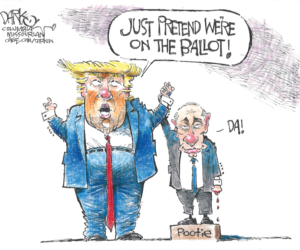
These are early days, but the sharp political divide points to upheavals that could trigger lasting changes in France and across the EU. The stakes are all the higher because Zelenskyy may ultimately be forced to accept defeat at Putin’s hands, particularly as Trump appears increasingly willing to look away.