









Nearly 17 years after the Fort Hood shooting that killed 13 people and wounded 32 others, the planned execution of former Army psychiatrist Nidal Hasan has sparked a new debate over whether executions may be televised and viewed by the public.
Hasan, who was convicted of carrying out the November 2009 shooting at Fort Hood, Texas, is scheduled to be executed by firing squad on December 3, 2026. If carried out, it would be the first U.S. military execution since 1961 and the first military execution by firing squad since 1945. The Pentagon has announced plans to livestream the execution, although President Donald Trump said on October 10 that he would make the final decision about whether the execution is in fact televised. As of October 12, Axios had reported that Trump had privately expressed doubts about the plan.
Defense Secretary Pete Hegseth called the decision to use a firing squad a “no-brainer.” He also defended making the execution public, saying, “We’ll make sure that people are able to watch it, that it’s public, because people need to understand [that] there are serious consequences for these types of things.”
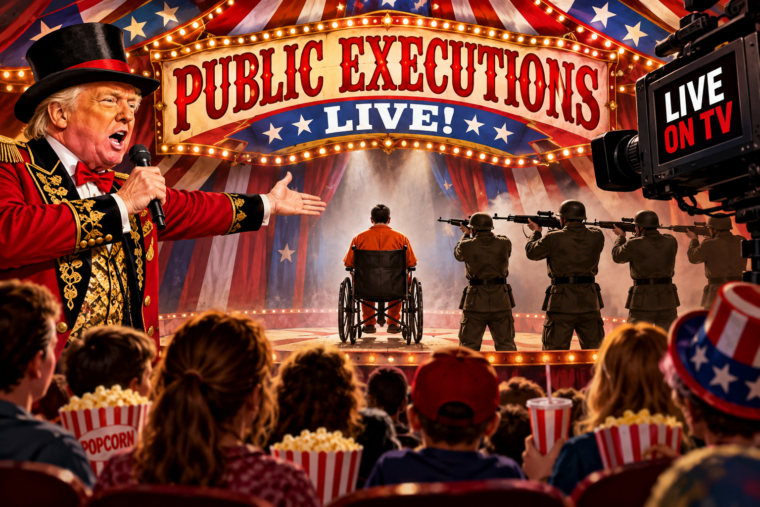
Trump has implied that making an execution public could deter future attacks. While addressing reporters, he said, “By showing it, maybe other people won’t be doing what he did.” The proposal has drawn criticism from lawmakers in both parties, religious leaders and human rights advocates, raising questions about whether broadcasting an execution would serve a public purpose or turn it into a spectacle or form of entertainment. On October 11, Homeland Security Secretary Markwayne Mullin defended the plan during an appearance on CBS’s Face the Nation, dismissing concerns that livestreaming the execution could create a security risk or turn Hasan into a martyr. “But I don’t see an elevated risk at this point at all because of this,” Mullin said. He also argued that “no one has to watch it if they don’t choose to.”
One of the most widely recognized public executions in U.S. history took place in 1936, when Rainey Bethea, a Black man convicted of raping a white woman, was hanged in Owensboro, Kentucky. Thousands of spectators attended the execution. Bethea’s hanging is often described as the last fully public execution in the United States, although Roscoe “Red” Jackson was publicly hanged in Missouri the following year in what is widely considered the last public execution in the country.
The closest modern comparison to a televised execution in the United States came in 2001, when Oklahoma City bomber Timothy McVeigh was executed by lethal injection. The Justice Department arranged a closed-circuit television broadcast for designated survivors and relatives of victims. According to The New York Times, 232 survivors and relatives gathered in a viewing room in Oklahoma City to watch McVeigh’s execution.
Some proponents of making executions public argue that allowing people to witness the process could increase transparency and help the public understand what capital punishment entails. Deborah Denno, a death penalty expert and law professor at Fordham University, has argued that livestreaming could make the process “much more transparent.”
“I think it could possibly be a good idea because it would be transparent and the public would be fully aware that it’s happening,” Denno said.
The proposed broadcast has also prompted mixed reactions among Fort Hood shooting survivors. In an ABC News report, survivor Alonzo Lunsford said he planned to attend the execution but expressed reluctance about making it available to the general public. He was also concerned that the execution could become a spectacle resembling a sporting event. Another survivor, Dayna Ferguson Roscoe, expressed a different perspective, saying that although she had not expected the execution to be livestreamed, she viewed the decision in the context of the historical documentation of death and war.
The debate surfaces amid renewed scrutiny of execution procedures following the failed lethal-injection attempt involving Christa Pike in Tennessee. The case has raised further questions about how executions are carried out and the methods used by states to enforce death sentences.
The various reactions illustrate the controversy surrounding the prospect of a public execution. For some survivors, the execution represents an opportunity to confront the person who attacked them and experience a sense of closure. For others, broadcasting it to a worldwide audience raises concerns about how the victims and their families will be remembered.
With President Trump’s decision on whether to livestream the execution still pending, the debate remains unresolved. The controversy is no longer simply about Hasan’s scheduled execution, but whether the public should witness it as it happens.