







Harry Cohen, the late founder and autocratic president of Warner Brothers, once said he had a way of judging whether a movie would be a success: “I have a foolproof device for judging a picture,” he said. “If my fanny squirms, it’s bad. If my fanny doesn’t squirm, it’s good. It’s as simple as that.”
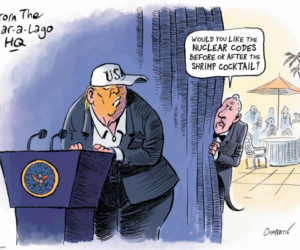
Donald Trump recently said the war will Iran will be over “when I feel it in my bones.” Fanny? Bones? It’s all about valuing a gut feeling.
But wars are generally not about gut feelings but intricate pre-war planning, trying to advance a winning strategy and overall goals and what to do if war plans go awry.
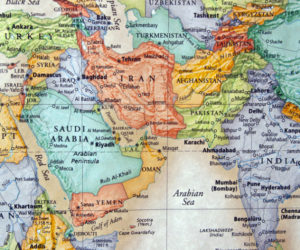
At issue is not simply whether the conflict will end quickly, but whether the U.S. entered it with a coherent strategy for what victory would look like and how escalation would be controlled. Wars in the Middle East have a long history of expanding beyond their initial objectives, drawing in regional actors, destabilizing energy markets, and testing domestic political support at home. With Iran capable of disrupting global oil supplies through the Straight of Hormuz and allied forces already on alert across the region, the consequences extend far beyond the battlefield. The central question is whether the administration’s public confidence reflects a carefully constructed plan–or an assumption that events bend to willpower.
Presidents typically hear out their generals, their policy makers and others before taking military action. In this case, it turns out that Donald Trump completely ignored his general’s warning. The Wall Street Journal:
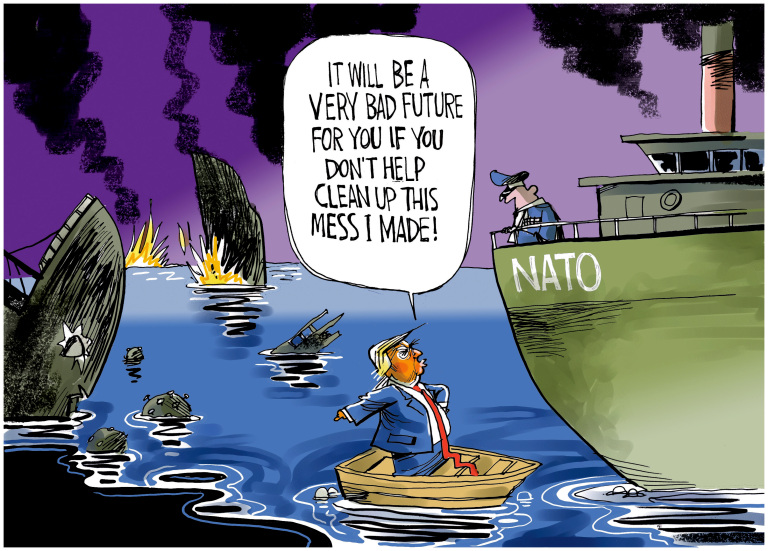
Before the U.S. went to war, Gen. Dan Caine, the chairman of the Joint Chiefs of Staff, told President Trump that an American attack could prompt Iran to close the Strait of Hormuz.
Caine said in several briefings that U.S. officials had long believed Iran would deploy mines, drones and missiles to close the world’s most vital shipping lane, according to people with knowledge of the discussions.
Trump acknowledged the risk, these people said, but moved forward with the most consequential foreign-policy decision of his two presidencies. He told his team that Tehran would likely capitulate before closing the strait—and even if Iran tried, the U.S. military could handle it.
Now, two weeks into the war, Iran’s leaders have refused to back down, and the Strait of Hormuz has emerged as Tehran’s most potent leverage point.
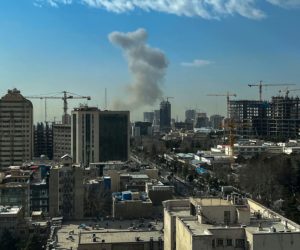
Iran has blocked tankers from the strait and struck cargo ships, triggering a surge in oil prices and an energy shock rippling around the world. U.S. forces are targeting Iran’s mine-laying ships and factories, trying to prevent the country from lining the waterway with explosives.
The joint U.S.-Israel military operation has killed Iran’s supreme leader, targeted military headquarters and damaged or destroyed more than 90 Iranian vessels.
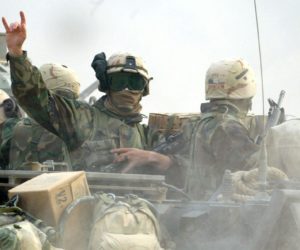
Yet, the price has been steep. At least 13 Americans have been killed, including six in a crash Thursday of an Air Force refueling plane, making the war in Iran the deadliest military operation of Trump’s two terms. At least 140 Americans have been wounded in the conflict. Roughly 175 people, mostly children, were killed in a strike on a girls’ school in Iran, which a preliminary U.S. investigation found was likely launched by U.S. forces.
Since the conflict began Donald Trump has offered a moving target of justifications for U.S. involvement, alternately framing it as a defensive necessity, a pre-emptive strike to prevent a nuclear threat, a response to attacks on U.S. interests, and at times as leverage to force negotiations.
In public remarks and interviews, the emphasis has shifted from imminent danger to deterrence, from retaliation to peace-through-strength and from limited objectives to broader regional stability. Critics argue that these evolving explanations suggest either a reactive strategy shaped by events rather than planning, or an attempt to sell different rationales to different audiences. Supporters counter that flexibility is required in a fast-moving crisis. Either way, the changing narrative has made it difficult to discern a single, consistent theory of victory or even a clearly defined end state.
And now there’s this:
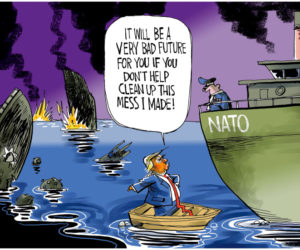
This isn’t surprising: since he took power after the 2024 election Trump has blasted and criticized Europe, European nations, NATO and Canada. As a result the U.S. remains far more diplomatically isolated that any time in recent memory. One-time allies are looking for more reliable nation-friends.
The New York Times Michelle Goldberg contends Trump has blown it winning support for the war:
Donald Trump must envy George W. Bush for the cultural compliance he got while dragging America to war in Iraq.
If you didn’t live through it, it’s hard to convey the atmosphere of stifling conformity that choked the country in the run-up to that disaster. Much of the Democratic Party fell in line; authorization for military force against Iraq passed the Senate 77 to 23. Phil Donahue was fired by MSNBC for giving voice to the antiwar movement. Artists were canceled for expressing their opposition.
When, on the eve of the invasion in March 2003, Natalie Maines, the lead singer of the Dixie Chicks, denounced Bush from a London stage, the fallout nearly buried the band. Radio stations boycotted their music and two Colorado D.J.s who played their songs were suspended. Once one of the most popular country acts in America, the band fell out of the Billboard Top 40.
The same month, when the documentarian Michael Moore gave an antiwar speech at the Oscars, he was met by loud boos in addition to applause. “One pundit after another was saying, ‘Well, that’s the end of Michael Moore,’” he told The New York Times.
Trump has received no such deference for his adventurism in Iran, so he’s trying to force it. On Sunday night, during a tirade on his Truth Social website, the president attacked The Wall Street Journal for reporting on an Iranian military strike against American planes in Saudi Arabia, and called on other news outlets to be charged with “TREASON.” Brendan Carr, Trump’s thuggish Federal Communications Commission chairman, threatened to revoke broadcasters’ licenses over their war coverage. Criticizing CNN’s reporting on the war last week, Defense Secretary Pete Hegseth made clear that he’s hoping its new owners quash its independence: “The sooner David Ellison takes over that network, the better.”
Rarely in modern history has an American administration made such blatantly authoritarian efforts to subdue its critics. Such naked coercion is a screaming sign of democratic breakdown. But we shouldn’t lose sight of how Trump is failing to bend the country to his will. Even as he’s wrecking American institutions, Trump is revealing the limits of his cultural influence.
American wars usually commence with public enthusiasm even if they end in shame.
Harry Cohen trusted his fanny, Trump trusts his bones. Unfortunately, neither has jurisdiction over the Strait of Hormuz.

Joe Gandelman is a former fulltime journalist who freelanced in India, Spain, Bangladesh and Cypress writing for publications such as the Christian Science Monitor and Newsweek. He also did radio reports from Madrid for NPR’s All Things Considered. He has worked on two U.S. newspapers and quit the news biz in 1990 to go into entertainment. He also has written for The Week and several online publications, did a column for Cagle Cartoons Syndicate and has appeared on CNN.