






When I finally ventured out to restock our pantry after the recent 2026 three-day “deep freeze” we experienced in South Texas, one of the items I had on my list was bananas, one of my English-born wife’s favorite fruits.
Alas, when I got to our local grocery store, I found the bananas shelves completely bare, as were the shelves of other fruits and vegetables.

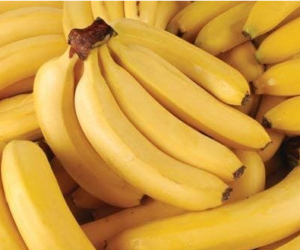
I knew my wife would be extremely disappointed and perhaps a little disbelieving, so I snapped a photo of the empty shelves (above) and showed it to her. I also posted it on our neighborhood’s social website with the famous 1923 tune “Yes!, We Have no Bananas” playing in the background.
When my wife – who was born right smack in the middle of World War II — saw my post, she had a story to tell me, not just about bananas, not just about the song, but also, about rationing, a system that started at the beginning of World War II and continued for certain food items long after the war had ended: 1953 for “sweets,” 1954 for meat.
My wife tells me that she was about six years old when she tasted her first banana and that her Dad told her she was afraid of them and didn’t like them.
Surprisingly, while scores of food items were rationed during the War, bananas were not. Bananas were simply unavailable because, in 1940, the British government totally banned their import. A ban that lasted until the end of 1945.
The reason: Great Britain needed every cubic foot of ship space for the transport of war supplies. Or, as Winston Churchill stated in January 1940, referring to rationing, “That is why we mean to regulate every ton that is carried across the sea and make sure that it is carried solely for the purpose of victory.”
Refrigerated ships, needed for the transport of bananas, were repurposed for transporting critical war supplies and more essential items.
Bananas were absent from British stores, restaurants, dining tables, cooking recipes for the next five years, resulting in small children growing up without knowing the taste of that delicious tropical fruit.
Displaying typical British wartime irony and humor, greengrocers put signs in their shop windows proclaiming “Yes, We Have no Bananas” and Britons memorialized the tropical fruit with wartime songs such as “When Can I Have a Banana Again?” and “I’ve Never Seen a Straight Banana.”
Of course, tropical bananas could not be grown in British dug-up flower gardens and empty city lots as promoted by the British government’s “Dig for Victory” campaign.
Encouraging the British people to make the most of their meager rations*, the Ministry of Food distributed and published recipes – along with catchy phrases such as “go easy with bread, try potatoes instead” urging people to be frugal and resourceful.
And indeed, the Government’s call brought out amazing creativity and innovation in British housewives. They came up with the most unlikely recipes to replace their favorite dishes: carrot fudge, vinegar cake, Spam Hash, the meatless Woolton Pie, the National Loaf…
These delicacies joined a parade of “mock” dishes such as mock sausages, mock fish cakes, mock oyster soup, even mock cream.. .
And of course there were “Mock Bananas.” These “bananas” were concocted from boiled and mashed parsnips, mixed with sugar and artificial banana flavoring.
They have been variously described as “quite drab and almost hard to eat,” “quite a stretch from the actual fruit, but edible,” and “it was awful!”
After five years of bananas abstinence, the long nightmare was finally over for some when, on a cold Sunday morning in December 1945, the cargo ship Tilapa docked in Bristol carrying several million Jamaican bananas.
The dockside celebrations, led by the Lord Mayor of Bristol, included numerous children, “most of whom had never had a banana before.” A little girl, offered a banana at the ceremony declared happily, “Isn’t it lovely!”
I write, “the long nightmare was finally over for some” because it would still be several years before bananas became readily available to the average Briton. As mentioned, my wife would not taste her first banana until about three years after the War.
It is said that rationing fundamentally changed British cuisine leading to it acquiring the reputation of being “bland” and boring. A legacy that lasted for several decades after the War, but a cuisine which is now drastically changing as Britain “is stepping confidently into a culinary future…[that] will change for the better.”
Whatever the future of British cuisine, the story of how the British people coped in the absence and scarcity of so many foodstuffs — including bananas — during the Second World War “is a tale as much of human resilience as of the fantasies people create in the face of scarcity. “
====
* A typical person’s weekly ration consisted of one egg, two ounces each of tea and butter, an ounce of cheese, eight ounces of sugar, four ounces of bacon and four ounces of margarine.
Sources:
https://www.atlasobscura.com/articles/banana-substitute
https://www.findmypast.com/1939register/rationing-in-britain-ww2
https://www.tastingtable.com/1090096/how-the-brits-made-their-own-bananas-during-wwii/
https://www.nationalgeographic.com/history/article/wartime-diet-britain-world-war-jack-drummond#:~:text=The%20rationed%20diet%20was%20supplemented,Food%E2%80%94became%20a%20national%20staple.
