
















 America is in deep financial trouble. Our national debt is about $37-38 trillion currently and growing with our annual budget deficits. Expenditures by the federal government consistently exceed income, which generally is 15-20 percent of our GDP. (GDP for 2025 is estimated at $30.5 trillion.) Mandatory expenditures which include Social Security and Medicare also encompasses the interest on our national debt which at some point may become unpayable. And the Social Security Trust Fund and Medicare are projected to run out of funding in the next decade. Our largest discretionary expenditure is our defense budget which is currently $908 billion.
If we default on payments of our national debt, it would be an economic calamity of major proportion, relegating the U.S. to virtual Third World status. Because the nation is in economic distress, food benefits (SNAP) for poor families and children have been under pressure, and it appears that health care benefits for the poor (Affordable Car Act) may not be paid. This means that poor Americans may not have access to health care and will be food insecure.
But there is a simple solution to all these problems- raising taxes on corporations and our most wealthy citizens. Is there any reason for an individual to have $200 or $300 billion and pay minimal taxes while accumulating more wealth. With relatively low marginal tax rates to start and the use of various tax avoidance schemes, wealthy Americans and corporations do not pay their fair share which would solve most of our economic problems. The billionaire investor Warren Buffett noted surprise in 2012 when he discovered that his secretary was paying a rate of 35.8 percent of her income in taxes while he was only paying a rate of 17.4 percent of his income in taxes. Obama was president at that time and declared that the ultra-rich should pay a minimum of 30 percent of their income to make the system somewhat more fair. But it never happened. And our borrowing, annual deficits and national debt have continued to rise.
Some people say that our entrepreneurs are driven by the ability to make money in the United States. And that businesses flourish because they pay so little in taxes. However, our tax laws are one of the main reasons for the glaring economic inequality in the U.S and our surging debt. And the Trump tax cuts have disproportionately favored the affluent. America has an entrepreneurial culture and increasing taxes on the wealthy and corporations would not change this culture and the need to start new businesses and bring new ideas to fruition. During World Wat II and for decades afterwards, the marginal tax rate was at 90 percent or higher, changing in 1963. Then it was at 70 percent until 1982 under Ronald Reagan when it was cut to 50 percent. Subsequently, it dropped into the 30s. During the period taxes were at their highest, America thrived economically with the middle class growing. And there was less inequality and our national debt was under control.
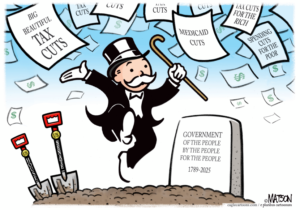
Now, with overall inflation, the cost of housing, health care and food, America’s middle class has been suffering and shrinking. People who previously lived a middle-class life are now considered poor and have more difficulty making ends meet. At the same time, we have a host of billionaires who keep growing their wealth. Government, particularly Trump and the Republican Party care little about the middle-class, favoring the affluent and corporations who spend large sums of money to support them.
Several days ago, Mitt Romney, a moderate Republican (not an oxymoron), former Senator from Utah, former Governor of Massachusetts and former presidential candidate, wrote an Opinion article in the New York Times suggesting that taxes be raised on wealthy people in The United States like himself along with means-based testing for future recipients of Social Security and Medicare. In addition, retirement ages and the onset of Social Security and Medicare should be raised as life expectancy goes up. And capital gains should be restructured to eliminate the death benefit and depreciation on real estate. These measures should be instituted quickly before our economic hole is so deep that it cannot be filled.
www.robertlevinebooks.com
ID 131934132 ©
Zimmytws | Dreamstime.com

Political junkie, Vietnam vet, neurologist- three books on aging and dementia. Book on health care reform in 2009- Shock Therapy for the American Health Care System. Book on the need for a centrist third party- Resurrecting Democracy- A Citizen’s Call for a Centrist Third Party published in 2011. Aging Wisely, published in August 2014 by Rowman and Littlefield. Latest book- The Uninformed Voter published May 2020