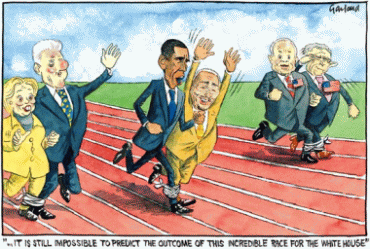
As has been repeatedly demonstrated over the past year, the world is riveted by the way Americans are choosing their president.
This op-ed from France’s Liberation examines the primary process and how it results in the selection of America’s ‘highly-trained’ political athletes.
Anne-Lorraine Bujon writes for Liberation:
“The 2008 Democratic primary race illustrated how, first and foremost, America is a grand spectacle of democracy. … The primaries cost one dearly. They are reserved for highly-trained athletes capable of committing themselves to a quasi-permanent campaign. But they have served to give America some of its biggest stars, like Ronald Reagan who reinvented conservatism to Bill Clinton who introduced a “third way.” And tomorrow …”
By Anne-Lorraine Bujon*
Translated By Sandrine Ageorges
June 24, 2008
France – Liberation – Original Article (French)
The 2008 Democratic primary race illustrated how, first and foremost, America is a grand spectacle of democracy. At the starting line, several competitors, under rules that aren’t necessarily the same from one state to another and are often minimal – apply for ballot access in the primaries. In the stands, supporters cheer bearing caps and T-shirts in the colors of their champion. The nomination is determined by ordinary citizens: they have simply chosen to declare themselves Republicans, Democrats or independents, either in advance or at the time of the election. Their membership in a “camp” gives them the right to vote without having to assume the responsibility of further commitment. The names of those induced to declare [their party allegiance] are inscribed on the electoral lists: in a country of abstainers, the primaries are the chance to register new voters.
These consultations in the states follow one another from January until June, and during the first “media-spectacles” in Iowa and New Hampshire, it isn’t so much victory or defeat that matters most, but any surprises that emerge in reference to predictions.
The mark of an important primary is one that allows an outsider to emerge, a candidate from beyond the establishment who creates a phenomenon. Obama and his campaign “for the base” followed in the footsteps of Howard Dean, who in 2004 pioneered the massive use of the Internet and appeals to small donors to finance his campaign. Similarly, this is how John McCain took revenge against his party in 2008, after it barred his way in 2000 to the benefit of George W. Bush.
READ ON AT WORLDMEETS.US, along with continuing translated foreign press coverage of the U.S. election.