



An Internet hub for moderates, centrists, and independents, with domestic and international news, analysis, original reporting, and popular features from the left, center, and right

Robert McNamara, Architect of Vietnam War, Has Died

pouipuihpihopiuhpoih.jpg

Tim Weiner, New York Times reporter and author of  Legacy of Ashes: The History of the CIA (I’ve read the book; it’s first rate), has a long, absorbing article about the former Defense Secretary’s career, which is also a mini-history of U.S. foreign policy at the height of the Cold War.

McNamara is a complex, contradictory character, fascinating to read about. He was widely reviled, both on the left and on the right, for the public regrets he expressed about the Vietnam War long after it was over, and for saying that the U.S. firebombings of German and Japanese cities, and the nuclear bombings of Hiroshima and Nagasaki, during World War II (he played a side role in the Japanese firebombings) would have been considered war crimes (and officials like himself would have been tried as war criminals) had we lost that war.

It’s hard to know what to make of McNamara. He fiercely and uncompromisingly supported the war for many years, and he was directly responsible for decisions that cost the lives of tens of thousands of Americans, and millions of Vietnamese — all ultimately in service to a war that could not be won. Yet, it’s also true that his regrets about the war haunted him for the rest of his life — to the point where, late in life, people who knew him described him as a broken figure:

The war became his personal nightmare. Nothing he did, none of the tools at his command — the power of American weapons, the forces of technology and logic, or the strength of American soldiers — could stop the armies of North Vietnam. He concluded well before leaving the Pentagon that the war was futile, but he did not share that insight with the public until late in life.

In 1995, he took a stand against his own conduct of the war, confessing in a memoir that it was “wrong, terribly wrong.” In return, he faced a firestorm of scorn.

“Mr. McNamara must not escape the lasting moral condemnation of his countrymen,” The New York Times said in a widely discussed editorial, written by the page’s editor at the time, Howell Raines. “Surely he must in every quiet and prosperous moment hear the ceaseless whispers of those poor boys in the infantry, dying in the tall grass, platoon by platoon, for no purpose. What he took from them cannot be repaid by prime-time apology and stale tears, three decades late.”

By then he wore the expression of a haunted man. He could be seen in the streets of Washington — stooped, his shirttail flapping in the wind — walking to and from his office a few blocks from the White House, wearing frayed running shoes and a thousand-yard stare.

He had spent decades thinking through the lessons of the war. The greatest of these was to know one’s enemy — and to “empathize with him,” as Mr. McNamara explained in Errol Morris’s 2003 documentary, “The Fog of War: Eleven Lessons from the Life of Robert S. McNamara.”

“We must try to put ourselves inside their skin and look at us through their eyes,” he said. The American failure in Vietnam, he said, was seeing the enemy through the prism of the cold war, as a domino that would topple the nations of Asia if it fell.

In the film, Mr. McNamara described the American firebombing of Japan’s cities in World War II. He had played a supporting role in those attacks, running statistical analysis for Gen. Curtis E. LeMay of the Army’s Air Forces.

“We burned to death 100,000 Japanese civilians in Tokyo — men, women and children,” Mr. McNamara recalled; some 900,000 Japanese civilians died in all. “LeMay said, ‘If we’d lost the war, we’d all have been prosecuted as war criminals.’ And I think he’s right. He — and I’d say I — were behaving as war criminals.”

“What makes it immoral if you lose and not immoral if you win?” he asked. He found the question impossible to answer.

At least he asked the question, though. Many never do. It has to count for something that, having been part of such a profoundly immoral and ill-advised venture, Robert McNamara at least had the capacity to — deeply and painfully — regret.

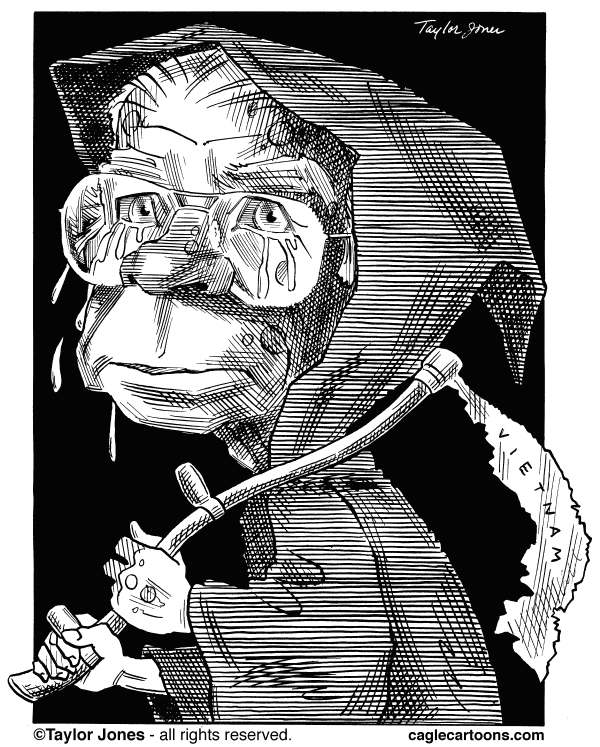
The cartoon by Taylor Jones, Politicalcartoons.com, is copyrighted and licensed to run on TMV. All Rights Reserved. Unauthorized reproduction prohibited.

  • Father_Time
    This man ADMITTEDLY lied repeatedly to President Lyndon B Johnson about the analysis and statistical facts regarding the Vietnam war. In his own arrogant manipulative actions he decided policy that the constitution permits only the president to decide. The fact that this man was never prosecuted for his obvious crimes remains a monument to the hypocrisy and thus weakness of our form of government. Not to mention our lack of respect for the rule of law.
  • keelaay
    Thanks for your analysis Ms Kattenburg. Mr McNamara is indeed a complex character. That he had so publicly and painfully confessed his inner torments is in my view a virtue -- not a failing to be derided as many are very happy to do. But I do not in any way argue that he is redeemed. He promoted policy positions and war actions with horrific consequences and was thus understandably haunted and tormented until his death. Mr. McNamara's national security views and actions during his tenure in the Kennedy and Johnson administrations are eerily similar to those of the Neocons of today. Thus his regrets such as in the documentary "Fog of War" should serve as warnings to those who are so over-confident that they refuse to consider, much less understand, our historical failings. Mr. McNamara's painful anguish and remorse remains generally ignored by those in power and vehemently reviled by the right. While I don't necessarily support the position that the Vietnam War could not have been won, I think there remains a more important question. Even if the war was winnable, should the US have interceded in Vietnam at all? This is not a query to lay at the feet of Mr McNamara but instead of Presidents Eisenhower, Kennedy, and Johnson. The covert and then overt incursions, ultimate war, and human tragedy of Vietnam was ultimately waged by these Commanders in Chief.
  • Leonidas
    Well we know who appointed McNamara, JFK, we all know who kept him on LBJ. We also know who was for scaling back in 1967 and who wasn't.

    From Wiki:

    In early November 1967, McNamara's recommendation to freeze troop levels, stop bombing North Vietnam and for the US to hand over ground fighting to South Vietnam was rejected outright by President Lyndon B. Johnson.

    LBJ also gave him the Medal of Freedom and the Distinguished Service Medal
  • AustinRoth
    Wait. None of this can be correct. It implies hypocrisy, self-serving government, and lying about war efforts and hiding key information existed both in a Democratic administration, and prior to George W. Bush being President.

    I am pretty sure from all my readings here the past few years that just cannot be the case.
  • Don Quijote
    In early November 1967, McNamara's recommendation to freeze troop levels, stop bombing North Vietnam and for the US to hand over ground fighting to South Vietnam was rejected outright by President Lyndon B. Johnson.


    Who was followed in the White House by some crook called Nixon who pursued identical policies for the following four years after having gone behind LBJ's back and torpedoed peace talks in Paris.
  • joeinhell
    Hip hip hooray the devil's gotten another one of his own. Die Kissinger, you fucking mass murderer, die you ancient piece of crap. Die of pancreatic cancer in its most painful form.
  • joeinhell
    keelaay
    Of course no blame should be laid at the foot of the merchants of death who financed and bought each of these Presidents. Boeing went bankrupt in 1927 and will never show a profit without those little subsidies for its "war profiteering." Dow would be bankrupt but for its contracts to run government arsenals. Inefficient too, read about the Rocky Flats nuclear excursion in the late 60s or early 70s. I'm sure we really need all of our 15,000 nuclear warheads, but I have a feeling quite a bit were built for "political contributions."

    If I had met Mr McNamara, I would have killed him in a hot second. Two of my friends died as a direct result of his choice of Westmoreland as General in command and his brilliant copy of Dien Bien Phu. For forty years since my tour in that hell we made of a nice little country, I have tried to figure out how I can contribute to stopping the evil. I still haven't figured it out, but my Agent Orange poisoning will kill me soon enough. I'm not sure who made that poison but I'll bet their profits were great during that filthy war.
  • Wait. None of this can be correct. It implies hypocrisy, self-serving government, and lying about war efforts and hiding key information existed both in a Democratic administration, and prior to George W. Bush being President.

    Actually, it's pretty well known that McNamara has been reviled by the Left. I'm kind of surprised, however, by how often those on the Left give Lyndon Johnson a pass, given that he misled us into an unnecessary war. Howard Dean, who gained heavy support from the Left due to his virulent opposition to the Iraq War, inexplicably listed Johnson as one of the best presidents of the twentieth century.
  • By "Left", I mean those falling left of center on the political spectrum (as opposed to the fringe left or partisan Democrats).
  • Don Quijote
    Actually, it's pretty well known that McNamara has been reviled by the Left. I'm kind of surprised, however, by how often those on the Left give Lyndon Johnson a pass, given that he misled us into an unnecessary war.


    He didn't mislead us into an unnecessary war, it had been going on for a couple of years prior to him moving into the White House, he just did what Obama has done in Afghanistan, DOUBLE DOWN.

    Medicare/Medicaid, Civil Right Act of 1964, PBS are all major legislative accomplishments that are still with us 40 years later...

    I 'll be shocked if Obama manages to do half of that...

    By "Left", I mean those falling left of center on the political spectrum (as opposed to the fringe left or partisan Democrats).

    Aren't partisan democrats and members of the "fringe left" whatever that is, not US citizens whose opinion have the same weight than anyone else opinion? By the way once you remove those two groups of people who's left on the "left"?
  • Leonidas
    "I'm kind of surprised, however, by how often those on the Left give Lyndon Johnson a pass, given that he misled us into an unnecessary war. Howard Dean, who gained heavy support from the Left due to his virulent opposition to the Iraq War, inexplicably listed Johnson as one of the best presidents of the twentieth century."

    I didn't like LBJ, but I will give him major points for one thing, his stance on Civil Rights. He is well worthy of scorn in other areas, but we should give him the credit that he does deserve on that issue.
blog comments powered by Disqus
© 2005-2009 The Moderate Voice | Site design by Elegant Themes | Site customization, hosting, and security by Enxit Group, LLC