













[Foreword: Whether you read this post or not, please scroll down to the bottom to listen to “One Voice,” this year’s inspirational holiday presentation by the U.S. Air Force Band, “a reminder that together we can create a better world” and to listen to some beautiful Christmas music.]
Leave it to the Department of Defense to write about big military actions that have taken place on December 25.
I do not want to jinx Christmas, nor does DoD, so let us view it in the spirit of and as a reminder that, while we are enjoying the holidays, numerous U.S.military are possibly in harm’s way and that indeed many have made the ultimate sacrifice on that special day.
Here are some excerpts of those events along with images, published by DoD. For the complete story please click here.
And, before we get too engrossed in the “Four Major Military Events that Happened on Christmas,” I join DoD author Katie Lange in her “Have a great holiday season, everybody!”

The winter of 1776 didn’t start as a good one for Gen. George Washington’s Continental Army…
Washington needed to renew faith in the battle for independence, so he decided to surprise the Hessians – German troops hired by the British – who were stationed in Trenton, New Jersey. He figured that doing so after the enemy’s Christmas celebrations would find them groggy and unprepared for a fight, especially as a terrible winter storm was brewing.
So late Christmas night, Washington and his troops hopped in boats and waded across the icy Delaware River to test his theory – and he was right. At dawn on Dec. 26, about 2,400 frozen Continentals pushed into Trenton, and they did indeed surprise the enemy, who surrendered within an hour and a half.
The mission, which became known as the Battle of Trenton, was of huge significance to the Continental Army’s cause. Not only did it raise the troops’ spirits, but it revived the hope of the colonists, who were beginning to think their battle for independence wasn’t feasible.

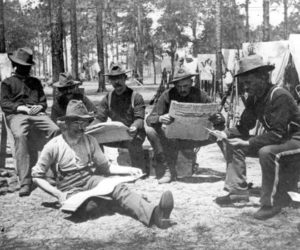
For most of the Civil War, North Carolina’s Fort Fisher saw very little combat. But that changed on Christmas 1864, when the Union decided it wanted to capture the last port the Confederates held on the Atlantic Ocean.
It was a debacle for the Union.
First, the Union tried to pack a warship with explosives and blow up the fort’s walls — but that didn’t work. It just blew up their ship and alerted the Confederates of an imminent attack. So on Christmas Eve, the Union tried again, bombarding the fort with heavy gunfire, most of which fell short or missed its target.
On Christmas morning, Union commanders decided to shell an area north of the fort so troops could land and come ashore. But when they did, more disappointment followed — the fort’s heavy artillery was completely unscathed, so that was a no-go, too. It was only then that the Union ordered troops to retreat.
…

American troops were in the middle of the biggest bombing mission in military history during the Christmas season of 1972. The air campaign, called Operation Linebacker II, has largely been considered the action that ended U.S. involvement in the Vietnam War.
President Richard Nixon ordered the bombings to begin on Dec. 18 after North Vietnamese delegates walked out on peace talks. Nicknamed the “11 Days of Christmas,” the operation consisted of 11 successive days of raids by B-52 Stratofortress bombers flown in from Andersen Air Force Base in Guam.
The only day that both sides got a reprieve was Christmas, when troops were given a 36-hour break to celebrate. During that time, Nixon ordered the North Vietnamese to return to the bargaining table. The North Vietnamese refused, so the bombings continued until Dec. 29, when they agreed to resume peace talks.
In 11 days, Linebacker II dropped 15,000 tons of bombs via 729 U.S. Air Force sorties involving about 12,000 airmen. Defense Department records show the raids destroyed or damaged 1,600 structures, 500 rail targets, 10 airfields and 80 percent of North Vietnam’s electric-generating capacity. Fifteen U.S. B-52s were also destroyed in the process, killing 35 men and leading to the capture of nearly 40 American prisoners of war.
…

[Katie Lange calls this one not exactly a military action, yet “it’s definitely a symbol of America’s military might.”]
John Philip Sousa, who grew up during the Civil War, was a talented musician who became a long-time director of the U.S. Marine Band. Known as the “March King,” he was a rock star of his time, eventually starting his own band in 1892.
On Christmas Day 1896, while crossing the Atlantic on his way home from a European vacation, Sousa’s lasting legacy came to him. He said the notes for “Stars and Stripes Forever” were born out of homesickness and fond memories of his time as the Marine Band’s leader.
The iconic song officially became America’s national march in 1987.
Katie Lange concludes with the words, “So this holiday season, while you’re enjoying leave, family, friends and feasts, think of some of your fellow troops, past and present, who had to forgo their holidays for the greater good of the country.” She includes a link to John Philip Sousa’s march “Semper Fidelis” recorded by “The President’s Own” United States Marine Band.
In the spirit of the season, I would like to replace it with “One Voice,” this year’s inspirational holiday presentation by the U.S. Air Force Band, “a reminder that together we can create a better world.”
But wait, how can we not have a repeat performance of the unforgettable 2014 USAF Band Holiday Flash Mob at the Smithsonian’s National Air and Space Museum, Steven F. Udvar-Hazy Center:
Merry Christmas!
All photos, courtesy DoD
