















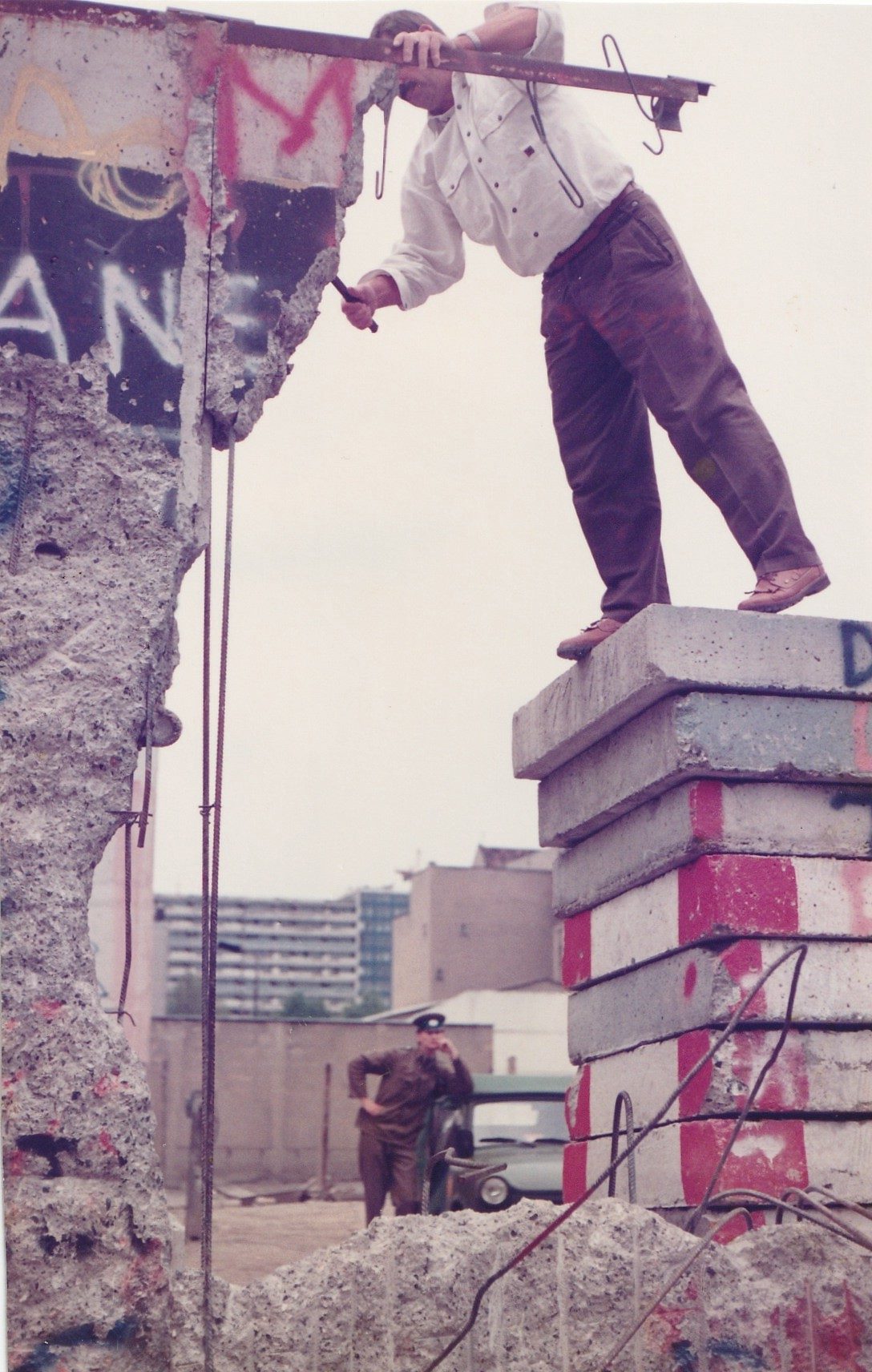
On Sunday, November 9, the free world will celebrate the 36th anniversary of the fall of the infamous Berlin Wall, a date that is remembered as marking the beginning of the fall of communism in Central and Eastern Europe and signaling the end of the Cold War.
Two days later, on November 11, we will celebrate Veterans Day once again, “a day to honor America’s veterans for their patriotism, love of country, and willingness to serve and sacrifice for the common good.”
Some may ask what the connection is between these two events.
Simply stated, the presence and steadfast commitment of over 300,000 U.S. service members — today, all Veterans — stationed across West Germany and in West Berlin at the time, were critical factors in ending the Cold War and in the collapse of the Soviet Union, starting with the fall of the Wall.
One of those service members was then-Staff Sergeant Juanyta D. Ortiz, assigned to the U.S. Air Force’s 66th Electronic Combat Wing at Hessich-Oldendorf Air Station, a small base in the British Sector of post-war Germany, about 200 miles West of Berlin. Ortiz’ Wing provided control and support for two NATO Tactical Air Force radar units.
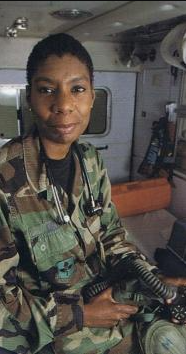
On the early morning of November 9, 1989, unsuspecting of the momentous events that were about to happen that day, Ortiz and a friend set off on the 200-mile drive to Berlin to do some Christmas shopping. A drive that included passing through the Helmstedt-Marienborn border crossing with its now-famous Checkpoint Alpha on the Allied (British) side of the border with East Germany, the Soviet checkpoint into the Soviet Sector and embarking upon a tense, 100-mile drive through the “corridor” to Berlin.
A drive which historian and author Jan Morris describes as “like entering a drab and disturbing dream, peopled by all the ogres of totalitarianism, a half-lit world of shabby resentments, where anything could be done to you…[and where] your every step was dogged by watchful eyes and mechanisms.”
Ortiz remembers noticing an unusually high number of East German Trabant cars (“Trabis”) traveling in the opposite direction but did not give it a second thought.
Finally, they reached Berlin entering the Western part the city through Checkpoint Bravo and subsequently into East Berlin through Checkpoint Charlie. Each time their military orders were meticulously time-stamped (below).
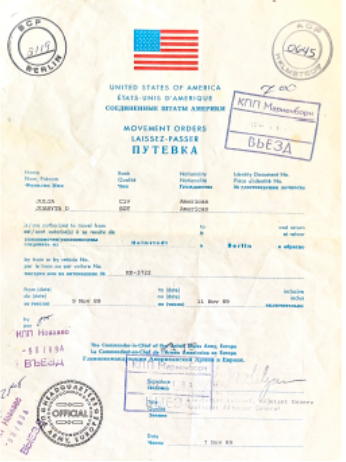
After spending the day in East Berlin, Ortiz and her friend made their way back to West Berlin fighting heavy westbound traffic and passing through an extremely busy Checkpoint Charlie. Once back in West Berlin it became obvious that something momentous and joyful had happened: “Lots of horn honking and flashing spotlights…people on top of the wall, yelling and chanting with spotlights shining on them as well as several news trucks with satellite dishes…” The Berlin Wall was coming down!
The monstrosity, complete with anti-vehicle trenches, 302 guard towers and mined “death strips” that resulted in the deaths of almost 200 people who were only seeking freedom, did not physically come down during that long night 36 years ago. It would take several more weeks and months for most of the massive, concrete-reinforced wall to be chipped, pickaxed and, eventually, bulldozed down.
Ortiz and her friend returned a few days later, armed with tire irons, to see the crumbling Wall, to do their part in helping its demise and to collect some concrete chunks of history (below).

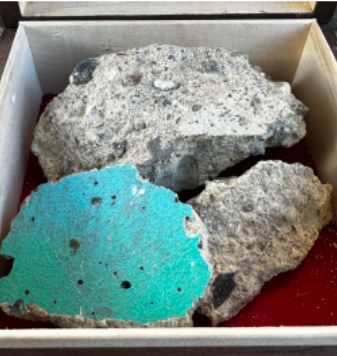
But history was not yet done with Sgt. Ortiz.
Exactly 10 years and one month later, Juanyta Ortiz — now a Technical Sergeant and an Air Force Medic — would earn the prestigious Airman’s Medal, one of the highest military decorations for heroism involving risk of life.
She did so while flying in a C-130 aircraft carrying 86 passengers and a crew of eight in the skies over Kuwait in support of Operation Southern Watch…when catastrophe struck.
The citation accompanying Sergeant Ortiz’ Airman’s Medal provides a glimpse into her heroic actions that day in the skies over Kuwait:
Technical sergeant Juanyta D. Ortiz distinguished herself by heroism involving voluntary risk of life near Ahmed Al Jabar Air Base, Kuwait, on 10 December 1999. On that date, Sergeant Ortiz rapidly responded to aid her fellow passengers who were seriously injured when the C-130 aircraft they were passengers on suffered severe structural damage upon ground impact. After the aircraft had become airborne again, she realized the ground impact had torn holes in the aircraft’s fuselage wheel well area and drove parts of the landing gear into the passenger compartment, injuring dozens of passengers, several fatally. With complete disregard for her own safety and despite a large hole in the fuselage near where she was working, Sergeant Ortiz unhesitatingly directed her attention to those around her, exercising her abilities as a trained Aeromedical Craftsman. While the aircrew assessed aircraft damage, she quickly unbuckled herself and made her way through the crowded plane, and attended a passenger with a critical head injury. Following a rapid assessment, Sergeant Ortiz utilized her medical knowledge and limited resources in an attempt to aid this individual. While other passengers moved him, Sergeant Ortiz moved about the damaged cargo hold to assess and treat other passengers. Only when the plane attempted to land, did she resume a safe position. After exiting the plane, despite personal trauma, she continued to assess other passengers and provide comfort as circumstances allowed…
“Our Veterans: She Almost ‘Touched the Face of God’” provides additional details on Sergeant Ortiz’ heroic actions.
I met Juanyta Ortiz (now Juanyta Johansen) several years ago. She is now retired from the U.S. Air Force and lives in Austin, Texas, with her beautiful family.
Of course, every person who has honorably served our nation in the military is a patriot and is recognized on Veterans Day.
There are some who have gone that one step farther, who have done that one deed that is truly “above and beyond,” and I am honored to recognize and thank one such Veteran.
