
















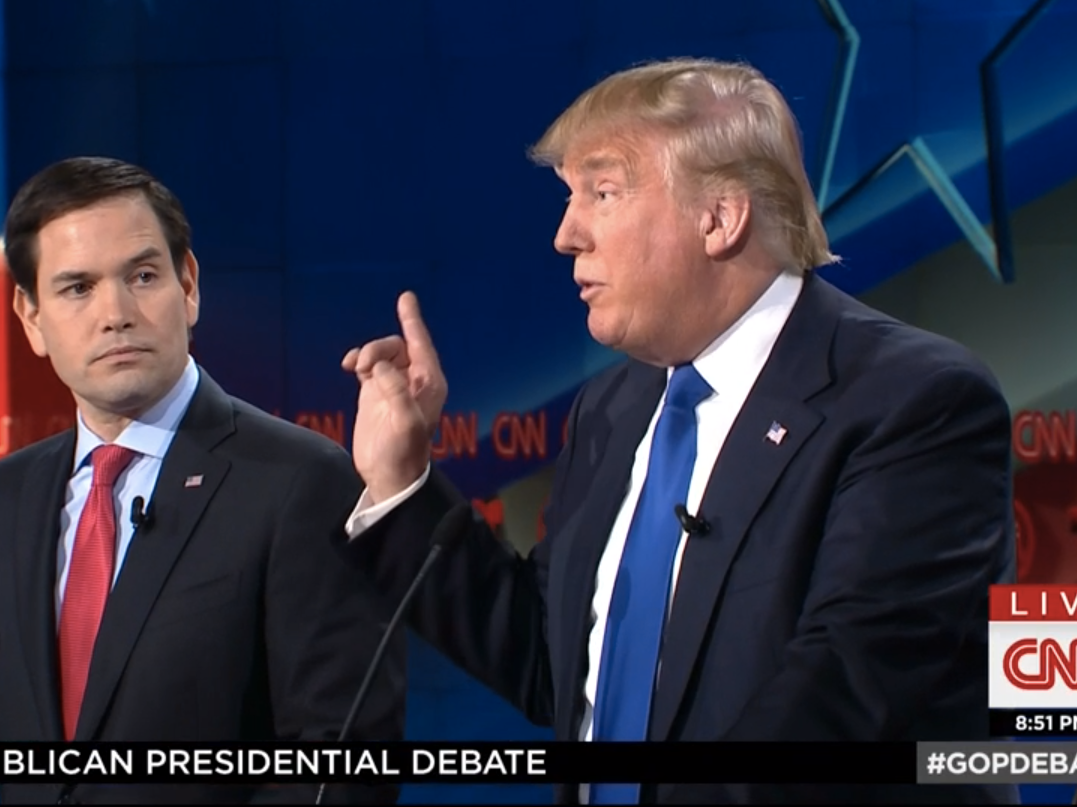
 There is so much to be depressed about as we contemplate the possibility, even the likelihood, that Donald Trump will be the Republican nominee for president. I’ll tell you what is near the top of my list: The way the media and countless voters have so easily accepted the idea that schoolyard name-calling and taunting is worthy of our political process. I have heard at least a half dozen times from media pundits over the past few days that Sen. Marco Rubio has now grasped the need to attack Trump in the same way that he has been attacked but, they say with a shake of the head, it might be too late. If only we had all been subjected to this kind of garbage sooner from other candidates, the race would be tighter and, perhaps the media types are suggesting, more exciting in terms of ratings.
We spend money on multiple ad campaigns to teach young people about the dangers of bullying, how attacking the self-esteem of their peers can have horrible consequences, sometimes even leading to suicide. One can find many definitions of verbal bullying, for example. Here’s just one:
This is any bullying that is done by speaking. Calling names, spreading rumours, threatening somebody, and making fun of others are all forms of verbal bullying. Verbal bullying is one of the most common types of bullying. In verbal bullying the main weapon the bully uses is their voice.
Now, thanks to Donald Trump and Marco Rubio we are sending a different message that bullying is a perfectly acceptable way to communicate on one of the biggest stages the country can provide.
It’s been hard to miss these, but just to re-cap some more recent jollity: Trump said Rubio looks like he puts on make-up with a trowel, also implying the Rubio needs make-up to cover his ears. Rubio said Trump applies make-up backstage at debates to cover his “sweat moustache.”
Trump laughed at Rubio for his performance during the televised State of the Union response speech in 2013, in which Rubio famously reached for water many times. Trump took a bottle of water, and mocked Rubio gasping for air.
Trump ridiculed Rubio’s sweating habits, calling him a “nervous basket case.” “It’s disgusting,” he said. “We need somebody that doesn’t have whatever it is that he’s got.”
Rubio laughed at Trump for a series of misspelled tweets saying that the only way to explain this is “that’s how they spell at the Wharton School of Business,” a school Trump attended.
And, one of my personal favourites, Rubio said that backstage at the debates, Mr Trump asked for a full-length mirror, presumably, “to make sure his pants weren’t wet”. Rubio added, “He [Trump] called me Mr Meltdown. Let me tell you something, last night in the debate, during one of the breaks – two of the breaks – he went backstage, he was having a meltdown.”
I’m not even sure I’m critical of Sen. Rubio. Maybe it’s true that the rules of the game have changed so much that failing to engage in adolescent taunting is considered a sign of weakness. We all tune in to watch and listen to what Trump will say next, who he will insult and how he will do it, to the point that anyone not playing along soon bores us.
Sure, one can point to political humour performed by various entertainers and say that many are to blame. But we have never seen candidates for president, or their surrogates, conduct themselves in such an inappropriate manner.
To my original point, how do you tell children they shouldn’t engage in bullying, in name-calling, in characterizing other people in hurtful ways, when someone soon to become the nominee for president of a major political party has made a very successful career, in private business, and now in politics, doing just that.
Maybe this is what some people mean when they say they are tired of political correctness. Perhaps they want to go back to a time when people could freely articulate their miserable little prejudices without repercussion.
Trumps supporters so often say that he says what he means, as they imply that they wish they could too.
Follow me on Twitter at: @RichardKBarry1

Retired political staffer/civil servant. Dual U.S./Canadian citizen writing about politics and the arts on both sides of the border.