














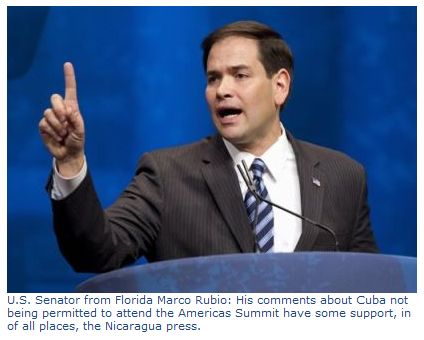
Finally, in Nicaragua of all places, we have found a Latin American newspaper that agrees with the U.S. position of excluding Cuba from the Summit of the Americas.
Can it be argued that Latin America governments, even right-of-center democracies like Colombia, are jealous of the absolute power wielded by totalitarian regimes like Cuba’s? This editorial from Nicaragua’s La Prensa sides with U.S. Senator Marco Rubio, who has called on Latin American leaders to shun tyranny, but warns that few will heed Rubio’s call, since a free election does not make a democracy, and many Latin American governments appear to continue to covet unquestioned authority.
The La Prensa editorial says in part:
According to U.S. Republican Senator Marco Rubio, the failure of the Sixth Summit of the Americas in Cartagena, Colombia last weekend was due to a mistaken intent to “contaminate a summit of democrats with a dictatorship.” In Cartagena, Rubio gave this explanation to the Voice of America, citing the pressure exerted by almost all Latin American and Caribbean governments for totalitarian Cuba to be invited to the Summit of the Americas, even if the meeting is reserved for democratic governments elected by the people.
To be democratic, a ruler must not only be elected by the people in a free and fair election, but must govern according to the rules established in the Inter-American Democratic Charter of the Organization of American States.
Regrettably, more and more Latin American presidents don’t care about complying with the Charter, although it was adopted in 2001 with commitments from all governments. In this regard, the comments of Colombian President Juan Manuel Santos to journalist Andrés Oppenheimer take on added significance: “Washington and the countries of Latin America should discuss and perhaps reevaluate their definitions on subjects like freedom of press, free elections and democracy.” This was mentioned in the global journalist’s column last Saturday in the pages of La Prensa.
Is this just a cynical interim position, or deep down, do these governments view “democracy” covetously, wishing to have the absolute power that the dictators in Cuba hold in their hands? Or perhaps, giving them the benefit of doubt, is this a strategy to move Cuba’s communist dictatorship, little-by-little, toward freedom and democracy?
READ ON IN ENGLISH OR SPANISH AT WORLDMEETS.US, your most trusted translator and aggregator of foreign news and views about our nation.