

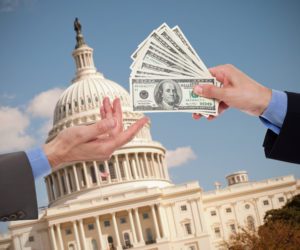












The top 20 richest Americans (as identified by Forbes magazine) and their companies contributed $22.6 million to state-level candidates and political committees from 2005 through 2008. As a group, they accounted for nearly half of all contributions to Republican candidates and committees, according to FollowTheMoney.org.
And this was before the Citizens United Supreme Court decision.
Lest you think these data contain contributions made by employees of those firms, the study authors explain that employees were excluded from the analysis.
The person with the deepest pockets? Michael Bloomberg (10th on the Forbes list) contributed $2.7 million, with most of that staying in NY State. George Soros (14th on the Forbes list) was a close second with $2.6 million in contributions. Reminder: these are state issues, not federal.
The list is overwhelmingly high-tech (8 of the 20):
- Three of the 20 richest people on the Forbes list are associated with Microsoft: Bill Gates (#1) and Paul Allen (#16), co-founders of the company, and Steve Ballmer (#17), the current CEO.
- Larry (#3) Ellison, founder of Oracle, and his wife Melanie.
- Larry Page (#11) and Sergey Brin (#12), co-founders of Google.
- Michael Dell (#15), founder of Dell Computers, and his wife Susan
- Jeff Bezos (#18), the founder of Amazon.com
The next clump comes from inherited wealth and Wal-Mart:
- Christy (#4), Jim (#7), Alice (#8), and S. Robson (#9) Walton
Followed by manufacturing:
- Charles and David Koch (tied for 5th) operate Koch Industries, Inc.. This private energy conglomerate is headquartered in Wichita, KS. Koch owns Invista, Georgia-Pacific, Flint Hill Resources, Koch Pipeline, Koch Petroleum Group, Koch Fertilizer, Koch Engineering, Koch Minerals and Matador Ranching Company. (source)
Media and Entertainment:
- Michael Bloomberg (#10), mayor of New York City and owner of Bloomberg, LP
- Sheldon Adelson (#13), chair and CEO of Las Vegas Sands Corporation, and his wife Miriam
- Anne Cox Chambers (#19), the communications company heiress
Trailing the pack, finance:
- George Soros (#14), founder and director of Soros Fund Management
- Hedge fund manager John Paulson (#20)
Methodology
The National Institute on Money in State Politics collected the campaign-finance reports filed by state-level candidates and committees with the disclosure agency in their respective states. The Institute then entered the numbers into a database for analysis. The Institute used the employer and occupation information provided on disclosure reports to assign an occupation code to individual contributors. When that information was not provided, staff members conducted additional research to determine a contributor’s economic interest, where possible. The occupation codes are based on the Standard Industrial Classification system used by the federal government.This report analyzes direct contribution data attributable to the top twenty individuals named on the Forbes 400 Richest Americans list, their spouses, the companies owned by those individuals, and direct subsidiaries of those companies made for elections decided in the years from 2005 through 2008. Unless specifically noted, contributions made by subsidiaries of subsidiaries were excluded from this analysis. Contributions made by employees of those individuals were excluded from this analysis. Data collection for the 2010 elections is still underway; analysis of those contributions is therefore limited.
Image from LickMyLayout.com.

Known for gnawing at complex questions like a terrier with a bone. Digital evangelist, writer, teacher. Transplanted Southerner; teach newbies to ride motorcycles. @kegill (Twitter and Mastodon.social); wiredpen.com