









As the Tea Party movement holds its first big convention this weekend — amid talk about it consolidating and expanding its constituency, becoming a potent force in American politics, and awaiting a big speech by former Arkansas Gov. Sarah Palin — a new poll finds that to many Americans the movement is still a yet-to-be-completely-defined, kind of blank slate:
So the question becomes: will what those Americans who are yet to make up their minds see and hear coming out of the convention help it expand its constituency and support or will it appeal mostly to already-true believers (mostly conservative Republicans) and turn off some Americans who are in the middle or independent voters? A new CNN poll underscores how the movement’s all-important mass electorate image remains to be shaped:
One-third of Americans have a favorable view of the Tea Party movement, but a plurality has no opinion at all, according to a new national poll.
A CNN/Opinion Research Corporation survey indicates that 26 percent of the public has an unfavorable view of the Tea Party movement and that 4 in 10 have not heard of the movement or don’t know enough to form an opinion. The poll’s Friday-morning release comes as what’s billed as the first national Tea Party convention begins its first full day of meetings in Nashville.
“The Tea Party movement is a blank slate to many Americans, which is not surprising for a political movement that is only about a year old,” said CNN Polling Director Keating Holland. “Not surprisingly, opinion breaks along partisan and ideological lines.”
According to the survey, Democrats by a 2-to-1 margin have an unfavorable view of the Tea Party movement; Republicans like it by a 3-to-1 margin. Among independents, 35 percent of independents holding a positive view and 24 percent a negative view.
And the appearance of Palin, Fox News’ newest rising star: a masterstroke or a potential mistake? She remains a highly divisive polarizing figure liked or disliked depending on partisanship:
The also poll indicates that Americans are split on the former Alaska governor and 2008 GOP vice presidential nominee, with 43 percent seeing her in a positive light and 46 percent holding an unfavorable view.
“Opinion on Sarah Palin also breaks down along party lines, with seven in 10 Democrats disliking her and seven in 10 Republicans with a positive view. She has a net-negative rating among independents: 42 percent favorable and 47 percent unfavorable,” Holland added. “She also continues to rate better among men than women.”
Palin is soaring to new heights as a media superstar. Her speech is bound to get huge publicity, discussion on ideological left and right radio and cable talk shows, be discussed in the increasingly-polarized blogosphere, and be rerun via sound bytes on TV and You Tube. Will it mostly rally the faithful — but also turn off some of those yet to form an opinion? And since the movement has no real de facto leader, if Palin’s speech is a hit will she emerge as a major figure associated with the movement whether she runs for higher office or not (her set up with Fox, book and speaking fees may give her a more potent microphone than higher office)?
The Washington Post says the tea party movement is still taking shape while an uneasy political establishment watches:
The 600 delegates at the National Tea Party Convention feel taxed to death, ignored by their elected representatives and the media, and appalled at the federal government’s spending — and there are millions of Americans just like them. Their anger has helped claim some political scalps, and they vow to “take back America.” What is unclear to them, and to the political establishment watching warily, is how they might do this.
It’s a critical moment for a movement that is unmistakably people-powered, that has been deliberately left leaderless to give voice to all frustrations. And although the mood here has been festive, even giddy, the fluidity of the group has been on full display.
Here was a California woman counseling people on how to register new Republican voters in their communities, but there were others who criticize the Republican Party as fiercely as they do the Democratic Party. Here attendees lashed out against the practices of the Washington establishment, but there a man from Memphis announced the formation of a political action committee. Here a former congressman delivered a fiery defense of America’s “Judeo-Christian values,” but there delegates walked out of a prayer session they thought crossed a line.
The convention, which concludes Saturday night with a keynote address by former Alaska governor Sarah Palin (R), in some respects has had the feel of a big blind date. The delegates chatted each other up for a year online, checking out each other’s ideas and grievances, and they thought they might have something in common. Now they are spending a couple of days together, at a very nice resort, nibbling hibachi beef and browsing elegant “tea bag” jewelry, to see whether they like each other enough to be together.
The New York Times reports that the movement’s bigwigs are trying to convert the rage and anger that propelled the movement into real political power:
As they opened their inaugural national convention here, Tea Party advocates from across the country declared that they would turn the grass-roots anger that burst onto the streets a year ago into real political power, wielding money and campaign infrastructure as well as sheer energy.
Organizers of the convention announced on Friday that they were forming a political action committee to raise money and provide political consulting and campaign management for Tea Party-approved candidates. The PAC, an offshoot of a newly incorporated 501c4 called Ensuring Liberty, will seek to raise $10 million this year to spend in races in the 2010 Congressional elections.
To start, it will back conservative challengers in five races in the South. In the most highly visible, organizers want to run a candidate against Senator Blanche Lincoln, an Arkansas Democrat who has been under fire for her votes on health care legislation. In the coming weeks, organizers said they would identify another 15 or so races for Tea Party-backed challengers.
“Let us not be naïve here,” said Mark Skoda, leader of the Memphis Tea Party and a spokesman for the convention, who said he would be president of the PAC. “The notion of holding up signs does not get people elected.”
In sessions here, organizers also urged fellow advocates to focus on getting like-minded conservatives elected in primaries in the next several months, so that Tea Partiers would not end up in the general election in November with a choice between a Democrat and someone they would define as a Republican in name only.
So the push will truly begin to purge the party’s elected officials who do not adhere to the conservative line.
And they outlined plans to take over the Republican Party from the ground up by having Tea Party conservatives fill local Republican committee slots with the power to decide which candidates to endorse and finance.
Which is how Barry Goldwater’s activists grabbed the GOP away from Northeast “country club Republicans”
Mr. Skoda said the Ensuring Liberty PAC would choose candidates based on their fidelity to what he called the “first principles”: less government, fiscal responsibility, lower taxes, states rights and national security
.
Meanwhile, The Politico reports friction among some tea party members:
Three former allies of the National Tea Party Convention are planning a guerilla press conference near the convention hall Saturday afternoon to highlight what they contend are the organizers’ efforts to hijack the tea party movement.
The three men, Anthony Shreeve, Robert Kilmarx and Mark Herr, are Tennessee tea party activists who were involved in the early stages of planning the convention and say they resigned in protest after disputes with lead convention organizers Judson and Sherry Phillips, who contend that the ex-allies were banned from the group planning the event for incivility or indiscretion.
The disputes have since gone public and turned ugly. At their press conference – which they plan to hold in the same sprawling hotel convention center that is hosting the convention – the three “intend to challenge [the convention] on all levels,” said Shreeve.
They announced the presser in a Friday night email to local and national reporters covering the convention, though Shreve admits he did not seek permission from the hotel to use the facility. “If they run us out, we will have it in the parking lot,” he said.
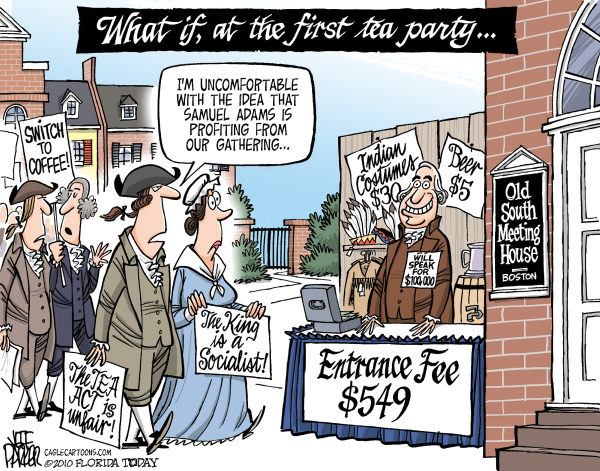
Since parting ways with the Phillipses, the three have formed a coalition of 34 tea party groups from around Tennessee, and have blasted the convention for its $550 tickets, lavish trappings (including a steak-and-lobster banquet on Saturday where Sarah Palin will deliver the keynote address), for-profit status, and ties to the Republican Party.
“This movement is not about the Republican Party. It is a grassroots movement about we the people,” said Shreeve, who said he resigned from the convention steering committee in protest over the convention’s unusual finances.
So there is a split between those who see it as something that trascends one party and if necessary will not support Republicans and those who see it as strongly linked to the GOP — which is how the GOP leadership would like to see it:
But the wild card remains:
How will Americans not yet inclined to support the tea party movement perceive the movement based on what comes out of the convention — and if Palin’s speech dominates the news? Will what they see move them to support the movement, or will it scare some of them and cause some to vote Democratic?
If the bulk of Americans conclude it’s a non-partisan tea party movement comprised of passionate people it’ll likely gain steam.
If the bulk of Americans conclude its more like a Rush Limbaugh offee break it probably won’t.
Benefit or backlash?
The copyrighted cartoon by Jeff Parker, Florida Today, is licensed to appear on TMV. Unauthorized reproduction prohibited. All rights reserved.
UPDATE: Here’s CNN’s report on the convention, which notes that “constitution” is the operative word and concern of many there.

Joe Gandelman is a former fulltime journalist who freelanced in India, Spain, Bangladesh and Cypress writing for publications such as the Christian Science Monitor and Newsweek. He also did radio reports from Madrid for NPR’s All Things Considered. He has worked on two U.S. newspapers and quit the news biz in 1990 to go into entertainment. He also has written for The Week and several online publications, writes a column for Cagle Cartoons Syndicate and has appeared on CNN.