













An Internet hub for moderates, centrists, and independents, with domestic and international news, analysis, original reporting, and popular features from the left, center, and right

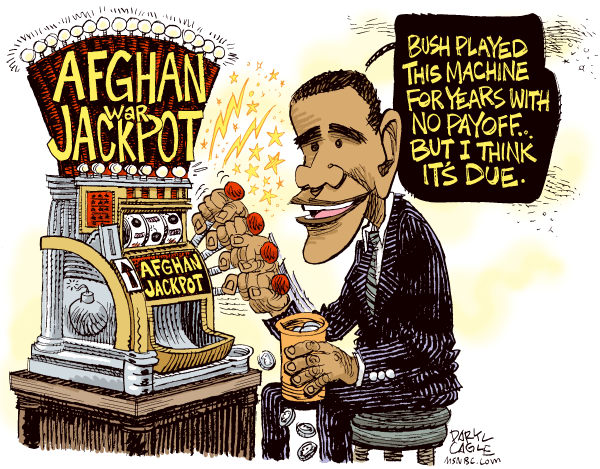
Mission Creep In Afghanistan

69147_600.jpg

To the dismay of our military leaders, President Barack Obama is pulling a Brett Favre in deciding to send more troops to Afghanistan. While weighing a change in strategy by the president , Gen. Stanley A. McChrystal warns that unless he is provided more forces and a robust counterinsurgency strategy, the war in Afghanistan is most likely lost.

Today I am filing a comprehensive report on the Afghan divide based on articles in The New York Times and Washington Post. Nothing in these reports convinces me of my conclusions several weeks ago: We should pull out our forces and concentrate on its neighbor Pakistan from afar as we are now doing.

The New York Times:

In a series of interviews on the Sunday morning talk shows, Obama expressed skepticism about sending more American troops to Afghanistan until he was sure his administration had the right strategy to succeed.

“Right now, the question is, the first question is, are we doing the right thing? Are we pursuing the right strategy?” Obama said on CNN. “When we have clarity on that, then the question is, O.K., how do we resource it?”

Obama said that he and his top advisers had not delayed any request for additional troops from Gen. McChrystal because of the political delicacy of the issue or other domestic priorities. “No, no, no, no,” Obama said when asked on CNN’s “State of the Union” whether Gen. McChrystal had been told to sit on his request.

Obama said his decision “is not going to be driven by the politics of the moment.”

In an interview on CBS’s “Face the Nation,” Obama said his top priority was to protect the United States against attacks from al qaeda and other terrorist groups.

“Whatever decisions I make are going to be based first on a strategy to keep us safe, then we’ll figure out how to resource it,” the president said. “We’re not going to put the cart before the horse and just think by sending more troops we’re automatically going to make Americans safe,” he said.

Obama and his advisers have said they need time to absorb the assessment of the Afghanistan security situation that Gen. McChrystal submitted three weeks ago — a separate report from the general’s expected request for forces — as well as the uncertainties created by the fraud-tainted Afghan elections.

Said the top military official in Afghanistan in a 66-page report to the White House and Defense Secretary Robert Gates:

“Failure to gain the initiative and reverse insurgent momentum in the near term (next 12 months) — while Afghan security capacity matures — risks an outcome where defeating the insurgency is no longer possible.”

In his five-page commander’s summary, Gen. McChrystal ends on a cautiously optimistic note: “While the situation is serious, success is still achievable.”

Reports in both the Times and Washington Post say Gen. McChrystal is expected to propose a range of options for additional troops beyond the 68,000 American forces already approved, from 10,000 to as many as 45,000.

In his report, Gen. McChrystal issues a withering critique of both his NATO command and the Afghan government. His NATO command, he says, is “poorly configured” for counterinsurgency and is “inexperienced in local languages and culture.”

“The weakness of state institutions, malign actions of power-brokers, widespread corruption and abuse of power by various officials, and ISAF’s own errors,” Gen. McChrystal says, referring to NATO, “have given Afghans little reason to support their government.”

The general also describes an increasingly savvy insurgency that uses propaganda effectively and is using the Afghan prison system as a training ground. Taliban and Qaeda insurgents represent more than 2,500 of the 14,500 inmates in Afghanistan’s overcrowded prisons.
“These detainees are currently radicalizing non-insurgent inmates,” the report concludes.

The president in March announced the Afghan policy in the broadest of terms. The Washington Post said Gen. McChrystal interprets it accordingly:

(H)e thinks the way to meet the president’s relatively narrow objective of denying al-Qaeda’s return to Afghanistan involves a wide-ranging U.S. and NATO effort to protect civilians from insurgents by improving the Afghan government’s effectiveness. That means not only more troops, but also a far more aggressive program to train Afghan security forces, promote good local governance, root out corruption, reform the justice sector, pursue narcotics traffickers, increase reconstruction activities and change the way U.S. troops interact with the Afghan population. The implicit recommendation is that the United States and its NATO partners need to do more nation-building, and they need to do it quickly.

The White House says the two major game-changers since the policy announcement in March were Afghanistan’s presidential election last month, which was compromised by fraud, much of it in support of President Hamid Karzai and recent polls that deem the Afghan war “not worth fighting” by 51% as well as a lack of support from Congressional Democrats.

The Post ended its analysis with this concluding paragraph:

But Obama’s deliberative pace — he has held only one meeting of his top national security advisers to discuss McChrystal’s report so far — is a source of growing consternation within the military. “Either accept the assessment or correct it, or let’s have a discussion,” one Pentagon official said. “Will you read it and tell us what you think?” Within the military, this official said, “there is a frustration. A significant frustration. A serious frustration.”

Obama should punt. We’ve been in that country eight years and even though it once was called the “good war” compared to Iraq we must keep in mind that in 1,000 years no invader has ever conquered the Afghans’ heart and soul. History usually proves correct in things of this nature. Just ask the Russians.

The issue is not losing the mission or abandoning the Afghans. It is facing reality they don’t want us and we cannot afford the costs.

The cartoon by Dayrl Cagle is copyrighted and licensed to appear on TMV. All Rights Reserved. Unauthorized reproduction prohibited.

  • shannonlee
    We've been there for 8 years, but have never put in the resources required. This is the 21st century, what couldn't be done 1,000 years ago has nothing to do with what cannot be done now. Sorry, but this is the good war...the war worth fighting. It is sad that our "leadership" took the eye off the ball and invaded Iraq, but they are gone and now we can do the right thing.

    Where would Afghanistan be right now had we dumped into it the same resources we dumped into Iraq?
  • jkremmers
    Answer -- The warlords and Karzai government officials would be much richer. The power structure, not the people, is beyond redemption. Spending money in Afghanistan is like spending money on a yacht. There's never enough dough. There's no such thing as a good war. Democrats framed it that way to avoid Republican blowback they were wimps. Sorry. That place is hopeless in terms of our soldiers and contractors being killed. -- Jerry
  • shannonlee
    "There's no such thing as a good war"

    So the Revolutionary war wasn't a good war? The Civil War? Should we not have fought WW2? Let Japan and Germany fight of our country or let Germany kill every Jewish person on the planet? Lets not be silly.

    "The power structure, not the people, is beyond redemption"

    The people are the power structure and people can be changed. You wrote that in a very interesting way. Your liberal ideals tell you that any person can be fixed, so you blame the "power structure" as if it was some unattached mechanism that was put in place before the people of that country ever step foot there. You want the war to end, so you say it cannot be won....but you can't blame the people for the fact that it can't be won.

    It is one or the other. Are people fixable or is the war unwinnable?

    I think it would be more reasonable to say that the war is not worth winning. I think that is where a reasonable debate can start. It isn't hopeless, but it will cost us too much to fix.


  • The problem is the previous 8 years of under resourced incompetence did accomplish one thing-the vast majority of the Afghan people hate the US and NATO. Given that there can be no winning strategy.
  • DaGoat
    Where would Afghanistan be right now had we dumped into it the same resources we dumped into Iraq?

    Seeing as how Rumsfeld would still have been the guy running the show the first few years, it's hard to answer that.
  • JeffersonDavis
    Both administrations (Bush and Obama) have screwed up in Afghanistan.
    The people there (in Kabul) don't care much for the US and NATO. That is correct.
    The vast majority of the people, however, don't care WHO is in power. All they want is to be left alone.

    And you stated "given that there can be no winning strategy".
    That is one heck of a "given".

    One winning strategy is to legalize opium. Another is to replace opium with another lucrative cash crop. Opium is power in Afghanistan. Change THAT game, and you change the world, and you can indeed win that war.
  • kathykattenburg
    I agree that there is no such thing as a good war. Wars are not good, by definition. They are proof of human failure to resolve a conflict any other way.

    With regard to Afghanistan, from the reading I've been doing since the Woodward article came out, I would say that Gen. McChrystal is asking for more troops because it's the only thing he can do other than admit that the "mission" -- whatever that was supposed to have been -- has failed. I highly recommend that you all read Ann Jones' piece at The Huffington Post. She has spent years in Afghanistan and understands what's going on there perhaps better than most of the media talking heads.

    Here is a snip:
    In eight years, American troops have worn out their welcome. Their very presence now incites opposition, but that's another story. It's Them -- the Afghans -- I want to talk about.

    Afghans are Afghans. They have their own history, their own culture, their own habitual ways of thinking and behaving, all complicated by a modern experience of decades of war, displacement, abject poverty, and incessant meddling by foreign governments near and far -- of which the United States has been the most powerful and persistent. Afghans do not think or act like Americans. Yet Americans in power refuse to grasp that inconvenient point.

    In the heat of this summer, I went out to the training fields near Kabul where Afghan army recruits are put through their paces, and it was quickly evident just what's getting lost in translation. Our trainers, soldiers from the Illinois National Guard, were masterful. Professional and highly skilled, they were dedicated to carrying out their mission -- and doing the job well. They were also big, strong, camouflaged, combat-booted, supersized American men, their bodies swollen by flack jackets and lashed with knives, handguns, and god only knows what else. Any American could be proud of their commitment to tough duty.

    The Afghans were puny by comparison: Hundreds of little Davids to the overstuffed American Goliaths training them. Keep in mind: Afghan recruits come from a world of desperate poverty. They are almost uniformly malnourished and underweight. Many are no bigger than I am (5'4" and thin) -- and some probably not much stronger. Like me, many sag under the weight of a standard-issue flack jacket.

    The illiteracy rate in Afghanistan, also, is staggering, and you can't have an American-style army without literacy. Plus, it's really arrogant of us to think that we can turn Afghanistan into a stable, sovereign democracy when only a bare handful of Americans there speak even one native Afghan language.

    This is the same problem as in Iraq: We have gone into a country we know nothing about, and we actually think we can "win" (again, whatever that means) without speaking Afghans' languages, without understanding, appreciating, or respecting Afghan history, culture, traditions, et al. We cannot create an American-style army in Afghanistan or teach the "American way of war" in a country that has nothing in common with the United States geographically, historically, religiously, culturally, linguistically, or any other way.
  • shannonlee
    Something tells me Kathy, that you also said the same things about the surge in Iraq. I bet you were convinced that it would not work and was railing against it on every blog you can find. Liberals wonder why Americans trust conservatives when it comes to defense....liberals give up too easily. Whether it be defense or the public option, liberals give up when they get too much resistance.

    Lets not forget, this is the one war that our allies are willing to fight with us. All of Europe is in Afghanistan. Germany is fighting...yes, fighting in Afghanistan. We aren't going it alone.

    But again, I think the real honest question is.....is this war/conflict/security operation worth fighting? A debate on how leaving Afghanistan/Pakistan would be good or bad for our security is what we really need. If there is good in us staying, how much good and for what cost. But lets not just toss in the towel because its too hard.

    The huffpost is no different than fox news. I am sure fox news has people in the middle east too, it doesn't mean they don't report with a serious bias.
  • elrod
    As long as the very people who attacked us on 9/11 are still roaming Afghanistan freely then we have a responsibility to fight there. A nation-building mission is fraught with all sorts of problems - as we've seen all along in Afghanistan and Iraq. But a hunt against the Taliban is something else. Iraq was bait-and-switch. Afghanistan is the real deal. If we pull out we are guaranteed a return of the Taliban to power and a return of Al Qaeda out of the closet in Afghanistan. We've already seen the consequences of that. I don't understand how we could set it up for that again.
  • kathykattenburg
    Can you imagine any scenario under which the U.S. could defeat the Taliban and Al Qaeda (because it wasn't the Taliban who attacked us; it was Al Qaeda -- the Taliban was just giving them sanctuary) in Afghanistan? We've been there eight years, the Afghan people see us as occupiers, we have built up enormous ill will due to our carelessness about and seeming indifference to civilian lives, and we're dealing with a geography that has defeated every empire in history.

    I'm not saying the Taliban should be given free rein; I'm saying continuing war is not the way to do it. But if you can see a strategy here that could result in a stable government in Afghanistan, and no more Taliban, in our lifetime (well, let's say in your lifetime, to be generous) then let's hear it.
  • Giulizacook
    The problem is the previous 8 years of under resourced incompetence did accomplish one thing-the vast majority of the Afghan people hate the US and NATO. Given that there can be no winning strategy.

    Force Factor supplements
  • jkremmers
    My wish is for a national debate on Afghanistan. I recognize a fallacy in my own argument. It has no exit strategy other than a flat pullout of troops.That would likely mean the Taliban would return to power and resume harbor for al-quada. And that likely would mean more power to the insurgents in Pakistan in which the military holds the button to atomic weapons. Nation-building not withstanding, we are using Afghan land as a jumping off point to attack terrorists by air in Pakistan and by occasional incursions by covert commando or special ops squads.

    One final comment. The question of a "good war" is absurd. That's for history books and movies.The Christian crusades were bloody, senseless massacres in which after studying them in school, darn near turned me into an atheist. Ask anyone who has been in a hot combat zone and you will get the same answer: It should be avoided at all costs. The late Don Hewitt of CBS said it best. In combat on D-Day he said the only thing missing was the music.
  • DaGoat
    I tend to agree with you Jerry. Obama really has two choices - either commit to listen to his generals or pull out. He seems to be delaying a decision while searching for a third option. One thing we hopefully learned from Vietnam is that limited actions don't work, they lead to drawn-out painful wars that ultimately accomplish nothing.
blog comments powered by Disqus
© 2005-2009 The Moderate Voice | Site design by Elegant Themes | Site customization, hosting, and security by Enxit Group, LLC